Bob's Boutique

Blog

Jackson Evans

Blog

Best Boutique Guitars for Jazz: High-End Archtops for Jazz Enthusiasts

For the serious jazz guitarist, an archtop serves as a direct extension of touch, phrasing, and acoustic identity. Expressing that level of nuance requires an instrument specifically built to respond to it, a standard that has defined Benedetto Guitars since Robert Benedetto carved his first archtop in 1968. From our workshop in Savannah, Georgia, our small team of master luthiers builds instruments designed to translate every subtle dynamic shift and complex voicing into pure acoustic tone.

Whether you are exploring rare, one-off instruments in Bob’s Boutique, drawn to the acoustic depth of a hand-carved solid spruce top, or seeking the feedback-resistant focus of a stage-ready laminate model, finding the right archtop begins with understanding how boutique lutherie shapes your sound.

What Makes an Archtop Guitar Truly Boutique?

True boutique lutherie relies on single-roof integrity and absolute bench continuity. In mass-production guitar manufacturing, an instrument passes through dozens of hands across automated assembly lines, often traveling between different facilities or overseas subcontractors for milling, binding, painting, and final assembly. Segmenting the build process this way optimizes for output speed, but ultimately sacrifices the individual voice of the instrument.

Benedetto Guitars operates on a fundamentally different philosophy in Savannah, Georgia. No outsourced manufacturing or piecework dilutes our process. Every instrument leaving our shop is milled, carved, tap-tuned, bound, and final-assembled under one roof by a tight-knit team of luthiers. Hand-crafting each piece sequentially ensures that the luthier shaping the top plate is intimately aware of how the neck joint, bridge position, and internal bracing will interact. Working under a unified vision gives each guitar a cohesive acoustic personality, exceptional dynamic sensitivity, and long-term structural integrity that no factory spec sheet can replicate.

Our workshop is deliberately organized around two specialized build environments to serve different performance requirements:

  • Flagship Series: Hand-carved solid spruce archtops, including iconic models like the Manhattan™, La Venezia™, and Cremona™, built specifically for maximum acoustic depth, delicate dynamic bloom, and rich overtone complexity.

  • Professional Series: High-performance laminate-top instruments, such as the Bravo™, Bambino™, and Pat Martino Signature Model™, engineered to deliver classic Benedetto voice and playability while offering maximum stability and feedback resistance on active stages.

Across both build environments, our guiding principle remains absolute: zero compromise at any tier. Every neck profile, binding edge, and fret wire receives the exact same painstaking finishing care, ensuring that every instrument carrying the Benedetto name meets the highest standards of professional lutherie.


Architectural Feature


Flagship Series


Professional Series


Top Construction


Hand-carved solid spruce


Laminated spruce / maple


Primary Design Target


Studio recording, solo chord-melody, unamplified acoustic


Live stage performance, high-volume venues, touring


Acoustic & Dynamic Response


Maximum acoustic bloom, complex overtones, deep resonance


Focused fundamental tone, immediate note attack, controlled amplification


Feedback Resistance


Moderate (Acoustically lively and open)


Exceptional (High dampening for stage volume)

Why Boutique Construction Shapes Your Tone

Mass-production manufacturing optimizes for structural uniformity, creating rigid tops designed to survive extreme environments rather than vibrate freely. A hand-carved boutique archtop, voiced and graduated by an experienced luthier, actively responds to your right-hand attack. The carved spruce plate flexes and breathes with your playing, giving you delicate control over micro-dynamics, chord warmth, and single-note articulation.

Does Boutique Require a Fully Custom Order?

Not at all. Boutique status describes how a workshop builds (small-batch, artisan-led, single-roof construction) rather than the presence of a custom spec sheet alone. Whether you choose a standard Professional Series model or configure a fully bespoke instrument, both are crafted under the same roof, by the same master builders, to the exact same bench standards.

Why Jazz Guitarists Trust Benedetto

Trust within the jazz community is earned over decades of consistent benchwork, not constructed through marketing claims. Since Bob Benedetto built his first archtop in 1968, our workshop has focused almost exclusively on the unique acoustic and mechanical demands of the jazz archtop. That single-minded specialization gives our luthiers a deep, intuitive understanding of how subtle structural adjustments dramatically alter the instrument’s tonal weight and responsiveness.

Such sustained focus explains why generations of legendary jazz masters, including Johnny Smith, Kenny Burrell, Bucky Pizzarelli, Pat Martino, and Martin Taylor, have relied on Benedetto archtops to define their sonic footprint. When you pick up a Benedetto, you are engaging with over fifty years of continuous refinement between master builders and the world’s most demanding jazz guitarists.

How to Choose the Right Archtop Guitar for Your Style

Finding the ideal archtop requires an honest look at where you play, how you position your hands, and what acoustic voice you want to hear coming back to you. The physical dimensions and hardware configuration of an archtop should always align with your primary performance setting and playing style.

Key Factors to Consider

  1. Performance Environment & Body Dimensions

  • 17-Inch Lower Bout: Displaces the maximum volume of air, producing a dark, lush low-end bloom that excels in solo chord-melody, acoustic recording, and intimate duo settings.

  • 16-Inch Lower Bout: The versatile sweet spot preferred by gigging musicians, striking a perfect balance between rich acoustic presence and manageable stage volume.

  • 14.5-Inch Lower Bout: Compact, lightweight, and exceptionally comfortable for travel or extended stage sets, without sacrificing true archtop voice.

  1. Scale Length

    • 25.0″ Scale: The engineering foundation of our entire lineup. We build around this optimal 25.0″ length to deliver firm string tension, dynamic snap, punchy acoustic projection, and pristine note separation across wide, complex chord voicings.

  2. Pickup Architecture

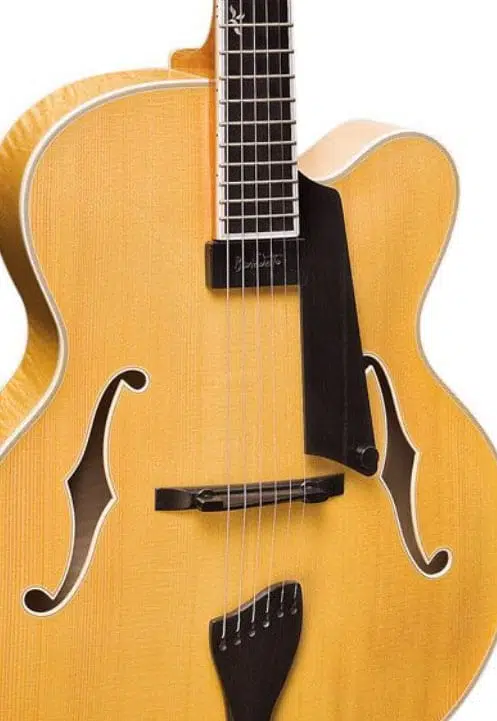
  • Floating Mini-Humbucker: Mounted directly to the fingerboard extension so the carved spruce plate remains completely unhindered, maximizing open acoustic volume.

  • Embedded Humbuckers: Set directly into the wood top to increase note sustain, warm up the midrange focus, and eliminate unwanted feedback on loud stages.

Finding Your Lifetime Instrument

A truly exceptional archtop should never feel like a barrier between your hands and your musical ideas. When top graduation, bracing patterns, body volume, scale length, and neck profiles are balanced with precision, the physical instrument becomes transparent, allowing your phrasing, touch, and individual musical personality to take center stage.

Choosing a Benedetto brings single-roof boutique craftsmanship directly to your hands, connecting your sound to a living tradition of American lutherie dedicated entirely to the art of the jazz archtop. Whether you are performing on festival stages, recording in the studio, or playing for your own enjoyment at home, an instrument built with that level of focused intention will inspire your playing for a lifetime.

Frequently Asked Questions

What makes Benedetto Guitars a top choice for boutique jazz instruments?

Every Benedetto is handcrafted under one roof in Savannah, Georgia. Guided by over 50 years of archtop innovation, our small team of master luthiers maintains total control over every build stage, ensuring studio-grade acoustic performance, effortless playability, and lasting investment value.

How do I choose between the Flagship and Professional Series?

Choose the Flagship Series if you prioritize a solid hand-carved spruce top for maximum acoustic resonance, subtle dynamic control, and studio recording. Choose the Professional Series if you need a durable, stage-ready laminate instrument engineered for high feedback resistance in loud ensemble settings.

Can I order a custom Benedetto tailored to my specific preferences?

Yes. You can work directly with our Savannah workshop to configure scale lengths, nut widths, body depths, neck profiles, tonewood selections, and pickup layouts tailored to your exact physical and tonal needs.

Best Boutique Guitars for Jazz: High-End Archtops for Jazz Enthusiasts

Blog

Famous Jazz Guitarists: The Masters Who Shaped the Archtop Legacy

We’ve spent over fifty years around the workbench, listening to how different hands drive a piece of carved spruce. When you build archtops day in and day out, you realize quickly that the history of jazz is written in the instrument’s geometry as much as in the sheet music.

The story of the famous jazz guitarists who built this genre is inextricably tied to the physical boxes they held against their ribs. As players pushed for more velocity, richer chord-melody extensions, and feedback-resistant sustain, luthiers had to rethink top thickness, bracing patterns, and scale dynamics. Here is how the icons of jazz guitar reshaped the music, changed the way we build, and established the gold standard of jazz archtops.

From Rhythm Anchor to Lead Voice: The Evolution of the Jazz Archtop

As jazz evolved from swing-era dance halls to modern bebop and post-bop clubs, the role of the guitar shifted dramatically. The instrument had to adapt from an unamplified percussive anchor into a primary melodic voice capable of horn-like speed and intricate harmony.

When looking at the history of our Benedetto players roster and the broader tradition of jazz archtops, that musical evolution maps directly to three fundamental mechanical shifts:

  • Plectrum Projection to Amplified Fluidity: Early rhythm players needed stiff tops and high action for raw acoustic projection, while modern soloists rely on refined top resonance and smooth action for fast, effortless articulation.

  • Harmonic Separation: As chord structures expanded beyond basic triads into complex alterations and 7-string counterpoint, archtops required tighter acoustic focus to prevent dense voicings from muddying together.

  • Timbral Balance: Blending the natural acoustic resonance of carved spruce with pickup amplification created the signature warm, punchy archtop voice heard on definitive jazz recordings.

The Archtop Architects: Benedetto Players Who Redefined the Genre


Master Guitarist


Architectural Preference


Primary Innovation


Tonal & Mechanical Legacy


Chuck Wayne (1923–1997)


17″ Hand-Carved Archtop w/ Floating Pickup


Economy-Picked Bebop Fluidity


Carried bebop vocabulary onto the archtop in its first generation; pioneered consecutive-string economy picking for horn-like velocity.


Cal Collins (1933–2001)


Carved Acoustic Archtop, Heavy Strings


The Swing Rhythm Pulse


Brought big-band comping authority into the small-group era; proved an unamplified carved top could still drive a rhythm section.


Bucky Pizzarelli (1926–2020)


7-String Custom Archtop


Low-A Bassline Counterpoint


Combined walking bass, chord voicings, and melody on one instrument; the first player to gig a Benedetto.


Pat Martino (1944–2021)


14.5” Chambered Solid Body


Minor-Conversion Velocity


Demanded heavy string tension, feedback suppression, and lightning-fast linear chromaticism at high stage volume.


Garrison Fewell (1953–2015)


Carved-Top Archtop w/ Floating Pickup


Modal & Intervallic Pedagogy


Codified modern improvisation for a generation of students; pushed the archtop into contemporary harmonic territory.


Howard Alden


7-String Archtop


Modern 7-String Virtuosity


Extended the Van Eps lineage into modern classical-influenced jazz contexts and film work.

How Player Demands Drove Luthiery Innovations

Every time a player hit a wall on stage, luthiers went back to the drawing board. Understanding this evolution helps illuminate why certain instrument specs exist today.

The Acoustic Bark vs. The Amplified Horn

In the unamplified swing era, rhythm masters like Cal Collins needed an archtop to do one job above all else: stay audible next to a blaring trumpet section. Luthiers carved tops thick, and rhythm players ran heavy strings with high action so they could dig in hard without string rattle. Struck close to the bridge, that setup produced a tight, punchy attack with short sustain, the classic acoustic bark that drove an entire swing orchestra.

Electricity turned that dynamic on its head. Bebop soloists like Chuck Wayne didn’t need brute force to be heard; they needed string response fast enough to keep up with their fingers. Plugging into an amplifier meant a player could use a lighter attack, lower action, and focus on long, fluid single-note runs.

That shift changed how we cut wood on the bench. While an ultra-resonant soundboard delivers rich acoustic bloom, high stage volume drives spruce into sympathetic feedback. We bridge this divide with two distinct build paths: our acoustic-first Flagship Series features thin, tap-tuned carved spruce for maximum natural bloom, while our Professional Series uses laminated tops and chambered construction for total feedback control on a loud stage.

The Floating Pickup Revolution: Johnny Smith

Johnny Smith wanted the pristine response of a hand-carved, tap-tuned solid spruce soundboard, but he needed to amplify it without cutting holes in the wood. Routing a hand-carved soundboard to mount a heavy humbucker restricts the movement of the top diaphragm, deadening its natural acoustic resonance.

The solution was the neck-mounted floating pickup. By suspending the pickup off the fingerboard extension and mounting controls directly to the pickguard, the carved spruce top remains free to vibrate. It’s an acoustic-first design option we still offer when designing a custom Benedetto archtop for players looking to capture pure soundboard resonance.

High-Volume Punch & Feedback Control: Pat Martino

Pat Martino played with uncompromising power, thick strings (.015 to .052 gauge), and staggering speed. Put Pat on stage in front of a loud quartet with a fully acoustic, lightweight 17″ archtop, and the top would immediately resonate sympathetically and howl with low-frequency feedback.

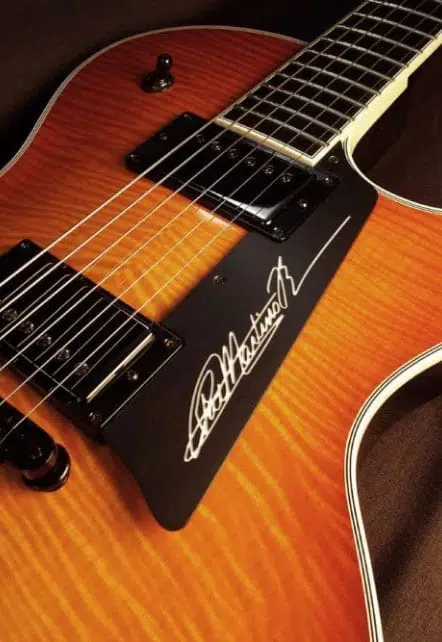
To handle Pat’s heavy attack and extreme stage volume without sacrificing warmth or articulation, Bob Benedetto designed the Pat Martino Signature Model™. Built with a compact 14-1/2″ lower bout, a chambered solid mahogany body, and a carved maple top, it offered total feedback immunity alongside a dark, authoritative fundamental voice. That same engineering philosophy underpins our gig-ready Professional Series laminated archtops, instruments built for high-volume structural rigidity, lightning-fast note tracking, and total feedback control.

The Benedetto Legacy: Handcrafted for Uncompromising Performance

When Bob Benedetto established our workshop standards in 1968, he set out to refine the archtop into its absolute peak as a musical tool. The choices made on our Savannah workbench, from the feedback-resistant bodies engineered for Pat Martino to the floating pickups Johnny Smith used to preserve top resonance, were never about factory convenience. We do not outsource our labor, rely on offshore factory assembly, or cut corners to meet mass-production targets. Instead, we dedicate our small-batch production entirely to meeting the exacting demands of professional and aspiring jazz guitarists.

Today, if you meet our team of master luthiers at our shop, you’ll see the same hand-building techniques in motion. We still hand-carve solid acoustic spruce tops, meticulously tap-tune each soundboard to its resonant sweet spot, and execute exacting joinery one instrument at a time. At our Savannah workshop, nothing is mass-produced, because honoring the legacy of the masters who shaped jazz requires an equal commitment from the hands carving the wood.

FAQ: Archtop Mechanics & History

Why do straight-ahead jazz guitarists prefer archtops over flat-top acoustic guitars?

Flat-top guitars are engineered to sustain notes longer by using thin tops and X-bracing that flex under light tension. Archtops use a carved, arched spruce soundboard supported by parallel or longitudinal bracing. This creates a quick, punchy note attack with a strong fundamental frequency and short, controlled sustain, ideal for fast single-note runs and complex chord voicings that would sound muddy on a resonant flat-top.

What is the difference between parallel bracing and X-bracing in a jazz archtop?

Parallel bracing uses two acoustic tone bars running lengthwise along the top, yielding maximum acoustic projection, cutting power, and a brighter, punchier fundamental tone (classic for big band comping). X-bracing uses two crossing tone bars under the bridge, producing a warmer, darker, more complex acoustic tone with longer sustain, ideal for modern chord-melody and solo playing.

What made Bucky Pizzarelli and Howard Alden adopt the 7-string archtop?

The 7-string archtop, popularized by George Van Eps in the late 1930s, adds a low A (or low C) string. This allows chord-melody players like Bucky Pizzarelli and Howard Alden to play walking basslines underneath mid-register chord inversions simultaneously, effectively turning the guitar into a self-contained piano-like instrument without requiring a stand-up bassist.

Famous Jazz Guitarists: The Masters Who Shaped the Archtop Legacy

Blog

What Factors Influence the Final Price of a Custom-Built Guitar?

Commissioning a premium, handcrafted archtop is a unique experience, one that goes far beyond simply purchasing a beautiful guitar. It’s an opportunity to shape an instrument that captures your personal musical identity. But as you move beyond mass production and assembly lines, you might be curious: what really determines the final price of a custom-built guitar?

Building a custom Benedetto guitar means every detail is in your hands, and each decision, from wood selection to the hours our artisans spend at the bench, plays a part in the final price. Because this process is entirely collaborative and transparent, you’ll know exactly where every dollar goes. And if you want to see the hands that will be turning those choices into reality, explore the passion and artistry of our luthier team.

At a Glance: Custom Pricing Quick Reference

To help you plan your build, here’s a quick overview of how different custom choices can influence your guitar’s final price:

  • Baseline Cost (Carved vs. Laminated): Hand-carving a solid top from a raw billet requires extensive master-luthier bench time, placing our Flagship Series at a higher baseline. Laminated tops require fewer manual carving hours, making the Professional Series more accessible.

  • Aesthetic Wood Upgrades: Opting for a translucent or Blonde finish requires a cost upcharge to select visually flawless, higher-grade structural woods underneath.

  • Body Dimensions: Standard dimensions are built into the base price. Modifying body depth is easily accommodated, but changing structural pickup layouts on a small body requires a dedicated carving upcharge.

  • Ergonomic Adjustments: Standard nut widths (1-3/4″ or 1-11/16″ depending on the model) are interchangeable at no additional cost. Non-standard neck shapes incur an extra charge for custom alignment and tooling.

  • Hardware & Inlays: Custom internal bracing modifications for non-standard pickups add to the build cost. Simple inlays are handled for a nominal fee, while complex outsourced inlay artwork increases the final quote.

  • Travel Protection: Flight cases are included with Flagship models. Professional Series models include a hardshell case, with a flight case upgrade available at our factory cost (around $1200).

The Foundation: Custom Labor vs. Factory Assembly Lines

To understand how custom pricing works, you have to look at how build hours translate to cost. High-volume factory builders rely on repeatable formulas, automated machinery, and bulk material purchasing to keep consumer prices low.

Custom instruments operate outside those factory economies of scale. Each build requires dedicated bench time, specialized hand skills, and a significant investment of labor. Rather than aiming for broad commercial appeal, a custom archtop is designed around your specific tonal, aesthetic, and ergonomic preferences. This one-on-one attention means your investment reflects the time and expertise a master luthier pours into crafting an exceptional instrument from start to finish.

Major Structural Cost Drivers: Construction Methods

The core structure you select for your instrument is the biggest single factor influencing your starting price. The technique used to shape the top and back plates determines how many hours of skilled manual labor go into your guitar.

Hand-Carved Solid Tops vs. Custom-Pressed Lamination

A hand-carved archtop represents the highest level of investment because of the intense labor involved. Our luthiers start with a solid billet of master-grade wood and carefully shape it using hand planes, chisels, and scrapers, creating the delicate graduation of the top plate. Throughout the process, they use tap-tuning by ear to optimize the guitar’s natural resonance. With so many hours dedicated to each build, hand-carved instruments, like our premier Flagship Series, naturally sit at the top end of the price range.

On the other hand, our tour-ready Professional Series features premium, custom-pressed multi-ply laminated construction. This approach uses stable wood veneers pressed into a precise arch, delivering excellent feedback rejection and climate stability, perfect for working musicians on loud stages. Since this method requires fewer hours of hand carving, it offers legendary Benedetto performance at a more accessible price point.

Body Sizes and Carving Upcharges

We’re committed to maintaining our signature shapes and sizes, which preserve both the unique look and sound of our instruments. While you can customize body depth, like ordering a deeper 3-inch Bravo or a slimmer 2.5-inch Manhattan, we don’t offer drastic redesigns of our established outlines. If you’d like a smaller-bodied model like the 16-B, Bravo Elite, or Bambino Elite to be hand-carved for a floating pickup (instead of the standard built-in configuration), we’re happy to accommodate this, with a dedicated carving upcharge to reflect the extra bench labor involved.

Premium Materials and Ergonomic Upcharges

Beyond the basic build style, the materials and hardware you select will also shape the final price of your guitar. Through our collaborative Build Your Own Benedetto program, you’ll have the chance to explore a range of material upgrades and customizations.

1. Tonewood Grading and Finish Upcharges

Premium tonewoods naturally come with a higher market value. Rare, highly figured master-grade maple or perfectly straight-grained spruce increase the initial material cost. In addition, the finish you choose interacts directly with these raw material choices, sometimes requiring even finer woods for the best visual result.

For example, if you request a translucent or Blonde finish on a model like the Bravo, we’ll select visually flawless, Bravo Deluxe-designated woods to ensure the grain shines through beautifully. This attention to detail introduces a material upgrade that’s reflected in your final quote.

2. Scale Length and Nut Width Costs

Ergonomic adjustments, like custom nut widths or scale lengths, can affect the tooling and setup time involved:

  • Nut Widths: Our standard widths are 1-3/4 inches on 16-inch and 17-inch archtops (including the Benny), and 1-11/16 inches on smaller Bambino models. You can mix and match these options at no extra cost. If you’re after a fully custom width or a unique neck shape, we’re happy to accommodate for a modest additional fee, covering the extra tooling and setup time.

  • Scale Lengths: Most Benedetto models feature a standard 25-inch scale length, and we highly encourage customers to trust Bob’s preference for this scale length in his designs. We can adapt your build to a 24-3/4 inch or 25-1/2 inch scale for an upcharge, which covers the extra planning and setup involved. Extra-long or extra-short scales aren’t available, as they require a full redesign of the guitar’s core structure and wouldn’t deliver the Benedetto sound we’re known for.

3. Visual Customization and Inlays

You can also personalize the look of your fingerboard. Simple, elegant inlays, like names or stylized floral designs, are handled in-house for a modest upcharge. If you envision something highly intricate or elaborate, we partner with master inlay artists, which can add to the timeline and cost. To stay true to our brand’s heritage, we don’t offer standard dot inlays, but traditional floral patterns or Fratello-style blocks are always options.

Electronics, Bracing, and Setup Labor

The final details, like your chosen hardware and setup preferences, also influence the complexity and base cost of your build.

Pickup Integration and Bracing Alterations

We’re proud of our proprietary Benedetto pickups, designed by Bob and crafted exclusively for us by Seymour Duncan. If you’d like to use a different, dimensionally similar pickup, we’re happy to install it ahead of the build at our standard rate. Please keep in mind that unique or unusual pickup placements may require changes to the guitar’s internal bracing or tooling, which can incur significant additional charges.

We also maintain strict acoustic standards to protect your instrument’s musical integrity. For example, we don’t build laminated guitars with floating pickups. Our S-6 and S-7 floating pickups are specifically engineered to hover above a carved acoustic top plate; mounting them on a stiffer, laminated top simply wouldn’t deliver the sound quality we stand by.

Factory Stringing and Voice Calibration

The work involved in precision fretwork, nut slotting, and voicing is tailored to the specific string gauges you choose for your guitar. By default, we use Benedetto Round Wound Strings, carefully adjusted for each model:

Model / Series

Default String Configuration

Setup Specification

The Benny Model

Benedetto Round Wound

Gauges: .011–.050

Laminated Professional Series (Bravo / Bambino)

Benedetto Round Wound

Gauges: .012–.052

Hand-Carved Flagship Series

Benedetto Hybrid Round Wound

Gauges: .014–.052

Pat Martino Signature Model

Preferred Flat Wound

Heavy Gauges: .015–.052

If you prefer different strings, just let us know. We’re happy to set up your instrument with custom gauges or alternative brands at no extra charge. All we ask is that you send us two sets before your shipping date.

Long-Term Asset Value and Flight Case Upgrades

When considering a custom instrument, it’s worth looking at long-term value. Handcrafted guitars from heritage builders like Benedetto often hold or even appreciate in value, something mass-produced guitars rarely match. We have spent more than five decades refining the art of archtop construction, and our archtops have been played by four generations of world-class musicians, each one becoming part of a living musical legacy.

Because these instruments represent such a significant long-term investment, keeping them protected on the road is just as important as building them right. Every custom guitar comes with a high-quality protective case as part of your purchase. Laminated instruments are shipped in a premium TKL hardshell case, while our carved Flagship models include your choice of top-tier Carbon Fiber or Fiberglass flight cases. If you’re buying a laminated model and need maximum travel protection, you can upgrade to a flight case at our direct factory cost (about $1200).

What Your Investment Really Delivers

At the end of the day, the cost of a custom archtop comes down to the master luthier’s hours, premium materials, and our uncompromising “ear first” philosophy. By connecting our pricing directly to acoustic performance and structural excellence, we make sure your investment inspires you for a lifetime.

Frequently Asked Questions

Why does a custom archtop cost more than a standard factory model?

Custom instruments eliminate the automated, bulk assembly lines of mass production. Every instrument is individually voiced, hand-fit, and tailored to a specific player’s layout, requiring immense bench time from master luthiers.

Can I specify any wood combination or visual design for my custom build?

We maintain a curated inventory of rare exotic woods, but we prioritize tone above all else. During our pre-order consultations, we evaluate your material selections. If a specific wood combination or structural change would compress acoustic resonance or hurt performance, we will openly advise against it or refuse the order to protect your sound.

Is a flight case upgrade available for Professional Series laminated models?

Yes. While our laminated models ship standard with a protective TKL hardshell case, you can upgrade to our carbon fiber or fiberglass flight cases at our direct factory cost, which is roughly $1200.

What Factors Influence the Final Price of a Custom-Built Guitar?

Blog

Why the Archtop Is the Definitive Guitar for Jazz

For nearly a century, hollow-body archtop guitars have anchored the sound of jazz. When you pluck a chord on a premier archtop, the instrument responds with a warm, punchy, and highly focused voice that flat-top acoustics or solid-body electrics simply can’t replicate.

This isn’t an accident or just a historical coincidence. Every structural element of an archtop, from its hand-carved soundboard to its violin-style f-holes, is uniquely suited to handle the complex chords and fast melodic lines that define the genre. Whether you require a road-ready touring workhorse like our Professional Series for amplified stage settings or a traditional carved instrument for acoustic purity, understanding why this specific design works so well is the secret to finding the best archtop guitars for jazz.

The Acoustic Physics: Why the Archtop Design Fits Jazz Perfectly

The best archtop guitars for jazz earn their reputation through a specialized blueprint rooted in acoustic physics. Unlike flat-top guitars, which are built to maximize sustained, booming bass frequencies for folk strumming, an archtop is engineered for note separation, midrange clarity, and rapid response.

1. Midrange Punch and Voice Matching

Jazz harmony relies on dense chord voicings (extensions, alterations, and close-interval clusters). On a standard flat-top guitar, these complex chords can easily sound muddy because the instrument emphasizes massive low-end overtones that ring out for too long.

An archtop’s curved top plate acts like a built-in mechanical equalizer. It naturally rolls off those muddy sub-bass frequencies and tames piercing high overtones, leaving you with a warm, focused midrange voice. This frequency response fits beautifully in the exact sonic space occupied by other classic jazz instruments like the upright bass, saxophone, and piano, allowing the guitar to blend seamlessly into an ensemble.

2. Fast Attack and Immediate Decay

Because an archtop top plate is carved or pressed into a rigid arch, it reacts differently to your pick attack than a flat piece of wood.

  • The Attack: When you strike a string, the floating bridge drives that energy straight down into the arched top, compressing the air inside the body cavity. This creates an immediate, punchy acoustic response.

  • The Decay: Right after that initial punch, the note drops off quickly rather than ringing out forever. This rapid decay is incredibly important for fast bebop lines or steady “four-on-the-floor” rhythm playing. It ensures that fast notes and complex chords don’t bleed into one another, keeping every single note crisp and articulate.

3. Directional Projection

Traditional flat-top acoustic guitars push sound out in a wide, ambient bubble around the player. Archtops, using dual f-holes modeled after the violin family, act more like directional projectors. The sound waves are focused and pushed straight out from the front of the instrument. This design gave early jazz guitarists the pure acoustic horsepower they needed to cut right through loud horn sections before amplifiers came along.

Do You Actually Need an Archtop for Professional Jazz?

While you can technically play jazz on any guitar, professional players consistently return to the archtop because the instrument acts as a direct extension of your musical phrasing.

The dynamic range of a hand-carved archtop responds immediately to the slightest change in how you hold your pick or press your fingers. Dig into a single-note line, and the instrument barks with punchy midrange authority. Lighten your touch, and it responds with a dark, smoky warmth. This wide palette of expression gives your lines a vocal quality that solid-body guitars, which rely almost entirely on electronic pickups and tone knobs, simply can’t recreate.

Choosing Your Build Style: Carved vs. Laminated Archtops

When you’re exploring the best archtop guitars for jazz, you’ll have to make a choice between a hand-carved solid top and a custom-pressed laminated top. Both styles offer distinct performance advantages depending on where you plan to play.

Construction Type

Acoustic Character

Structural Benefit

Best Performance Setting

Hand-Carved Solid Top

Maximum resonance, deep harmonic complexity, open acoustic bass.

Highly responsive to a nuanced, delicate pick attack.

Solo jazz, acoustic recording, intimate trio settings.

Custom-Pressed Laminated Top

Focused midrange punch, faster note decay, uniform response.

High stiffness provides exceptional stage-volume feedback rejection.

Working musicians, loud stage environments, touring.

The Carved Approach: Pure Acoustic Expression

A hand-carved solid spruce soundboard functions like a fine cello or violin. It is incredibly sensitive to string vibrations, opening up and developing deeper tonal complexity the more it is played over the years. For pure acoustic jazz or low-volume club gigs, a carved top delivers unmatched air, depth, and organic texture.

The Laminated Approach: Gig-Ready Stability

When you put a highly resonant acoustic instrument right next to a loud jazz guitar amplifier, the top wood can start to vibrate uncontrollably from the speaker’s sound waves, causing annoying low-end feedback. To solve this for touring musicians, high-quality laminated archtops use custom-pressed multi-ply configurations. The added stiffness dampens those feedback-causing vibrations while keeping the essential woody warmth and punch you need for live jazz.

The Benedetto Standard: Designing for the Jazz Ear

At Benedetto Guitars in Savannah, Georgia, our team of eleven skilled artisans has spent more than five decades refining the archtop guitar specifically for the jazz community. Founded by master luthier Robert Benedetto in 1968, our workshop follows a strict “ear first” philosophy.

We approach building as a deliberate balance of acoustic science and intuition. Because wood is an organic material, no two pieces of spruce or maple resonate exactly alike. Our builders inspect every raw wood billet by hand, tap-tuning and planing micro-layers off the plates to tune the natural resonant frequency of the timber. This meticulous voicing ensures that the finished guitar vibrates in perfect harmony with your hands.

Exploring Our Instrument Lineup

To serve the varied needs of modern jazz guitarists, we manufacture two distinct series of instruments inside our Savannah workshop, maintaining a strict policy of zero outsourcing.

The Flagship Series

Our Flagship Series represents the absolute peak of traditional, hand-carved luthiery. Built using master-grade European and American tonewoods, these archtops are individually voiced for the player seeking maximum acoustic depth, projection, and refined visual elegance.

The Professional Series

Designed from the ground up for the working jazz musician, our Professional Series utilizes premium laminated constructions. These models deliver incredible feedback control and structural stability across changing climates on tour, all while maintaining the exact same elite playability, fretwork, and final assembly standards as our premier carved instruments.

The Custom Order Experience

For players who need a truly personalized tool, our Build Your Own Benedetto program lets you collaborate directly with our workshop team. This process eliminates the guesswork, letting you tailor key elements to your exact requirements:

  • Tonewood Selection: Pair select spruce soundboards with figured maple, mahogany, or glassy ebony components.

  • Electronic Layouts: Choose between built-in humbuckers or floating pickups to match your amplification goals.

  • Neck Geometry: Specify custom nut widths, depths, and profiles for optimal playing comfort.

Join a Living Legacy

From historic jazz festival stages to recording studios worldwide, the archtop guitar remains the definitive voice of jazz expression. You can explore the rich history of our workshop on the About Benedetto Guitars page, or see how these instruments perform in the hands of global masters by browsing our official Players Roster.

Whether you choose a highly responsive carved model or a gig-ready laminated tool, your archtop forms the foundation of your creative voice. Explore our available inventory or contact our Savannah team today to begin designing your custom build.

Frequently Asked Questions

Why do archtop guitars have less sustain than flat-top guitars, and why is that good for jazz?

Archtops are designed to transfer string energy to the top plate very rapidly, resulting in a punchy attack and a quicker note decay. This shorter sustain is exactly what you want for jazz because it prevents fast-moving bebop lines or complex, altered chords from ringing over each other and turning into a muddy blur. It keeps your notes distinct and clean.

What is the tonal difference between a floating pickup and a built-in pickup?

A floating pickup is attached to the pickguard or neck extension, never touching the soundboard itself. This lets a hand-carved top vibrate completely freely, preserving the guitar’s natural acoustic voice when amplified. A built-in pickup is mounted directly into a cutout in the wood top. This dampens some of the top’s acoustic resonance, which helps cut down on feedback and creates that heavier, darker, and warmer electric jazz tone popular since the 1950s.

How does the wood on the back and sides affect an archtop’s tone?

While the spruce top acts as the main acoustic engine, the back and side hardwoods serve as a reflective chamber. Figured maple is highly dense and reflects sound waves quickly, adding brightness, crisp note separation, and high-end clarity. Mahogany is less dense, absorbing a bit more high-frequency energy to produce a warmer, woodier midrange response with a rounder treble profile.

Why the Archtop Is the Definitive Guitar for Jazz

Blog

Uncompromising Excellence: What Benedetto Guitar Reviews Reveal About Our Craftsmanship

For over half a century, the name Benedetto has stood as the definitive gold standard in jazz archtop luthiery. Founded by master luthier Robert Benedetto and driven forward today under the leadership of President and CEO Howard Paul, the brand occupies a special space where musical instrument design crosses into fine art.

When you invest in an instrument of this caliber, it’s natural to look for real-world feedback from players who have already put these guitars to the test on stages and in studios worldwide. The most common question among discerning jazz guitarists looking to step up to a legacy-tier instrument is simple: Are there any customer reviews highlighting the craftsmanship of these instruments?

The short answer is a resounding yes. From independent gear critics to long-term owners and four generations of jazz masters, the consensus is clear. Authentic Benedetto guitar reviews consistently highlight exceptional resonance, world-class wood selection, precise intonation, and an absolute dedication to hand-finished details.

The Benchmarks of Modern Archtop Craftsmanship

What separates a Benedetto from assembly-line instruments is a complete rejection of shortcuts. Every modern instrument leaves our workshop in Savannah, Georgia, where a tightly knit, highly specialized team of craftspeople executes every single step of production, from rough milling to final nitrocellulose buffing.

To fully understand the praise shared across the global jazz community, it helps to look at the distinct tiers of production available through our workshop, each built to the exact same high standards:

  • The Flagship Series: These instruments represent the peak of carved acoustic archtop art. Hand-selected, solid carved tonewoods are meticulously tuned by ear to achieve maximum acoustic resonance. Discover the peak of jazz guitar design in the Flagship Series.

  • The Professional Series: Engineered specifically for the working musician, these models often employ premium laminate construction to minimize feedback in live settings while delivering that signature warm, complex Benedetto voice. Explore the stage-ready lineup in the Professional Series.

  • Bob’s Boutique & Custom Shop: For players seeking rare, one-of-a-kind instruments, limited production runs, or fully customized dream guitars. Browse unique masterworks in Bob’s Boutique or discover how to Build Your Own Benedetto tailored exactly to your specifications.

What the Reviews Say About Legendary Models

Independent reviews from leading industry voices and touring pros who have spent serious time with these instruments all point to one thing: an incredible level of consistency, no matter the body style or construction method.

Model

Construction Type

Noted Tonal Characteristics

Key Craftsmanship Highlight

Benedetto 16B

Solid Carved Spruce & Flamed Maple

“Acoustic cannon”, rich, warm, balanced bass & snappy mids

Flawless fretwork (22 frets), micro-intonation precision

Benedetto Bravo

Premium Arched Laminated Spruce/Maple

Full, round low-end, articulate midrange, resists high-volume hum

Meticulously fitted ebony bridge, perfect energy transfer

Benedetto Pat Martino

Chambered Solid Body, Maple/Mahogany

Exceptional sustain, thick jazz tone without heavy body weight

Seamless neck design, immaculate edge and binding work

The Benedetto 16B: Masterful Execution and Balance

In an exclusive review for Jazz Guitar Today, contributor Brad Jeter evaluated the Benedetto 16B, framing it as an heirloom-quality masterpiece built without compromise. Featuring a carved spruce top on a 16-inch Venetian cutaway maple body, the guitar earned high praise for its exceptional fretwork, which completely eliminates dead spots and maintains spot-on micro-intonation up and down the neck.

Acoustically, he described the 16B as an “acoustic cannon” with a powerful voice characterized by a muscular bass, silky midrange, and clear top-end definition. The instrument proved incredibly responsive to picking dynamics, preserving its composure from light fingerstyle playing to aggressive attacks. Plugged in, the single neck humbucker faithfully amplifies this natural acoustic clarity, making it a premier choice for accomplished professionals.

“Simply put, the Benedetto 16B is as close to perfect as any guitar I have ever had the pleasure of playing. [. . .] With unreserved and complete candor, this assertion is not exaggeration or hyperbole.”

The Bravo: Flawless Performance for the Working Musician

In a comprehensive review by Vintage Guitar magazine, the Benedetto Bravo earned a “Standing O” for its flawless craftsmanship and exceptional value. A key structural standout was the guitar’s adjustable ebony bridge, which is meticulously hand-fitted to the top contour. Unlike many production archtops that suffer from poorly fitted bridges, the Bravo achieves superior energy transfer and excellent sustain.

The review highly praised the instrument’s playability, noting its dead-straight neck, immaculate fretwork, and accurate intonation. At a lightweight 2.5″ body depth, it is comfortable to play while remaining significantly less prone to feedback than traditional solid-top jazz boxes. Plugged in, the Bravo delivered a beautifully balanced voice with full low-end, articulate mids, and a distinctive midrange “jazz pop,” leading the publication to conclude that it offers effortless playability and an unmistakable high-end vibe.

“The Benedetto Bravo is a flawlessly crafted archtop with a very live and responsive top, effortless playability, and an unmistakable high-end vibe. The wise would do well to take a close look.”

The Pat Martino Signature Model: Purpose-Built Versatility

For players seeking a high-performance chambered instrument, another extensive review by Brad Jeter for Jazz Guitar Today highlights the workshop’s incredible versatility. Designed in close collaboration with the late jazz icon, this lightweight, chambered model features a gorgeous maple top and a comfortable neck carve that Jeter noted easily suits everything from traditional jazz comping to high-speed lines.

Jeter particularly praised the fretwork, noting that the bass-side fret ends remain perfectly consistent all the way up to the 22nd fret. Plugged into various amplifiers, the pickups delivered a full-bodied, articulate tone free of harshness, proving that this impeccably built instrument is thoroughly at home in jazz, fusion, and rock settings alike.

“The fret choice, installation, and finish on the Benedetto Pat Martino [are] some of the finest I have seen. It is flawless.”

Long-Term Owner Testimony: Consistency Over Eras

At the end of the day, the real test of a world-class instrument is long-term satisfaction. Beyond professional critics, real-world community discussions show that the love for a Benedetto only grows deeper over decades of playing.

Renowned international jazz artist Luca di Luzio highlights how these instruments perform across diverse musical settings. Speaking on his Bravo Elite, di Luzio praises its “incredible acoustic sound and very balanced tone,” noting he swapped to a Benedetto PAF pickup for extra punch in group settings. He calls his Fratello 7-String the absolute “benchmark archtop guitar,” admiring its meticulous details like the custom mother-of-pearl inlays and cello-style tailpiece. For his album Globetrotter, di Luzio relied on his Custom Benny and Custom Bambino Deluxe 7-String for rhythm tracks, calling them a “dream” to play across fusion, Bossa Nova, and straight-ahead jazz.

This level of enduring craftsmanship is why legendary players across generations, including Bucky Pizzarelli, Kenny Burrell, Pat Martino, Martin Taylor, and educator Joe Negri, have trusted these guitars to define their musical legacies. You can view the full roster of legendary artists who share this bond on our dedicated Players Page.

The Elements that Define Premium Luthier Techniques

When you’re trying to spot a truly world-class archtop, there are a few specific build details and craftsmanship markers that set an elite instrument apart from a standard factory guitar:

  • Acoustic Tap Tuning: For our solid wood models, rather than carving the tops and backs to a rigid measurement, our builders shape the wood by hand to maximize its unique character. Tapping the wood throughout the process, they listen closely to its natural resonance and shave away fractions of a millimeter until the soundboard reaches its full acoustic potential.

  • Perfect Joint Fitting: The neck-to-body joint is everything when it comes to a guitar’s sustain and how long it will last. A perfectly executed dovetail or neck-thru junction ensures the whole instrument vibrates as one seamless unit.

  • Thin Nitrocellulose Finishing: Unlike the thick, plastic-like polyurethane finishes you find on mass-produced guitars, a thin, hand-rubbed nitrocellulose gloss lets the tonewood breathe, vibrate freely, and sound even better as it ages.

  • Expert Fret Dressing: To get low, buzz-free action, every single fret needs to be perfectly seated, leveled, and hand-polished. This keeps your notes from choking out during complex chord melodies or fast single-note runs.

Behind every one of these choices is our dedicated crew of master builders. We invite you to learn about the artisans who handcraft these instruments by reading about our luthiers.

The Ultimate Investment in Jazz Heritage

Ultimately, authentic Benedetto guitar reviews mirror the core philosophy of our workshop: we build functional works of art designed to inspire expression across generations. Whether you are a professional touring guitarist seeking a reliable, feedback-resistant workhorse for the stage, or a dedicated collector looking to preserve a piece of modern musical heritage, a Benedetto instrument represents an uncompromising investment in excellence.

Frequently Asked Questions

Are Benedetto guitars still made by Robert Benedetto?

Bob Benedetto retired in 2014, but his pioneering luthier techniques and structural philosophies serve as the foundation for every instrument we build. Today, our highly trained, elite team of luthiers meticulously hand-crafts each guitar in our Savannah, Georgia facility, maintaining the exact patterns, carving graduations, and strict quality standards established by Bob himself.

What is the primary acoustic difference between a carved top and a laminate archtop?

A solid carved top (featured on our Flagship models) is carved out of a single piece of premium spruce and tap-tuned to maximize raw acoustic projection, harmonic complexity, and organic warmth. A laminate top (featured on our Professional Series) utilizes layered woods pressed into shape, offering enhanced structural durability and feedback resistance at higher stage volumes while retaining a punchy, classic jazz voice.

How does the bridge fitting affect the overall sound of an archtop?

The bridge is the sole conductor of string vibration from the strings directly into the soundboard. A poorly fitted bridge leaves microscopic air gaps that damp sustain and choke high frequencies. Every Benedetto bridge is hand-contoured to perfectly mate with the guitar’s top, ensuring total energy transfer and rich tonal response.

Uncompromising Excellence: What Benedetto Guitar Reviews Reveal About Our Craftsmanship

Blog

What Common Issues Should You Be Aware of When Purchasing an Archtop Jazz Guitar?

Investing in a premium jazz guitar is an exciting milestone for any musician or serious collector. Unlike mass-produced solid-body electric guitars, archtops are highly sensitive acoustic instruments. Every structural joint, wood graduation, and setup tolerance directly determines your amplified tone, acoustic projection, and the long-term investment value of your instrument.

When navigating the premium market, it helps to know exactly what separates a masterfully built archtop from a compromised alternative. Lower-tier manufacturers frequently cut corners on materials and final assembly, leaving buyers with instruments that require immediate repairs. Knowing what to look for can help you identify these factory defects before you buy.

At Benedetto Guitars in Savannah, Georgia, our small workshop team eliminates these structural risks entirely by building to strict artisan standards. Whether you are exploring our meticulously hand-carved Flagship Series or looking for a dependable stage partner, this guide outlines the critical structural and material points to keep in mind so you can find an instrument that performs beautifully out of the box.

The Initial Evaluation: Tracking Factory Deficits and Added Costs

One of the most common issues players face when purchasing a jazz guitar from a mass-production factory is a lack of precision in the final setup. Because detailed bench adjustments take time, large-scale manufacturers often rush their instruments to shipping, leaving the buyer with an unrefined setup that can be expensive to fix.

Common Quality Shortcuts in Mass Production

  • Improper Nut Slotting: If the string slots at the headstock nut are cut too shallow, the guitar’s action will feel incredibly stiff in the lower registers, causing hand fatigue. If they are cut too deeply, you will face persistent open-string buzzing.

  • Uneven Fret Levels: Budget factory instruments routinely exhibit high or low frets across the fingerboard. This forced manufacturing shortcut makes it impossible to get low string action without localized buzzing, meaning you have to raise the bridge action to uncomfortable heights.

  • Poor Bridge Contour: A floating archtop bridge base must be carefully scraped by hand to match the unique three-dimensional contour of the guitar’s top plate. Mass-produced brands often use pre-fab bridge bases that leave small gaps beneath the feet, which chokes your sustain and ruins intonation.

Improper Nut Slotting: If the string slots at the headstock nut are cut too shallow, the guitar’s action will feel incredibly stiff in the lower registers, causing hand fatigue. If they are cut too deeply, you will face persistent open-string buzzing.

Uneven Fret Levels: Budget factory instruments routinely exhibit high or low frets across the fingerboard. This forced manufacturing shortcut makes it impossible to get low string action without localized buzzing, meaning you have to raise the bridge action to uncomfortable heights.

Poor Bridge Contour: A floating archtop bridge base must be carefully scraped by hand to match the unique three-dimensional contour of the guitar’s top plate. Mass-produced brands often use pre-fab bridge bases that leave small gaps beneath the feet, which chokes your sustain and ruins intonation.

Correcting these fundamental factory oversights can require significant post-purchase shop labor, which quickly erodes the apparent savings of a cheaper instrument. At Benedetto, every guitar undergoes a rigorous setup and multi-point inspection before it ever leaves our Savannah shop, ensuring the action is low, smooth, and ready for the stage immediately.

Soundboard Architecture: Understanding Carved vs. Laminated Tops

The soundboard acts as the guitar’s primary engine, flexing under string tension and moving air out of the body cavity. When evaluating an archtop, understanding the construction approach—whether a hand-carved solid top or a custom laminated top—is essential, as each design serves a distinct musical purpose.

Top Construction

Primary Characteristics

Ideal Playing Environment

Solid Hand-Carved

Maximum acoustic resonance, unmatched acoustic dynamic range, complex overtones.

Solo jazz, acoustic studio recording, small unamplified ensembles.

Custom Laminated

Enhanced structural stability, feedback resistance at volume, focused note punch.

Amplified stage performance, high-volume club dates, modern electric ensembles.

Hand-Carved Tops: Acoustic Purity and Resonance

Hand-carved soundboards are crafted from solid billets of select tonewood. Using precise graduation techniques Robert Benedetto perfected over 50 years, the wood is sculpted thinner near the edges while maintaining strength at the center. This allows the grain to flex freely, delivering the rich acoustic warmth, crisp note separation, and open dynamic response prized in acoustic environments.

Laminated Tops: Stage Control and Punchy Tone

Laminated tops are constructed using hydraulic presses to fuse select wood plies. While some view laminates purely as a cost-saving measure in mass production, in expert luthiery, laminated construction is a deliberate performance choice. Models like our Bravo and Bambino feature custom-pressed tops crafted from just three ultra-thin layers of select, high-grade tonewood veneers. This minimal, lightweight 3-ply design preserves the natural acoustic responsiveness of the wood, providing working musicians with exceptional feedback resistance at higher stage volumes while delivering a warm, punchy, highly focused electric tone through an amplifier.

Material and Assembly Checkpoints: Factory Shortcuts vs. The Benedetto Bench

When you are inspecting any archtop jazz guitar on the open market, certain construction details instantly reveal whether the instrument was mass-produced on an assembly line or built by a specialist.

To help you run your own hands-on inspection, here is how typical factory shortcuts compare to the structural standards we maintain at Benedetto:

1. The Top and Back Arches

  • The Factory Issue: Assembly-line guitars often display uneven graduation, flat spots, or even slight tool ridges under the finish where high-speed copy carvers left rough marks.

  • The Benedetto Standard: Our builders graduate each plate smoothly from the thickest part of the center crown out to the delicate recurve near the edge binding, creating a perfectly balanced geometric arch that flexes evenly under full string tension.

2. F-Hole Cutting and Binding

  • The Factory Issue: Check the inside edges of the f-holes for rough wood splinters, uneven routing tracks, or binding joints that look forced or messy. Mass-production tools often cause tearout on the delicate soundboard grain.

  • The Benedetto Standard: Every f-hole on our instruments is cut cleanly and bound flush to the soundboard with microscopic precision, keeping the internal soundboard edges sealed and structurally stable.

3. Neck Joint and Binding Integration

  • The Factory Issue: Mass-market imports often hide small gaps, finish sinking, or heavy glue lines around the neck heel joint. You might also notice the edge binding feels sharp or uneven against the neck wood.

  • The Benedetto Standard: Our wood-to-wood joinery at the heel is entirely flush. The binding is scraped perfectly smooth to eliminate any tactile ridges, ensuring a completely uninterrupted feel as your hand moves up the neck.

4. Finish Application

  • The Factory Issue: Factory brands often spray a thick, heavy coat of UV-cured polyurethane over the body because it dries instantly. This acts like a hard plastic shell, choking the guitar’s natural acoustic projection and preventing the wood from aging well.

  • The Benedetto Standard: We apply a traditional, ultra-thin nitrocellulose lacquer finish. This allows the tonewood cells to breathe, flex naturally, and mature in tone over decades of playing.

Component Layout: Floating vs. Built-In Electronics

Another crucial element to consider is how the electronics are integrated into the guitar’s body. The mounting style you choose directly affects how the soundboard behaves.

Archtop Electronics Quick-Reference

Configuration Type

Installation Method

Acoustic Footprint

Optimal Performance Setting

Floating Pickup

Mounted directly to the neck extension or pickguard; no body routing.

Preserves 100% of the hand-carved soundboard’s acoustic resonance and vibration.

Solo jazz, small acoustic ensembles, and pristine studio environments.

Built-In Humbucker

Routed directly through cutouts in the solid wood top plate.

Dampens acoustic top flex, offering a warm, highly focused electric tone.

High-volume club dates, modern electric groups, and large festival stages.

Choosing between these options depends on where you perform most. If you want a purely acoustic voice that sings through a microphone, a floating layout is ideal. If you require maximum feedback resistance on a loud stage, our gig-ready Professional Series utilizes specialized laminate geometries and built-in pickups to ensure predictable, warm electric performance under heavy amplification.

Inside the Benedetto Workshop: From Raw Billet to the Bench

When you step away from mass-produced commercial factory options, the process of acquiring an archtop becomes a direct, human collaboration. At Benedetto, we maintain an intentionally small footprint. Our 11-employee workshop operates as a true artisan collective, meaning your guitar isn’t passed down an anonymous assembly line. Instead, a dedicated team of craftsmen oversees your build from the moment the raw tonewood is pulled from our inventory until the final lacquer polish is applied.

This hands-on bench environment completely eliminates the mechanical and structural defects that plague mass-market instruments. Our luthiers spend the necessary hours meticulously balancing the top plate graduation, hand-profiling the neck, and scraping the bridge base so that your guitar arrives with flawless intonation and low, fluid action. By managing every variable under one roof, we ensure your instrument leaves our shop as a lifetime performance tool, perfectly optimized for your specific touch.

The foundation of this approach comes from decades of dedicated American luthiery. Discover the history of Benedetto Guitars to see how this lineage shapes our daily bench work, and browse our official Players Roster to see how our exacting standards translate to world tours and recording studios.

Want to talk through your ideal setup? Let’s map out your instrument’s performance profile together. Get in touch with our team to initiate a bench consultation and explore what is possible for your next archtop.

Frequently Asked Questions (FAQ)

What common issues should I look for when purchasing a jazz guitar?

When purchasing an archtop, you should watch out for setup deficits like uneven fret levels, poorly slotted headstock nuts, and floating bridges that do not sit flush against the body. You should also check for structural shortcuts like heavy factory polyurethane finishes and steam-pressed plywood tops, which limit acoustic projection.

How can I tell if an archtop jazz guitar has a hand-carved or pressed top?

You can identify a hand-carved top by checking its graduation and acoustic response. A hand-carved top features varying thickness, thinner near the outer rims and thicker at the center crown, allowing the solid wood to vibrate freely. Pressed tops have a completely uniform thickness because they are steam-bent into shape, which compresses the internal grain cells and deadens resonance.

Why do mass-produced archtop guitars often require a professional setup out of the box?

Mass-produced guitars require extra setup work because large assembly plants prioritize shipping speed over detailed bench adjustments. Factory assembly lines frequently skip the time-consuming tasks of precision fret leveling, deep nut slotting, and hand-scraping the floating bridge base to match the unique curvature of the guitar top.

Does a thick factory finish change the tone of a jazz guitar?

Yes. Heavy applications of UV-cured polyurethane act as a structural constraint on a hollow-body guitar, dampening the wood’s natural vibration and choking the acoustic volume. Premium archtops use an ultra-thin nitrocellulose lacquer finish instead, which permits the tonewood to breathe, flex, and mature in tone over time.

What Common Issues Should You Be Aware of When Purchasing an Archtop Jazz Guitar?

Blog

Experience the Benedetto Legacy: Buying Archtop Guitars Online

Bringing home a Benedetto puts a piece of living jazz history straight into your hands. Since Robert Benedetto carved his first archtop back in 1968, our workshop has spent over five decades refining how a jazz guitar feels, breathes, and speaks. Today, every single instrument is built completely from scratch under one roof at our shop in Savannah, Georgia, where our small team carries forward a legacy focused entirely on acoustic precision, perfect note balance, and absolute tonal clarity.

Whether you’re commissioning a fully custom build or selecting a ready-to-ship model from our online showroom, every instrument carries five decades of proven acoustic design, perfect note balance, and uncompromised craftsmanship. Here is a closer look at what goes into building a world-class archtop and what you need to know when buying your guitar online.

What Makes Benedetto Custom Guitars a Lasting Legacy?

Bob Benedetto is widely recognized as the premier maker of archtop guitars today. Back in the late 1960s, when big factories were cranking out heavy, stiff guitars built for raw volume rather than tone, Bob took a different path. He focused entirely on loosening up the acoustic response and balancing string dynamics. That obsession with letting selected tonewoods breathe set the benchmark that defines modern archtop building.

It’s also why four generations of elite jazz masters have trusted our instruments. Over the years, Benedettos have been the go-to tools for legends like Johnny Smith, Kenny Burrell, Bucky Pizzarelli, Martin Taylor, and Pat Martino. When you browse our lineup, you’re looking at the exact same engineering, craftsmanship, and acoustic DNA demanded by the most discerning ears in jazz history. You can see our community of artists and hear their stories by exploring the Benedetto Players roster.

How Are Benedetto Custom Guitars Built?

Every Benedetto is built right here in the US, inside our Savannah, Georgia workshop. We don’t outsource labor, and we don’t buy pre-made parts from outside factories. Everything happens under one roof, giving us total control over the build from start to finish.

While we build a few different series to suit different playing environments, the exact same pair of skilled hands works across every line.

The Production Process

Our build process follows a high disciplined, time-tested sequence:

  1. Material Audition and Rough Milling: Premium, seasoned tonewood billets are carefully selected and rough-shaped in-house to match the specific model template.

  2. Hand-Carving: Luthiers sculpt the top and back plates by hand at the workbench, graduating the thickness of the wood to tune its specific acoustic properties.

  3. Finishing and Buffing: Micro-thin coats of nitrocellulose lacquer are applied and meticulously buffed to protect the wood while allowing the soundboard to vibrate freely.

  4. Final Assembly and Voicing: Hardware, pickups, and strings are integrated under one roof, followed by precision fretwork and a comprehensive setup.

Material Audition and Rough Milling: Premium, seasoned tonewood billets are carefully selected and rough-shaped in-house to match the specific model template.

Hand-Carving: Luthiers sculpt the top and back plates by hand at the workbench, graduating the thickness of the wood to tune its specific acoustic properties.

Finishing and Buffing: Micro-thin coats of nitrocellulose lacquer are applied and meticulously buffed to protect the wood while allowing the soundboard to vibrate freely.

Final Assembly and Voicing: Hardware, pickups, and strings are integrated under one roof, followed by precision fretwork and a comprehensive setup.

Who Carves the Guitars Today?

Today, a new generation of master craftspeople carves our archtops at Bob Benedetto’s personal workbench. These highly trained luthiers maintain the exact quality control benchmarks and techniques that established our brand’s reputation as a world leader in archtop construction. Read more about our luthiers to see the professional backgrounds and personal stories of the people behind our benches.

The Benedetto Instrument Lineup

We break our catalog into distinct series to match what you actually need on stage, in the studio, or for your collection. Knowing how these lines differ structurally makes it easy to pick the right tool for your style.


Instrument Series


Construction Method


Primary Tonal Profile


Ideal Application


Flagship Series


Hand-carved, solid master-grade tonewoods (Spruce/Maple).


Maximum acoustic resonance, intricate harmonic depth, wide dynamic range.


Concert performance, studio recording, and investment collections.


Professional Series


Premium laminate or specialized chambered construction.


Controlled acoustic sustain, punchy articulation, high feedback rejection.


Touring professionals, ensemble players, and daily classroom use.

The Flagship Series

Our Flagship line represents the absolute maximum realization of our acoustic engineering. Models within this collection, such as the legendary Manhattan, the Fratello, or the ornate Sinfonietta, are sculpted entirely from solid blocks of master-grade spruce and maple. These instruments maximize pure acoustic projection, yielding an organic, complex voice that responds immediately to the subtlest changes in your picking attack. 

The Professional Series

Engineered specifically for the rigors of modern performance, the Professional series provides a working jazz musician with exceptional road stability and reliable feedback control on loud stages. Utilizing premium laminate construction or specialized chambered bodies, models like the Bravo, Bambino, and Andy retain our signature warm, clear voice while easily adapting to changing travel climates. 

Ordering and Customization Options

We love working directly with players who want a truly personal instrument. Through our custom program, you can collaborate with our workshop team to tailor a guitar to your exact physical and electronic preferences.

Our luthiers can adjust a wide variety of structural and cosmetic specifications:

  • Neck Specifications: Select custom nut widths and neck profiles to match your hand geometry perfectly.

  • Tonewood Grading: Choose unique visual figuring for the maple back and sides or specific grain density for the spruce top.

  • Hardware & Electronics: Specify built-in humbuckers for a thick, warm electric tone, or floating pickups to keep the carved soundboard completely uninhibited.

  • Aesthetic Finishes: Select from our traditional honey-to-espresso sunburst lacquer gradients or unique custom stains.

Neck Specifications: Select custom nut widths and neck profiles to match your hand geometry perfectly.

Tonewood Grading: Choose unique visual figuring for the maple back and sides or specific grain density for the spruce top.

Hardware & Electronics: Specify built-in humbuckers for a thick, warm electric tone, or floating pickups to keep the carved soundboard completely uninhibited.

Aesthetic Finishes: Select from our traditional honey-to-espresso sunburst lacquer gradients or unique custom stains.

Every custom build stays within Bob Benedetto’s proven design rules. This ensures that even with your personalized tweaks, the guitar maintains the exact same structural strength and rich tone as our classic models. Instead of receiving a cookie-cutter instrument off an assembly line, you get a genuinely personal tool built precisely to your specs without sacrificing quality.

Where Can You Buy Benedetto Guitars Online?

We work directly with players for custom builds, shipping instruments to musicians and collectors all over the world. When you’re ready to acquire an archtop online, you have two simple paths:

  1. The Custom Build Program: You can launch a custom build right through our site. Our shop team will work with you one-on-one through digital consultations to map out your specs, woods, and hardware before we touch a piece of timber.

  2. Immediate Stock at Bob’s Boutique: If you’d rather skip the custom build queue, explore the live inventory in our online showroom, Bob’s Boutique. It features completed workshop builds and certified pre-owned or consignment archtops that are prepped and ready to ship out immediately.

The Custom Build Program: You can launch a custom build right through our site. Our shop team will work with you one-on-one through digital consultations to map out your specs, woods, and hardware before we touch a piece of timber.

Immediate Stock at Bob’s Boutique: If you’d rather skip the custom build queue, explore the live inventory in our online showroom, Bob’s Boutique. It features completed workshop builds and certified pre-owned or consignment archtops that are prepped and ready to ship out immediately.

To help working musicians invest in a lifelong tool, we offer flexible payment structures with no hidden fees, letting you manage your balance easily throughout your guitar’s production schedule.

Can You Try a Benedetto In Person?

Because we’re a small 11-person shop, we don’t build in high enough volumes to supply big-box retail chains. If you want to put your hands on a Benedetto before making up your mind, here are two great options:

  • Boutique Partners in NYC and LA: For players wanting to play one in person outside of Georgia, we partner with select boutique dealers in New York City and Los Angeles. They know fine archtops inside and out and keep a few models on hand for play-testing.

  • Savannah Workshop Visits: You can schedule a private appointment to visit us at our workshop in Savannah, Georgia. It’s the best way to feel different body sizes, check out raw wood billets, and talk through specs right at the bench with our lutherie team.

Boutique Partners in NYC and LA: For players wanting to play one in person outside of Georgia, we partner with select boutique dealers in New York City and Los Angeles. They know fine archtops inside and out and keep a few models on hand for play-testing.

Savannah Workshop Visits: You can schedule a private appointment to visit us at our workshop in Savannah, Georgia. It’s the best way to feel different body sizes, check out raw wood billets, and talk through specs right at the bench with our lutherie team.

From Our Bench to Your Hands

When you pick up a Benedetto, you’re getting an instrument built to the exact standards that have set the bar for generations of jazz guitarists. From how we orient the grain on a top plate to the final hand-scraping on a bridge base, every minute at our Savannah benches serves one goal: creating a responsive, living instrument that feels like an extension of your hands.

Ready to start your next build? If you have a specific neck profile, tonewood, or pickup layout in mind, we are here to help you build it. Send a note to our Savannah workshop to talk specs and map out your next archtop together.

Frequently Asked Questions (FAQ)

What common issues should I look for when purchasing a jazz guitar?

When purchasing an archtop, you should watch out for setup deficits like uneven fret levels, poorly slotted headstock nuts, and floating bridges that do not sit flush against the body. You should also check for structural shortcuts like heavy factory polyurethane finishes and steam-pressed plywood tops, which limit acoustic projection.

How can I tell if an archtop jazz guitar has a hand-carved or pressed top?

You can identify a hand-carved top by checking its graduation and acoustic response. A hand-carved top features a varying thickness that is thinner near the outer rims and thicker at the center crown, allowing the solid wood to vibrate freely. Pressed tops have a completely uniform thickness because they are steam-bent into shape, which compresses the internal grain cells and deadens resonance.

Why do mass-produced archtop guitars often require a professional setup out of the box?

Mass-produced guitars require extra setup work because large assembly plants prioritize shipping speed over detailed bench adjustments. Factory assembly lines frequently skip the time-consuming tasks of precision fret leveling, deep nut slotting, and scraping the floating bridge base by hand to match the unique curvature of the guitar top.

Does a thick factory finish change the tone of a jazz guitar?

Yes. Heavy applications of UV-cured polyurethane act as a structural constraint on a hollow-body guitar, dampening the natural vibration of the wood and choking acoustic volume. Premium archtops use an ultra-thin nitrocellulose lacquer finish instead, which permits the tonewood to breathe, flex, and mature in tone over time.

Can choosing highly figured or exotic woods cause issues with an archtop’s sound?

Yes. If exotic or deeply figured woods are not carefully selected and graduated, their natural density and stiffness can compress acoustic vibrations. Our workshop avoids this material mismatch by pre-screening all raw timber billets and hand-voicing each plate to ensure your visual preferences align with excellent acoustic performance.

Blog

The Artist’s Guide to Custom Guitar Wood Selection: Shaping Your Perfect Archtop

Commissioning a premier archtop is a direct investment in your creative voice. Every physical detail of that guitar will shape your performance, but among all the decisions you make during the design process, your custom guitar wood selection forms the true foundation of the instrument. It establishes the core acoustic voice, the response under your fingers, and the structural lifespan of the guitar.

At Benedetto Guitars in Savannah, Georgia, our team approaches wood selection as a beautiful balance of acoustic science and pure musical intuition. If you are getting ready to build your own Benedetto custom creation, understanding how different wood species behave under string tension is the best way to ensure the finished guitar sounds exactly like the music you hear in your mind.

What Prerequisites Do You Need Before Selecting Tonewoods?

Before making any definitive material choices, players and builders should explore how wood species directly shape audible tone. Wood is an organic material, and natural variation between species, and even between individual trees, means no two guitars sound completely identical.

Does the Species of Wood Really Change how a Guitar Sounds?

Wood type determines the baseline tonal character of a guitar. Each species resonates in its own way, emphasizing certain frequencies while softening others. Recognizing these acoustic profiles is the foundational knowledge every customer needs before specifying materials for their build.

Which Part of the Guitar Matters Most for Tone?

The top wood, or soundboard, carries more acoustic responsibility than any other single component on an archtop. When a string is plucked, the vibration travels through the bridge and directly drives the top plate, compressing and expanding the air inside the hollow body cavity. Back and side woods add sustain and color, but the top drives the core voice. Prioritizing aesthetics over sound at this stage can change the trajectory of the build.

Benedetto Guitars has refined this framework across more than 50 years of archtop construction since Robert Benedetto founded the company in 1968. That legacy gives customers a proven, structured starting point for wood decisions. Before finalizing your choices, we recommend completing these prerequisite steps:

  • [ ] Identify your tonal destination: Determine whether your goal is a warm, dark, woody acoustic response, or a cutting, highly focused electric sound.

  • [ ] Understand the component hierarchy: Prioritize your top soundboard selection first to establish the guitar’s core voice, then pick complementary rim and back hardwoods.

  • [ ] Review iconic benchmarks: Explore available options across our carved Flagship Series to understand how master-grade, hand-carved woods look and perform

How Do You Match Each Wood to Its Tonal Role?

Matching wood to its tonal role starts with understanding that every tonewood carries distinct physical properties. Hardness, density, and weight translate directly into resonant behavior, making wood selection a matter of careful calculation. Each position on the guitar body demands a wood whose physical character serves a specific acoustic function.

1. Soundboard Woods (The Acoustic Engine)

Historically, select spruce has been the industry standard for acoustic archtop soundboards. Spruce possesses an exceptional strength-to-weight ratio, which allows the carved top to remain thin and highly resonant while easily supporting the heavy downward load of the bridge. This material provides bright, clear projection, rapid transient response, and an expansive dynamic range.

2. Back and Side Woods (The Reflective Chamber)

Back and side woods are the structural backbone of an archtop’s voice. Hardwoods chosen for these positions contribute rigidity and stability to the body, which generates longer sustain as notes ring out.

  • Figured Maple: This dense hardwood is the traditional pairing for spruce. Maple back and sides reflect sound waves quickly, contributing brightness, rapid note decay, and outstanding harmonic clarity.

  • Mahogany: Offering a lower density than maple, mahogany introduces a warmer, woodier midrange character with a softer high-frequency response.

3. Structural Hardwoods (The Control Interfaces)

  • Premium Ebony: Reserved for high-wear areas like fingerboards, bridges, and tailpieces, ebony provides a smooth, glass-like playing surface, withstands heavy-gauge flatwound strings, and delivers an immediate, clean note attack.

Tonewood Performance Quick-Reference


Material Profile


Primary Application


Sound Character


Performance Contribution


Select Spruce


Hand-Carved Soundboards


Bright, focused projection with exceptional clarity


Flexes dynamically under heavy string tension


Figured Maple


Back Plates, Rims, and Necks


Crisp, clean attack with brilliant high-frequency separation


High density provides structural stability over decades


Mahogany


Back and Side Plates


Warm, rich midrange depth with a rounder treble response


Adds organic, woody texture to the acoustic profile


Premium Ebony


Fingerboards, Bridges, and Tailpieces


Immediate, glassy note tracking


Ultra-hard surface resists wear from heavy-gauge strings


For players who spend their lives in loud stage environments, alternative configurations can be highly beneficial. Our gig-ready Professional Series utilizes custom-pressed, multi-ply laminated configurations. This design choice provides exceptional feedback rejection and reliable climate stability on tour while maintaining essential archtop warmth.

Technical Curation: Tuning the Timber

In professional luthiery, wood selection goes way beyond just picking a species out of a catalog. You cannot rely on wood species alone to determine final sound quality, since there are massive variations in acoustic properties even within genetically identical trees based on climate, elevation, and how the wood was dried.

At our Savannah workshop, our builders inspect every single raw wood billet by hand. You can learn more about our luthiers and see how they use decades of combined bench experience to tap-tune, plane, and voice these materials. By carving micro-layers off the plates, they tune the natural resonant frequency of that specific piece of timber, ensuring the finished instrument vibrates in perfect harmony with your hands.

The Benedetto Standard: Designing for Sonic Integrity

When building a custom instrument, it is natural to want to explore unique visual avenues, including exotic woods, distinct grain patterns, or striking custom veneers. However, because every wooden surface in an archtop acts as a system to transfer sound energy from the strings down to the body, certain material combinations can have an adverse or compromised effect on the final sound.

The most common trap in custom ordering is prioritizing a dramatic visual over acoustic reality. Because we care deeply about the musical life of your instrument, our workshop maintains a strict sonic benchmark: we design for the ear first.

To ensure your investment delivers the performance you expect, our order process follows a dedicated collaborative framework:

  • Pre-Order Consultations: We discuss the acoustic and tonal properties of your chosen woods at length before accepting an order.

  • Preserving the Voice: We curate a small, highly select inventory of beautiful exotic woods and veneers that meet our strict structural and musical criteria.

  • Sonic Protection: To protect the integrity of your voice, we will openly advise against certain combinations. In rare cases, we may refuse an order if the requested wood selection would create an instrument that is not sonically appropriate for a world-class archtop.

This cooperative approach eliminates the guesswork from your build. A great way to see how we balance striking visual grain with pristine acoustic performance is to look at finished examples. You can check out Bob’s Boutique, our online showroom featuring a curated selection of certified pre-owned or consignment archtops that showcase these balanced material combinations in action.

Complete Your Build with a Master Luthier

Whether you prioritize warmth, acoustic projection, or sustain, the materials you choose form the foundation of your musical voice.

As an artisanal 11-employee workshop in Savannah, Georgia, we keep our production dedicated to the needs of professional and aspiring jazz guitarists. Jackson Evans or Benedetto CEO Howard Paul can guide you through every choice in the custom order process, serving as a sonic guardrail to eliminate the risk of a material mismatch. This collaborative approach ensures that your custom archtop meets your exact stylistic and acoustic requirements.

To see how these customized instruments come alive on stages worldwide, take a look at our official Players Roster for real-world inspiration. Ready to design your instrument? Build your own Benedetto custom guitar and collaborate directly with our workshop team today.

Frequently Asked Questions (FAQ)

Does wood species really change how a guitar sounds?

Yes. Each species acts as a natural equalizer for your guitar. Different types of wood filter, emphasize, or soften various frequencies, directly shaping the warmth, clarity, and projection of your acoustic or amplified tone.

Which part of the archtop guitar matters most for tone?

The soundboard, or top wood, does the heavy lifting for your core tone and acoustic projection. The back and side hardwoods act as a reflective chamber, adding sustain, structural integrity, and unique tonal colors.

Can choosing highly figured or exotic woods negatively impact an archtop’s tone?

Yes, if they are not selected carefully. Heavy exotic woods or intensely figured pieces can introduce densities and structural stiffness that compress natural acoustic vibrations or alter response. This is why our workshop pre-screens our exotic inventory and collaborates directly with you to ensure that your visual choices never compromise the acoustic soul of the instrument.

Blog

The Anatomy of Tone: How Archtop Guitar Materials Affect Sound and Projection

Great archtop design exists at the exact intersection of art and engineering. While the striking contours of a Benedetto catch the eye, it is the deliberate pairing of raw materials beneath the finish that defines the instrument’s soul. From the lightning-fast response of a spruce soundboard to the feedback-rejecting stiffness of a premium laminate, every material choice carries immense acoustic weight. Whether you are playing an acoustic venue or a loud, amplified stage, here is how the anatomy of our tonewoods, bracing, and component architecture shapes the legendary Benedetto voice.

The Core Tonewoods: The Physics of Spruce and Maple

The classic acoustic profile of a carved archtop relies on a time-tested pairing: Spruce and Maple. Rather than acting independently, these two woods work as a team to balance projection with structural integrity.

TonewoodMechanical & Physical PropertiesAcoustic & Performance Impact
Spruce SoundboardHigh Velocity of Sound; Low Internal Damping; High Strength-to-Weight RatioImmediate note attack and clarity; Vibrant, forward acoustic projection; High sensitivity to nuanced playing dynamics
Maple Back & SidesHigh Internal Damping; Dense Hardwood Structure; High Structural StabilityActs as an acoustic mirror to focus sound waves; Controls and dampens runaway stage feedback; Provides clean separation between chord notes

1. Spruce Soundboards and Clear Projection

Spruce is the gold standard for archtop soundboards, and for good reason. It boasts an incredibly high strength-to-weight ratio and a high “velocity of sound,” meaning vibrational waves travel through it at lightning speed. Because it’s so lightweight, the top can vibrate freely in response to your strings, giving you clear projection and instant note articulation.

The tight grain structure of select spruce provides the directional stiffness needed to handle heavy string tension while staying sensitive to the lightest touch, and because spruce has very low internal damping, it doesn’t soak up or muffle energy; it rings out immediately. This gives the guitar its forward, articulate voice, ensuring your complex melodies stay crystal clear, even in a dense ensemble setting.

2. Maple Back and Sides for Structural Tone

Where spruce provides the sensitivity and speed, maple delivers the rock-solid foundation. Used for the back, sides, and neck, maple is a dense hardwood that provides vital structural stability. In a carved instrument, the maple back essentially acts as an acoustic mirror, focusing the energy generated by the spruce top and throwing it forward.

Unlike spruce, maple has a higher degree of internal damping, acting as a natural acoustic limiter. It keeps the back of the guitar from vibrating completely out of control, which is exactly what prevents muddy, runaway low-frequency feedback when you’re plugged in on stage.

Debunking the Myth: Contrary to the old assumption that maple makes a guitar sound overly bright, a properly carved maple back actually helps articulate complex jazz chords. It provides clean separation between notes, emphasizing the fundamental pitch rather than a chaotic wash of overtones.

Material Architecture: Carved vs. Laminated Physics

How our master luthiers integrate these materials depends entirely on the musical demands of the player’s environment.

Flagship Series: Solid Hand-Carved Construction

In our Flagship Series guitars (such as the Cremona, La Venezia, or Sinfonietta), the tops, backs, and sides are entirely hand-carved from solid, aged tonewoods. Carving a solid block of spruce leaves the wood fibers running continuously from edge to edge. This structural continuity allows low-frequency acoustic waves to bloom naturally, maximizing the natural acoustic resonance, harmonic complexity, and dynamic sensitivity of the instrument. It is the ultimate acoustic experience.

Professional Series: Premium Laminated Construction

For instruments like the Bravo and Bambino in our Professional Series, we utilize premium laminated construction. The soundboards consist of thin layers of wood pressed together with alternating grain directions and targeted adhesives, forming a cross-grain matrix that creates omnidirectional stiffness. Because a laminated top doesn’t flex or vibrate wildly in response to sound waves coming from a loud stage amp, it inherently suppresses feedback while maintaining that clear, punchy, professional jazz tone touring musicians rely on.

The Role of Ebony in Playability and Note Definition

While the body woods dictate the main acoustic profile, the fingerboard, bridge, and tailpiece serve as the critical contact points for your strings.

For these peripheral components, Ebony is our absolute go-to because of its immense density and silky-smooth texture. As a playing surface, ebony gives you a wear-resistant fingerboard that supports fast, precise technique. Sonically, its hardness contributes to a crisp, immediate note attack, perfectly balancing the natural acoustic warmth of the carved body.

Down on the body, the ebony bridge and tailpiece act as direct conductors of string vibration. Because ebony is so dense, it transfers energy into the soundboard efficiently without eating up your high frequencies, supporting sustain and overall tonal consistency across all six strings.

Craftsmanship Techniques: Graduation and Bracing

Even the finest raw materials can’t achieve their full potential without precise graduation. Wood density and grain patterns vary from tree to tree, meaning a master luthier has to adapt their approach to every single piece of wood that enters the shop.

Hand-Carving and Tap Tuning

In our workshop, our luthiers evaluate each wood set by hand. Rather than carving to rigid, uniform measurements, the graduation of a soundboard is guided entirely by tap tuning.

An archtop soundboard is never uniform in thickness. It’s carved thickest right under the bridge to support the massive downward pressure of the strings, and tapers dramatically thinner toward the “recurve” near the rims, allowing the top to flex like the surround of a speaker cone. By flexing the wood and listening to its resonant response during the carving process, the luthier meticulously adjusts the contours. They aren’t just tuning the wood to a specific musical note; they are listening to the decay of the tap and checking the flexibility of the plate to perfectly balance stiffness against weight.

Bracing Architecture: Parallel vs. X-Bracing

The internal bracing pattern further refines how the top moves. The choice of bracing changes the fundamental character of the instrument:

  • Parallel Bracing features two parallel braces running along the longitudinal grain, mimicking the architecture of a violin. This restricts the top’s cross-grain flexibility, resulting in a punchy, mid-range forward, and compressed acoustic projection that easily cuts through a big band.
  • X-Bracing links the top plates diagonally, lowering the overall stiffness of the top. This allows the soundboard to breathe more freely, yielding a warmer, more spread-out low-end bass response and longer sustain.

This precise marriage of wood and technique is exactly why the world’s premier jazz players trust our tonal profile.

Material and Component Architecture

Every component swap or aesthetic choice carries physical and acoustic weight. Here is how standard material choices compare to alternative design paths across our instruments.

Component / Design ElementStandard BaselineStructural AlternativeAcoustic & Practical Impact
Body FinishesStandard NitrocelluloseTranslucent / BlondeTranslucent finishes require premium, highly graded visual woods because the natural grain remains completely visible.
Exotic WoodsSelect Spruce / MapleCurated Exotic ElementsUsed selectively for aesthetics, but densities must be strictly audited to avoid dampening the traditional acoustic voice.
PickupsCustom Benedetto (by Seymour Duncan)Dimensional AlternativesPickups must match standard dimensional footprints. Displacing or resizing routes can alter structural internal bracing.
StringsModel-Specific GaugesAlternative GaugesChanging gauges alters the down-pressure vector force on the floating bridge, requiring comprehensive setup adjustments.

Exotic Woods and Sonic Appropriateness

We maintain a highly curated, small inventory of exceptional exotic woods suitable for tops, backs, sides, binding, and veneers. However, material choice must always prioritize performance over purely visual appeal. Certain exotic materials are so dense they can stiffen or deaden the traditional acoustic voice of an archtop. If a wood set isn’t sonically right for the structural design of a model, the workshop selects a more appropriate alternative to protect the integrity of the instrument’s performance.

Translucent Finishes and Wood Grading

Aesthetics and wood selection are deeply intertwined. Highly translucent finishes, such as a classic Blonde finish, leave the natural grain completely visible. Because there is no pigment to mask visual imperfections, these instruments require wood sets with flawless visual grading. For example, applying a translucent finish to a standard model requires upgrading the build to premium materials typically reserved for ultra-premium tiers, which increases the baseline cost.

Pickups and Bracing Constraints

Our proprietary Benedetto pickups, designed by Bob and built exclusively for us by Seymour Duncan, are engineered to capture the natural acoustic voice of our instruments. They are specifically voiced to compensate for the acoustic properties of spruce and maple, smoothing out harsh upper-mids while preserving the complex frequencies moving through the top plate.

Because an archtop’s top is under immense string tension, the placement and size of a pickup route are critical. If you want us to install another company’s pickup, we are happy to accommodate you, as long as it shares the same dimensional footprint. However, unique placements or non-standard dimensions are restricted; cutting through traditional parallel or X-bracing patterns compromises structural integrity and requires significant custom tooling changes.

Designing an Instrument for Your Voice

Achieving your specific tonal preferences requires balancing construction style, wood choices, and hardware setups. Whether your priority is feedback resistance for a heavy touring schedule or the complex acoustic resonance of a hand-carved soundboard, selecting materials with intent ensures a reliable, professional instrument that performs consistently for a lifetime.

If you are ready to design an instrument tailored to your technical and musical needs, you can map out your custom specifications directly through the Build Your Own Benedetto platform.

Frequently Asked Questions

What are the best tonewoods for an archtop jazz guitar?

The industry standard for a premium archtop guitar body is a solid spruce soundboard paired with maple back and sides. Spruce provides the high strength-to-weight ratio and low internal damping required for clear projection, articulation, and responsiveness. Maple supplies structural stability and an acoustic reflection platform that controls overtones and maintains note definition across complex chord structures.

How does wood selection affect jazz guitar feedback on stage?

Solid, hand-carved wood soundboards flex freely, making them highly resonant but prone to feedback at high stage volumes. For performing environments requiring amplification, premium laminated tonewood construction offers superior feedback rejection. Laminated tops use alternating wood grain matrices that reduce unwanted microphonic top movement, ensuring reliable acoustic performance in amplified settings.

Why do custom archtop finishes like Blonde cost more?

Translucent or Blonde finishes do not contain opaque pigments, leaving the natural grain patterns of the spruce and maple fully visible. This requires builders to upgrade to wood sets that feature flawless aesthetic grading, free from mineral streaks or visual asymmetries. This strictly visual upgrade requires scarcer premium raw materials, which increases the overall build cost.

Can changing an archtop pickup affect its acoustic structure?

Yes. Archtop soundboards are graduated under high tension and reinforced with precise internal parallel or X-bracing patterns. While standard dimensional pickup swaps are simple to accommodate, non-standard pickup placements or enlarged cutouts can require cutting through these critical load-bearing braces. Altering braces compromises both the structural safety and the natural acoustic projection of the guitar top.

The Anatomy of Tone: How Archtop Guitar Materials Affect Sound and Projection

Blog

Famous Jazz Guitarists Who Trust Benedetto Guitars: Exploring Handcrafted Archtop Excellence

Benedetto Guitars holds a near-mythic reputation in the jazz world, celebrated for its immaculate precision engineering, structural integrity, and perfectly balanced acoustic tone. For decades, the world’s most discerning virtuosos have trusted these instruments to bring complex musical visions to life.

By looking closely at the renowned jazz artists who play Benedetto, you can see how deeply this brand is woven into the history of modern music. Below, we explore the precise craftsmanship behind these handcrafted archtop jazz guitars, the history supporting this iconic American lineage, and the specific reasons why premier musicians make a Benedetto their definitive voice on stage and in the studio.

The Living Instrument: Why Virtuosos Trust the Benedetto Build

At the highest levels of jazz performance, an instrument cannot merely be a beautiful piece of furniture; it must behave as an intuitive extension of the musician’s hands. While mass-produced guitars frequently hit their peak performance the day they leave an assembly line, a handcrafted Benedetto is uniquely engineered to evolve alongside the artist who plays it.

The deep trust premier jazz musicians place in these instruments comes down to how a master luthier listens to and shapes raw wood. Rather than using automated factory presses to force tonewoods into a standardized mold, a process that crushes organic fibers and stifles long-term resonance, Benedetto soundboards are sculpted by hand, following the natural, unbroken grain lines of premium spruce and maple.

By meticulously graduating the thickness of the top, keeping it structurally robust under the bridge to handle heavy string tension while carving it down to a flexible perimeter near the rims, the luthier creates an exceptionally responsive acoustic pump. When a touring professional performs night after night, the continuous vibrational energy physically breaks in the hand-sculpted top, allowing the wood to mature and “learn” the player’s specific dynamic habits, pick attack, and chord voicings. This organic elasticity creates an unmatched level of reliability on stage, ensuring a perfectly even frequency response, transparent note separation, and a rich, woody voice that only grows deeper and more expressive over a lifetime of performances.

Tailored for the Stage: Comparing the Core Series

A Benedetto is engineered to withstand the rigorous daily demands of professional touring. Every design choice, from proprietary bracing to custom electronics, supports an effortless partnership between the player and the fretboard. To see how these engineering philosophies translate across the instrument lineup, consider the distinction between our two primary product tiers:

Feature / AttributeProfessional SeriesFlagship Series
Primary FocusDaily workhorse reliability & high-volume feedback rejectionPure acoustic resonance & traditional hand-carving artistry
ConstructionSelected laminated or solid tonewoods optimized for performanceFully hand-carved, master-grade European & American woods
Typical ModelsBravo, Bambino, BennyBravo Elite, Bambino Elite
Ideal SettingInternational touring, high-volume ensemble stages, organ triosConcert halls, pristine recording studios, private collections

The Roster: Famous Jazz Guitarists and Their Benedetto Lineup

The relationship between a jazz musician and their archtop is deeply personal. Players choose Benedetto because the instrument allows their individual touch, phrasing, and identity to come through cleanly without sonic compromise.

The Vanguard & Masters

  • Pat Martino: As a titan of hard-bop innovation, Martino required an instrument capable of handling his legendary, high-velocity linear attacks and heavy string gauges. His long-standing collaboration with Robert Benedetto yielded an iconic signature model that balanced dark, punchy warmth with unparalleled structural stability.
  • Bucky Pizzarelli: Spanning a career over seven decades, Pizzarelli was the quintessential master of seven-string rhythm and solo guitar for icons like Benny Goodman and Stephane Grappelli. As Benedetto’s very first official artist champion in 1978, his historic 37-year partnership cemented the 7-String Benedetto as the gold standard for acoustic jazz accompaniment.
  • Chuck Wayne: A vital architect of the 1940s 52nd Street scene, Wayne brought a lyrical, fiercely swinging bebop vocabulary to bands led by Woody Herman, Dizzy Gillespie, and George Shearing. Transitioning from swing to bop, his sophisticated concepts were perfectly supported by his custom Benedetto, engineered for high-velocity linear clarity.
  • Howard Alden: A globally recognized seven-string virtuoso with an encyclopedic command of the jazz songbook, Alden famously shaped the soundtrack of Woody Allen’s Sweet and Lowdown, while teaching actor Sean Penn to play. To navigate his complex, contrapuntal chord melodies with absolute clarity, he relies on custom Benedetto 16-B models.

The Organ-Trio, Blues & Hard-Bop Masters

  • Dan Wilson: Blending a gospel upbringing with a deep devotion to Wes Montgomery’s lineage, Wilson’s explosive technique earned him years of global touring with organ legend Joey DeFrancesco and bassist Christian McBride. To cut through dense organ trios with focused muscle, he relies on the feedback-resistant Pat Martino Signature Model.
  • Paul Bollenback: A versatile New York area artist and educator, Bollenback is celebrated for his influential, two-decade partnership with Joey DeFrancesco and session work with Stanley Turrentine. He leverages his inventive chord voicings and soaring linear lines on stage and at The New School using a reliable Benedetto Bambino.
  • Solomon Hicks: A cross-genre phenom who began fronting a 13-piece band at the Cotton Club at just 13 years old, Hicks effortlessly traverses jazz, blues, R&B, and funk. He has shared stages with Tony Bennett, Russell Malone, and the B.B. King Blues Band, channeling his eclectic, soulful phrasing and deep blues heritage through a versatile Pat Martino Signature Model.

Global Voices & Contemporary Stylists

  • Romero Lubambo: Arriving in New York in 1985, Lubambo rapidly established himself as the premier, first-call guitarist for an authentic Brazilian sound fused with absolute fluency in American jazz. A brilliant solo improviser and co-founder of Trio Da Paz, his touch-sensitive dynamics have supported legends like Dianne Reeves, Yo-Yo Ma, and Diana Krall on a custom Benedetto 16-B.
  • Leandro Pellegrino: An internationally acclaimed Brazilian virtuoso, Pellegrino was the first South American to win first prize at the prestigious Montreux Jazz Guitar Competition. Celebrated for his work on Dianne Reeves’ Grammy-winning album Beautiful Life and collaborations with John Patitucci, his impeccably articulate lines find their voice via The Bravo and custom The Benny models.
  • Chris Standring: A contemporary jazz pioneer based in Southern California, Standring is widely celebrated for a chart-topping, flawless technique that masterfully bridges old-school soul-jazz with ultra-modern electronic textures. Bringing a fresh, groove-centric approach to electronic dance music, drum and bass, and progressive chill, Standring crafts his infectious melodies using a custom Benedetto Bambino.

The New Guard: Torchbearers & Educators

  • Davy Mooney: A New Orleans-born Sunnyside Records artist, UNT Assistant Professor, and finalist in the 2005 Thelonious Monk International Guitar Competition, Mooney has recorded seven albums as leader and toured globally. To cleanly execute his intricate harmonic concepts and advanced chord melodies, he relies on the extended range, absolute clarity, and flawless fretboard ergonomics of his 7-string Bravo Deluxe model.
  • Jocelyn Gould: As a JUNO Award winner and former Head of the Guitar Department at Toronto’s Humber College, Gould represents the vibrant future of mainstream jazz guitar storytelling. Her melodic, swinging style relies on the rich, natural acoustic resonance of a traditional Benedetto 16-B to captivate audiences worldwide.

Why Famous Jazz Players Prefer the Benedetto Voice

When interviewing professional jazz guitarists, three consistent design truths explain why they choose a Benedetto over mass-produced alternatives:

  • Acoustic Balance Across All Registers: Traditional archtops often suffer from unpredictably booming notes or thin, dead zones past the 12th fret. Every Benedetto is engineered for a completely flat frequency response, ensuring uniform volume, sustain, and clarity across the entire fingerboard.
  • Ergonomics and Reduced Fatigue: Touring virtuosos perform long sets night after night. Benedetto’s fast-grained necks, custom nut widths, and careful weight distribution ensure the guitar seamlessly supports the player’s natural technique.
  • Road-Tested Reliability: By combining proven luthier traditions with stable, professional-grade bracing and hardware, these instruments deliver consistent performance in every environment, from outdoor summer stages to dry recording studios.

The Benedetto Legacy and History

The history of Benedetto Guitars began in 1968 when Robert Benedetto built his first archtop guitar in New Jersey. His goal was straightforward yet revolutionary: to refine the traditional archtop design, focusing strictly on acoustic balance, clear projection, and structural consistency.

Over the last half-century, these design philosophies have fundamentally altered how modern archtops are crafted worldwide. The brand’s commitment to sharing these methods openly, most notably through Robert Benedetto’s landmark book and blueprint publications, has educated generations of modern luthiers and helped preserve the heritage of American jazz guitar making. Today, you can dive deeper into this journey by reading about the history of Benedetto Guitars and the master luthiers carrying the craft forward.

Selecting Your Instrument

Serious musicians invest in a Benedetto because it serves as an uncompromising, lifetime tool for their craft. Depending on your performance environment and aesthetic preferences, you can explore the durable gigging instruments of the Benedetto Professional Series collection or the heirloom-quality acoustic masterworks in the Benedetto Flagship Series collection.

If you require a specialized neck profile, distinct boutique tonewood combinations, or unique aesthetic appointments, you can design your dream archtop from scratch using the online Benedetto custom guitar builder portal.

Discover Your Definitive Voice

If you are ready to find an instrument that completely aligns with your musical identity, feel free to browse our current inventory or contact the Benedetto workshop directly to discuss your next instrument with a master luthier.

Frequently Asked Questions

What makes a handcrafted archtop superior for jazz music?

A hand-carved soundboard responds instantly to the subtle velocity of a player’s touch. The natural acoustic resonance provides a warm, round bass register and clear treble definition, ensuring complex jazz chords do not sound muddy or compressed.

How do Benedetto guitars handle stage feedback?

Models like The Benny feature chambered solid bodies designed to eliminate feedback entirely, while laminate-top models like The Bravo are explicitly engineered to dampen the specific frequencies that trigger feedback in high-volume settings, making them highly reliable on loud stages.

Are Benedetto guitars suitable for musical styles outside of jazz?

Absolutely. While the brand’s identity is deeply rooted in the history of jazz, the inherent tonal balance, note separation, and dynamic range of a Benedetto make it highly effective for blues, fingerstyle acoustic arrangements, neo-soul, and classical crossovers.

Famous Jazz Guitarists Who Trust Benedetto Guitars: Exploring Handcrafted Archtop Excellence
Shopping cart
There are no products in the cart!
Continue shopping