

Archtop vs. Flat-Top Guitars: How Top Architecture Shapes Your Sound

A flat-top acoustic easily fills a room when played solo. Put that same instrument inside a big band rhythm section, however, and its voice instantly disappears. An archtop, by contrast, is engineered specifically for that high-volume seat on the bandstand.
Although the two styles look like close cousins from a distance, their soundboards operate on completely opposing mechanical principles. Ever since Robert Benedetto crafted his first archtop in 1968, the fundamental difference between an archtop and a flat-top has come down to how each architecture manages string tension. Today, our Savannah workshop carries that legacy forward on every bench, building instruments where top structure directly dictates your tone, playability, and stage performance.
Mechanical Architecture: Push vs. Pull
The core distinction between these two designs lies in physics and string load dynamics.
On a flat-top, the strings anchor directly to a bridge glued to the soundboard. Because string tension pulls the bridge forward and twists the top, flat-tops rely on internal X-bracing to counteract that rotational force, yielding long sustain, a wide dynamic range, and rich lower-end overtones.
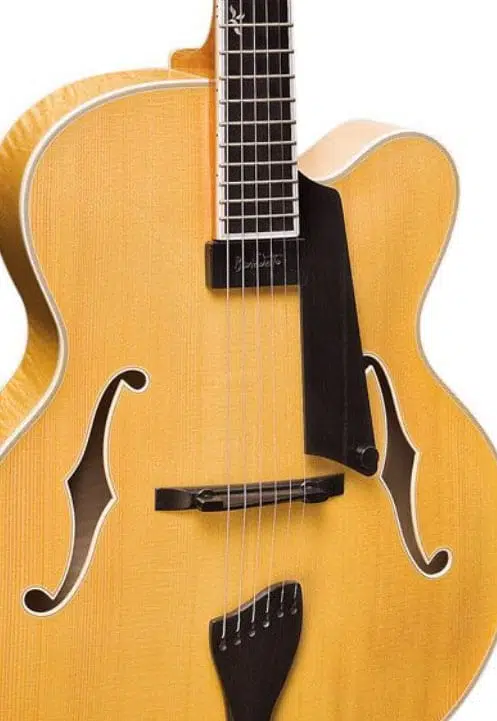
An archtop operates much like a violin. Strings anchor to a tailpiece mounted at the endpin, passing over an unattached, floating bridge. Rather than pulling forward, string tension exerts a downward vertical force onto an arched soundboard engineered to bear that load. To turn that downward force into tone, our Savannah workshop uses two distinct build methods. We hand-carve solid spruce plates for our Flagship Series to maximize acoustic resonance. Our Professional Series uses layered tonewood plies for feedback control on loud stages. Wood choice matters in both, and how tonewoods shape jazz guitar tone gets its own post.
Tension and String Dynamics
Because downward pressure drives an archtop’s soundboard, heavier strings give the top more energy to work with. While flat-tops typically favor phosphor bronze roundwounds for harmonic shimmer, archtops thrive on heavier gauges to generate balanced projection.
To ensure optimal response and immediate playing comfort, our standard setups are calibrated by model family:
Our standard setups follow that pattern by model family:
- Carved Guitars: Hybrid .014–.052
- Laminated Bravo & Bambino: .012–.052
- Benny: .011–.050
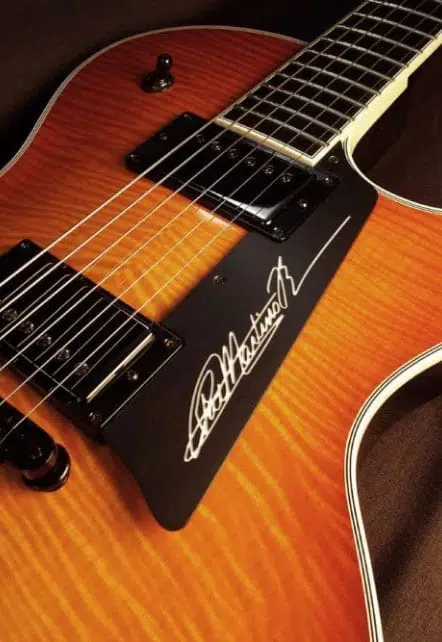
- Pat Martino Signature Model: Set up with Pat’s preferred .015–.052 flatwounds

Tonal Profile and Decay
These structural contrasts fundamentally dictate how each guitar projects sound in an acoustic space.
| Feature | Archtop | Flat-top |
| Top Construction | Hand-carved or laminated arch | Flat soundboard with X-bracing |
| Bridge Design | Floating, height-adjustable | Fixed, glued directly to top |
| Acoustic Voice | Articulate fundamental with quick decay | Broad overtones with extended sustain |
| Projection Pattern | Focused forward beam via f-holes | Broad, room-filling spread via round soundhole |
| Primary Strength | Note separation in dense voicings | Harmonic resonance and full acoustic volume |
An archtop’s rapid decay is an intentional asset. When you strike a dense 11th or 13th chord, the notes bloom immediately with distinct separation, then quickly get out of the way to leave breathing room for the bass, piano, and horn section. For the full physics, see our deep dive on archtop sound dynamics.
Stage Reliability and Amplification
Because a flat soundboard vibrates across a broad surface area, it acts like a sensitive diaphragm that easily triggers low-frequency feedback near amplifiers.
Archtops handle amplified environments with far greater control and inherent feedback rejection. We tailor our pickup design directly to the construction of the top:
- Floating Pickups: Designed by Bob Benedetto and built exclusively for us by Seymour Duncan, S-6 and S-7 pickups float above hand-carved tops without touching the wood, fully preserving the plate’s natural acoustic resonance. (We won’t put a floating pickup on a laminated top, because it would sound thin.)
- Built-in Pickups: Models like the 16″ Bravo Elite, 16-B, and Bambino Elite feature embedded A-6 or B-6 pickups for direct, focused amplification.
- Laminated Construction: Laminated tops offer superior feedback resistance and structural durability, making them ideal for working musicians on the road.

Body Size, Feel, and Projection
Body size plays a major role in how an instrument feels in your hands and responds to your touch:
- 17″ Flagship Models (e.g., the Manhattan): Deliver maximum acoustic volume, deep resonance, and projection.
- 16″ Models (Bravo & 16-B): Offer a versatile balance of physical comfort and acoustic punch for stage and studio work.
- 14-1/2″ Models (the Benny and the Bambino): Provide instant familiarity, comfort, and feedback control for players transitioning from solid-body electrics.
Selecting the Right Instrument
Choosing the right guitar depends on your primary performance environment:
- Choose a Flat-Top if you perform solo, play unamplified, or require expansive acoustic sustain and full-spectrum resonance.
- Choose an Archtop if your music demands precise note separation, punchy midrange presence, and effortless feedback control in group or amplified settings.
If you’re still weighing it, our guide on choosing a jazz guitar for your playing style covers what to look for in more detail.
Tailoring Your Custom Benedetto
Understanding these architectural principles makes it easy to select specs tailored to your playing style:
- Carved vs. Laminated Top: Carved tops optimize natural acoustic resonance; laminated tops maximize structural durability and feedback control.
- Body Dimensions: Depth and width directly alter soundboard response and physical ergonomics.
- Pickup Mounting: Floating or built-in configurations align directly with your top selection and acoustic needs.
- Nut Width & Scale Length: A 1-3/4″ nut width comes standard on our 16″ and 17″ archtops as well as the Benny, while the Bambino features a narrower 1-11/16″ nut. Most models use a 25″ scale.
Every specification we build honors Bob Benedetto’s architectural standards, ensuring purposeful construction that directly serves the working musician. Ready to spec yours? Build your own Benedetto tailored to how you play.

Crafted for Performance, Built for Legacy
The distinction between flat-top and archtop engineering highlights why Bob Benedetto dedicated his life to perfecting the arched soundboard. Every carve, top thickness, and bracing curve in our Savannah workshop is executed with intentional precision to maximize clarity and balance across every register. When you step onto the stage or into the studio with a Benedetto, you carry forward a legacy of functional art built to perform reliably for a lifetime. Contact our shop to discuss how we can build your ideal archtop.
FAQ: Archtop vs Flat-Top Guitars
What is the main difference between an archtop and a flat-top guitar?
Flat-top guitars use a glued bridge pulling on a flat soundboard, producing longer sustain. Archtops use a floating bridge and tailpiece system that presses down on an arched top, delivering clear note separation and focused projection.
Why do archtop guitars perform better in jazz and ensemble settings?
Archtops offer quick decay and direct forward projection. Dense chord voicings remain clear and distinct without muddying the ensemble mix.
How do carved and laminated tops differ?
Hand-carved spruce tops provide maximum acoustic resonance and natural voice. Laminated tops offer enhanced feedback control and durability for higher stage volumes.
Should I choose a floating or built-in pickup?
Floating pickups preserve the instrument’s natural acoustic voice by avoiding top contact. Built-in pickups route directly into the top for consistent electric focus and stage reliability.
Related Content

Understanding Tonewoods: How Wood Choices Shape Jazz Guitar Tone
How Tonewoods Shape the Sound of a Jazz Guitar Every jazz guitarist knows the importance of tone, but few elements influence that sound as much as the wood beneath your hands. From warmth and resonance to clarity and projection, tonewoods …
Read More >
How to Choose the Right Jazz Guitar for Your Playing Style
The guitar you choose defines how you sound and feel as a player. In jazz, tone and touch matter more than volume or flash. A well-chosen guitar responds to your phrasing, supports your rhythm, and inspires new ideas. Choosing the …
Read More >
Your Next Guitar?
This new Bravo is up in Bob’s Boutique and ready to go! Click on over to buy online, or contact us with any questions: info@benedettoguitars.com
Read More >