

How Archtop Guitars Differ in Sound: The Physics and Art of Jazz Tonality

When you pluck a chord on a fine archtop, the sound projecting from those f-holes possesses a character unlike any other guitar. Where a flat-top acoustic blooms with a wide wash of lower-end resonance and a solid-body electric relies on magnetic pickups to pull sustain out of solid wood, an archtop behaves like an articulate acoustic instrument. It delivers a quick, punchy attack, a rapid note decay, and a focused midrange clarity that allows dense chord voicings to remain crisp and distinct.
Inside our Savannah, Georgia workshop, a dedicated team of seven luthiers crafts these instruments every day—with Rod and Damon hand-carving the tops while five specialized builders handle each distinct stage of construction, tap-tuning, and voicing. Together, they strike a precise balance between pure acoustic depth and real-world stage utility.
Unlocking what gives these archtops such a distinct sonic profile means looking under the hood at the acoustic physics, structural choices, and luthiery techniques that shape their voice.
Curious where our obsession with tone began? Explore the history of Benedetto Guitars.
How Do Archtop Guitars Differ in Sound?
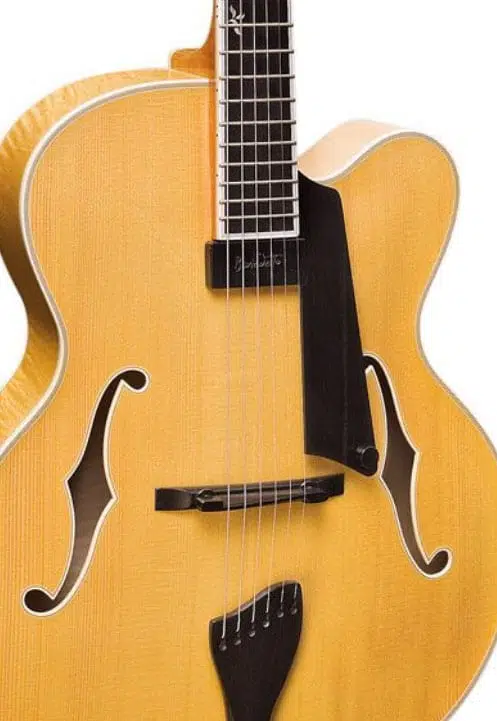
The fundamental acoustic difference lies in architectural compression. On a flat-top guitar, string tension pulls outward on a glued-down bridge, placing the flat soundboard under rotational strain. On an archtop, the strings pass over a floating ebony bridge and anchor at a rear tailpiece.
That single change in structure transforms how force moves through the instrument. String tension drives downward directly into the crown of the carved arch, loading the top plate under compression.
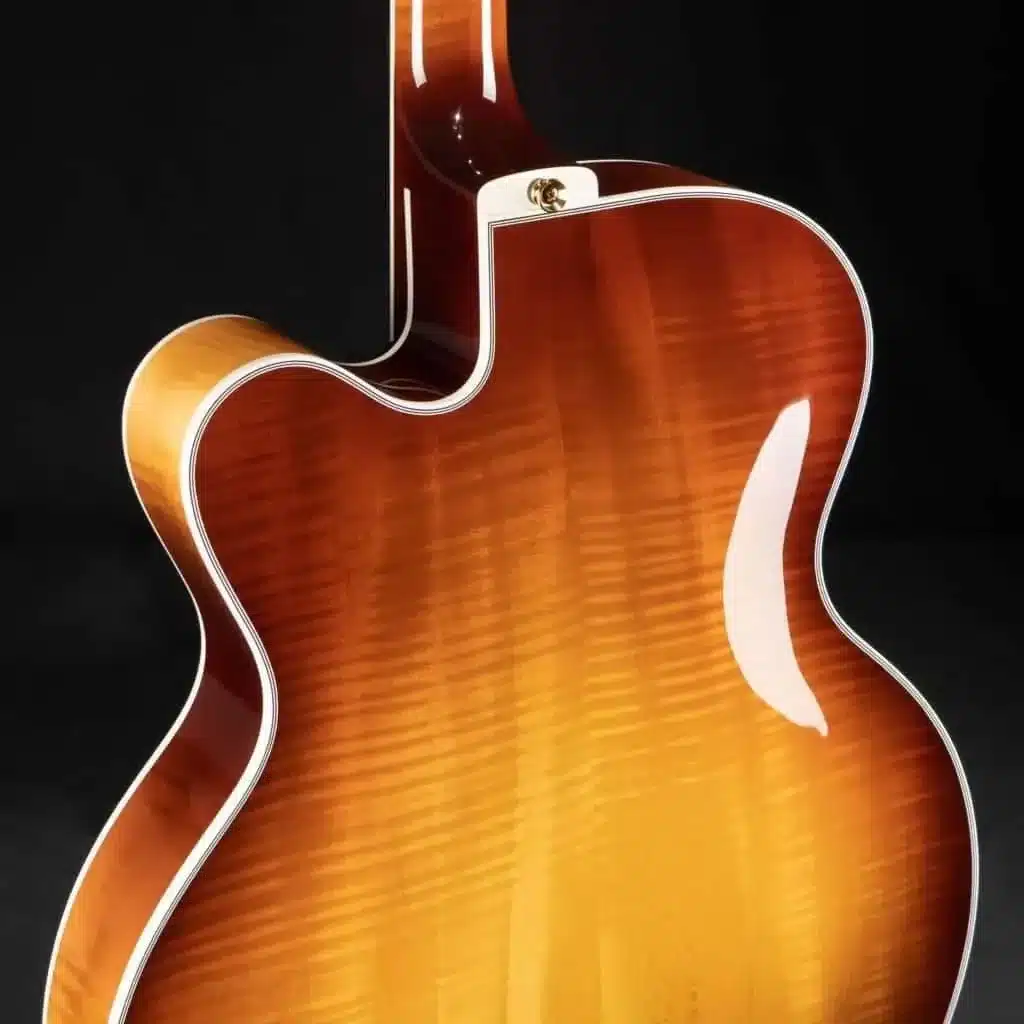
Because the soundboard is carved into a curve, this downward thrust acts like a stone archway supporting a bridge, gaining structural strength directly from the load. This natural stiffness allows us to carve the wood thinner along the recurve (the delicate perimeter just inside the purfling) without compromising the integrity of the top.
Immediate Attack Transients: Downward pressure loads the soundboard like a coiled spring, driving an instant acoustic response the moment your pick strikes the string.
Truncated Decay Envelope: Notes drop off faster than on a flat-top, keeping rapid bebop runs and six-note chord extensions clear rather than overlapping into a blur.
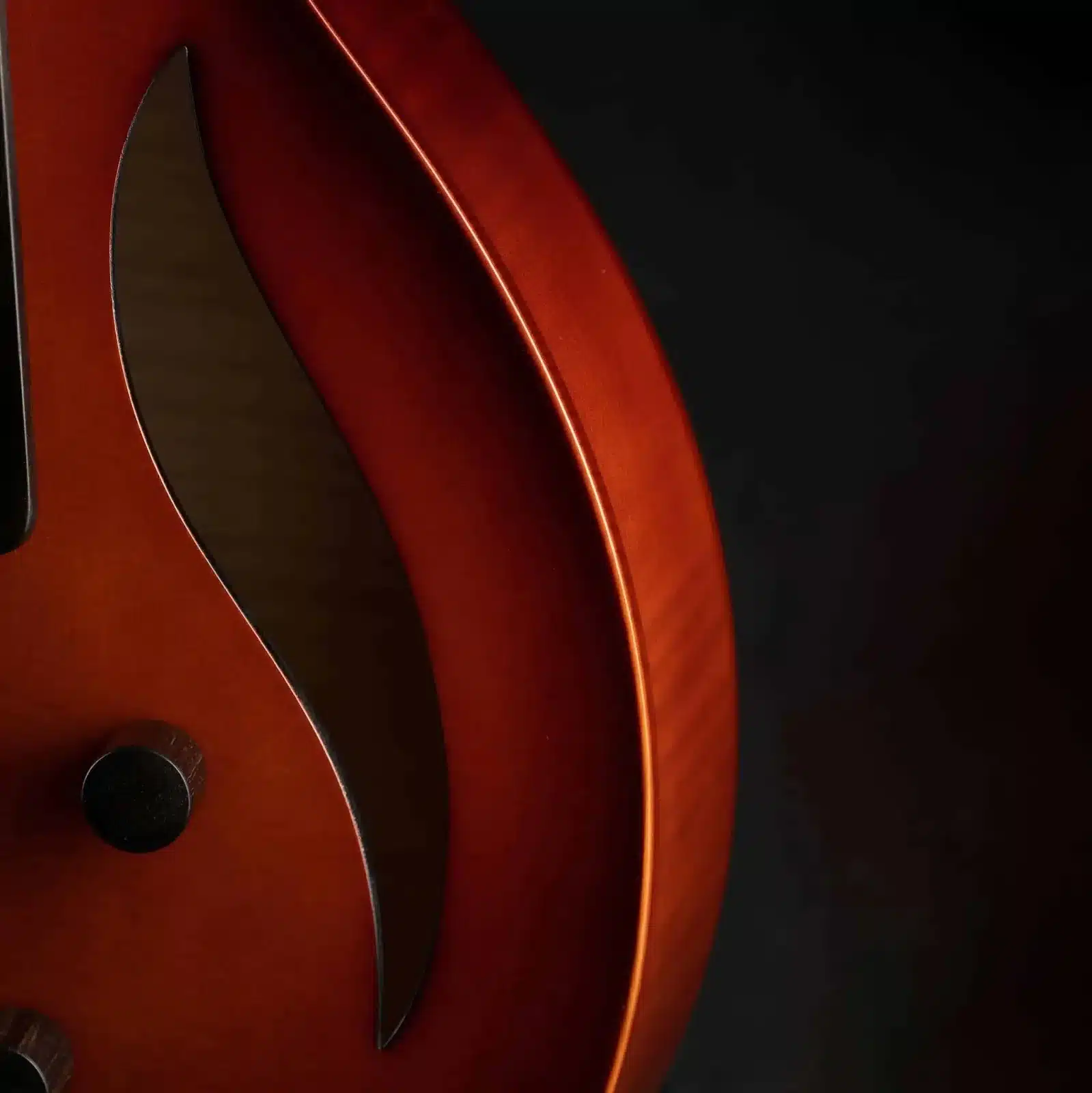
Focused Midrange Projection: The internal air cavity compresses sound waves and pushes them straight out through dual f-holes, acting like a directional projector rather than spreading sound in an ambient wash.
Hand-Carved Solid Spruce vs. Laminated Construction
Not all archtops share the exact same voice. The construction of the top plate fundamentally changes how the instrument responds under your fingers.
The Hand-Carved Standard
In our Flagship Series hand-carved archtops, we begin with thick, hand-selected billets of master-grade European or Sitka spruce. Our luthiers plane, chisel, and flex the wood at the bench, listening to the natural pitch of the timber through tap-tuning. As material is removed, the resonant frequency of the plate evolves.
By voicing the top to match the specific density of that individual piece of timber, we achieve maximum acoustic air, vocal midrange clarity, and rich harmonic overtones. A carved top responds intimately to the subtle nuances of your picking attack, making it the gold standard of jazz archtops for acoustic purity.
The Laminated Alternative
Working musicians performing plugged-in club dates navigate a different set of demands: elevated stage volumes and unpredictable room acoustics. When a highly resonant carved soundboard sits in front of a loud amplifier, the top can vibrate uncontrollably, leading to low-end feedback.
Our Professional Series laminate guitars address this through precise structural engineering. Instead of commercial plywood, we layer premium wood veneers and press them into a rigid arch. This construction stiffens the top plate, dampening feedback-causing vibrations while retaining that essential woody punch. The result is an articulate, clear tone that cuts through an ensemble cleanly without howling.

Scale Mechanics: The Sweet Spot of Tension and Tone
It can be tempting to view scale length as simply a dimension on a spec sheet, but it ripples through the entire physical architecture of an archtop, dictating bridge placement, f-hole positioning, and internal bracing alignment.
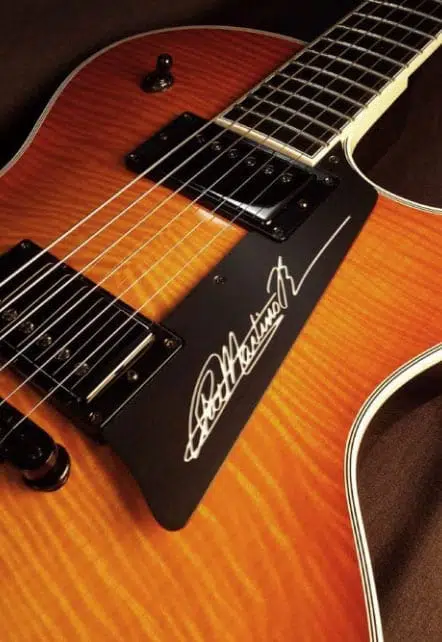
We adhere strictly to historic 25-inch scale length geometry across our core models (with specific exceptions like the 24-5/8″ Pat Martino Signature or the 23″ scale on The Andy). This standard provides the optimal balance of tension and tone.
Driving the Top: A 25-inch scale generates the proper string tension with a standard .012 or .014 gauge set to load the soundboard and drive the floating bridge efficiently.
Bracing Alignment: The bridge rests squarely between the center notches of the f-holes, directly over the internal parallel or x-bracing. Altering scale length shifts the bridge off its acoustic epicenter, compromising projection.
Fretboard Ergonomics: The tension remains firm and predictable under the fingers, giving fast single-note runs an articulate response without feeling overly stiff.
If you wish to design a custom build, you can customize wood selections, body depths, and neck profiles through our option to build your own custom Benedetto. That said, we strongly recommend keeping our foundational scale geometry intact, as it’s central to authentic Benedetto tonality.
Amplification Architecture: Floating Pickups vs. Integrated Humbuckers
How you amplify an archtop fundamentally alters its acoustic behavior. The interaction between pickup mounting and soundboard vibration creates two distinct sonic profiles.
Floating Pickups: Pure Acoustic Transparency
A floating pickup, like our S-6 mini-humbucker, attaches directly to the pickguard, suspended just above the wood without touching the soundboard.
Because no routes are cut into the spruce plate, the soundboard vibrates as an uninhibited acoustic diaphragm. When plugged into a clean amplifier, a floating pickup translates the natural, airy acoustic character of the carved wood. It is the ideal configuration for players seeking an amplified tone that directly reflects the instrument’s unamplified voice.
Integrated Pickups: Warmth, Mass, and Electric Punch
Routing apertures directly into the top plate to mount built-in humbuckers (such as our A-6) alters the acoustic dynamic. The mounting hardware and pickup mass rest directly on the wood, dampening the top’s raw acoustic movement.
While this trades off some unamplified acoustic volume, it yields the warm, dark, electric jazz voice established in the 1950s. The added mass increases electric sustain, smooths treble response, and provides enhanced feedback resistance on loud stages.
For players interested in unique, small-batch builds featuring specialized pickup layouts or exotic tonewoods, you can regularly inspect available offerings in Bob’s Boutique.
The Master Luthier’s Touch
Ultimately, understanding how archtop guitars differ in sound requires balancing acoustic science with lutherie intuition. You can measure wood thickness with calipers and calculate downward bridge pressure through structural mechanics, but true tonality is dialed in by hand and ear. Every piece of spruce or maple that enters our Savannah workshop possesses its own unique grain density and structural stiffness.
By tap-tuning every plate, micro-carving the recurve, and voicing internal bracing, our team ensures that every instrument vibrates in harmony with the player’s touch. This refusal to compromise is why a fine archtop carries your musical voice so effortlessly, whether you are practicing in a quiet studio or performing on a festival stage.
Ready to discover the instrument tailored to your touch? Explore our instrument lineup or contact our Savannah workshop today to begin designing your custom archtop.
Frequently Asked Questions
Why do archtop guitars have less sustain than flat-top acoustic guitars?
Archtops transfer string energy into the top plate rapidly through downward bridge pressure. This generates an immediate acoustic attack followed by a quick note decay. This shorter sustain is advantageous for jazz because it keeps fast bebop passages and dense chord extensions articulate without notes blurring together.
Can you play blues, country, or fingerstyle on an archtop guitar?
Yes. While the archtop is the definitive voice of jazz, its percussive attack, midrange punch, and directional projection made it a core instrument in early blues, swing, country flatpicking, and early rock ‘n’ roll long before solidbody electrics were introduced.
Does a laminated archtop sound inferior to a hand-carved archtop?
No; it is engineered for a different musical context. A hand-carved top provides maximum acoustic depth, air, and dynamic nuance for solo playing or studio recording. A high-quality laminated top delivers a punchy, focused midrange and superior feedback rejection, making it a dependable tool for high-volume club dates and touring environments.
Related Content

Understanding Tonewoods: How Wood Choices Shape Jazz Guitar Tone
How Tonewoods Shape the Sound of a Jazz Guitar Every jazz guitarist knows the importance of tone, but few elements influence that sound as much as the wood beneath your hands. From warmth and resonance to clarity and projection, tonewoods …
Read More >
How to Choose the Right Jazz Guitar for Your Playing Style
The guitar you choose defines how you sound and feel as a player. In jazz, tone and touch matter more than volume or flash. A well-chosen guitar responds to your phrasing, supports your rhythm, and inspires new ideas. Choosing the …
Read More >
Your Next Guitar?
This new Bravo is up in Bob’s Boutique and ready to go! Click on over to buy online, or contact us with any questions: info@benedettoguitars.com
Read More >