

How to Recognize Master Craftsmanship in Premium Handcrafted Jazz Guitars
For serious musicians and collectors, choosing a custom archtop guitar is a deeply personal journey. It’s an investment with no room for compromise on balanced tone, responsiveness, or long-term reliability. After all, a world-class archtop is not simply an instrument but a functional work of art, shaped by decades of design evolution, luthier expertise, and a profound respect for the jazz tradition.
Knowing what to look for within the nuances of hand-carving and structural engineering ensures you select a guitar that completely complements your individual playing style. Whether you are browsing the immediate, bench-tested builds available right now in Bob’s Boutique or exploring the rich heritage behind the Benedetto brand legacy, this guide serves as a practical map to help you recognize and appreciate the structural execution that makes a world-class jazz instrument an absolute joy to own and play.
1. Acoustic Response and Tonal Balance
An exemplary archtop must possess a natural acoustic voice characterized by clarity, distinct note separation, and an even response across all registers. Unlike mass-produced instruments that often suffer from muddy lower frequencies or brittle upper strings, a masterfully crafted archtop maintains perfect acoustic balance long before it ever meets an amplifier.
Hallmarks of Elite Voicing
- Even Decay and True Sustain: When you pluck a single note in the lower register and compare its sustain to a note high up on the fretboard, a masterfully carved soundboard will exhibit an even, gradual decay across both zones. There are no sudden drop-offs, dead spots, or choked frequencies as you move across the strings.
- Complex Chord Clarity: If you play a dense, multi-voiced jazz chord, especially one featuring close intervals or complex alterations, in the middle register, an elite archtop lets you hear distinct note separation. The inner voices remain beautifully transparent instead of dissolving into a muddy acoustic cluster, ensuring that no single string overpowers the rest of the voicing.
The projection should feel immediate and clear, reflecting a highly responsive top plate that maximizes vibrational energy. To achieve this level of musical purity, our workshop focuses on precision at every stage of production, a process driven completely by the hands of the dedicated team of master artisans in our shop.
2. Material Selection and Tonewood Integrity
The foundation of any exceptional handcrafted guitar rests upon how the luthier selects and grades the raw tonewoods. Premium archtops utilize seasoned, high-grade timbers chosen specifically for their grain structure, density, and resonant characteristics. The choice of materials dictates both the fundamental acoustic profile and the structural longevity of the instrument.
Visual Layout of Premium Timber
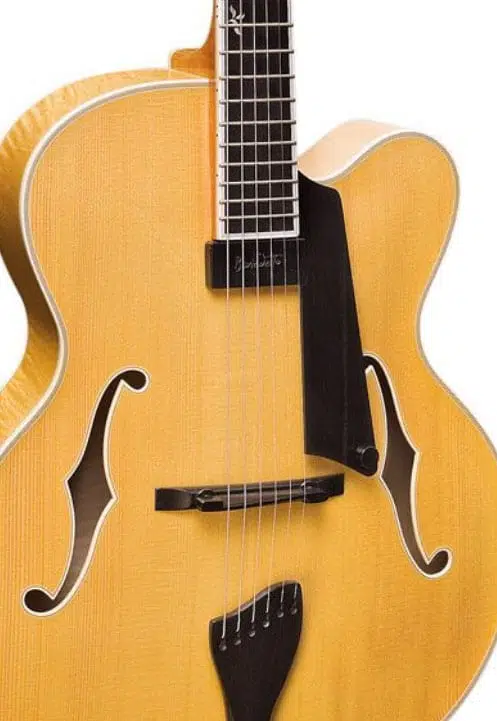
When evaluating an elite top plate, look closely at the spacing of the winter growth lines (the dark, narrow lines running vertically through the spruce grain). In a master-grade soundboard, you will see grain lines that run straight, parallel, and remain relatively uniform in width from the center seam all the way out to the edges. While tight, dense grain at the center indicates excellent structural stiffness, what matters most is consistency. If the grain shifts wildly across the top, the wood will flex unevenly under string tension, creating unpredictable acoustic blind spots, a flaw that master wood selection successfully avoids.
Selecting and matching these materials requires an experienced eye and deep luthier intuition. It’s a deeply collaborative process, and one that we enjoy exploring firsthand with players who choose to design a bespoke creation tailored entirely to their touch.
3. Structural Construction and Hand-Carving Techniques
The defining element of a premium archtop is its hand-carved construction. Master luthiers graduate the thickness of the top and back plates by hand, tuning the wood to optimize resonance and control feedback.
Traditional Hand-Carving → Graduated Plate Thickness → Optimal Acoustic Resonance
Factory Pressing → Uniform Sheet Thickness → Restricted Tonal Projection
Hallmarks of Masterful Carving and Bracing
- The Fluid Recurve: Look closely at the recurve, the slight dip in the carving just before the top meets the rim binding. A hand-carved top will have a smooth, fluid transition into this recurve that acts as a natural acoustic hinge, whereas factory-pressed tops often look flat, rigid, or abrupt.
- Flawless Internal Execution: Looking inside the f-holes of a world-class build reveals the true discipline of the builder. The parallel or X-bracing should be meticulously sanded, glued cleanly to the top without visible glue squeeze-out, and tapered smoothly at the ends. Rough, unsanded internal work is a telltale sign of rushed factory construction.
In a benchmark build, all external seams are completely flush, showing no gaps or uneven adhesive lines. This level of hand-carving precision differentiates our premium, solid-wood Flagship Series instruments from standard guitars.

4. Playability, Neck Alignment, and Fret Execution
For the working musician, a guitar is an immediate extension of their voice, demanding effortless playability and complete reliability on the road. The neck profile must support natural hand geometry to prevent fatigue during long performances, recording sessions, or daily teaching.
What Professional Alignment Feels Like
- Perfect Straightedge Geometry: Sighting down the edge of a properly stabilized fingerboard reveals a straight profile with a very subtle, intentional relief (a slight forward bow), entirely free of twisting or S-curves.
- Seamless Fret Dressing: Running your finger along the edge of the neck binding should feel completely smooth. On a premium instrument, the fret ends are perfectly crowned, beveled, and polished, guaranteeing zero sharp edges or metal “sprouts.”
- Uniform Action Across the Board: Playing a chromatic scale from the lowest register to the highest frets should yield clean, pure tones. A meticulously voiced instrument eliminates the “wolf tones” and dead spots that plague mass-produced setups.
For players who need this exact type of dependable, gig-ready performance night after night, our Professional Series offers workhorse instruments engineered specifically for the stage, studio, and classroom.
5. Component Integration and Electronics Quality
A premium archtop must perform flawlessly when amplified, maintaining its natural acoustic voice without introducing feedback or electronic noise. The selection and placement of electronics are critical to ensuring professional reliability.
The Standard for Clean Signal Integration
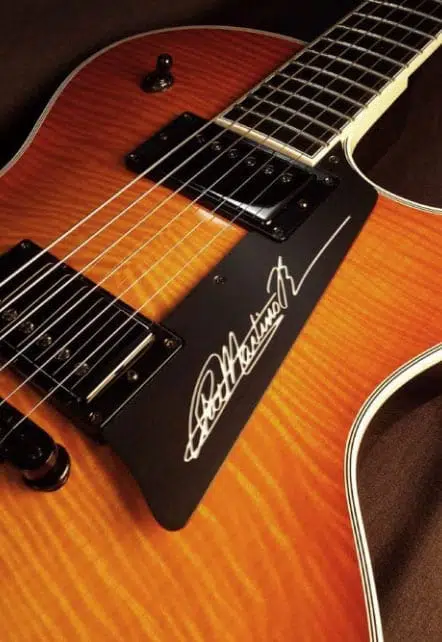
When plugged into a clean jazz amplifier, the volume and tone controls must operate smoothly with absolutely no scratching, static, or dropouts. The mounting of a high-quality floating or built-in pickup should be structurally isolated, meaning it captures pure string vibrations cleanly without translating excessive microphonic body noise if you tap the pickguard.
Furthermore, the internal wiring harnesses must be anchored securely within the hollow body, eliminating any internal clicking or rattling that could cause acoustic interference while you are performing.
6. Finish Application and Visual Depth
The finish of a custom archtop serves dual purposes: it protects the wood and enhances its natural beauty without dampening its acoustic resonance. Fine instruments typically utilize a thin nitrocellulose lacquer or specialized ultra-thin finishes that allow the wood to breathe and vibrate freely.
Visual Clues of an Artisan Finish
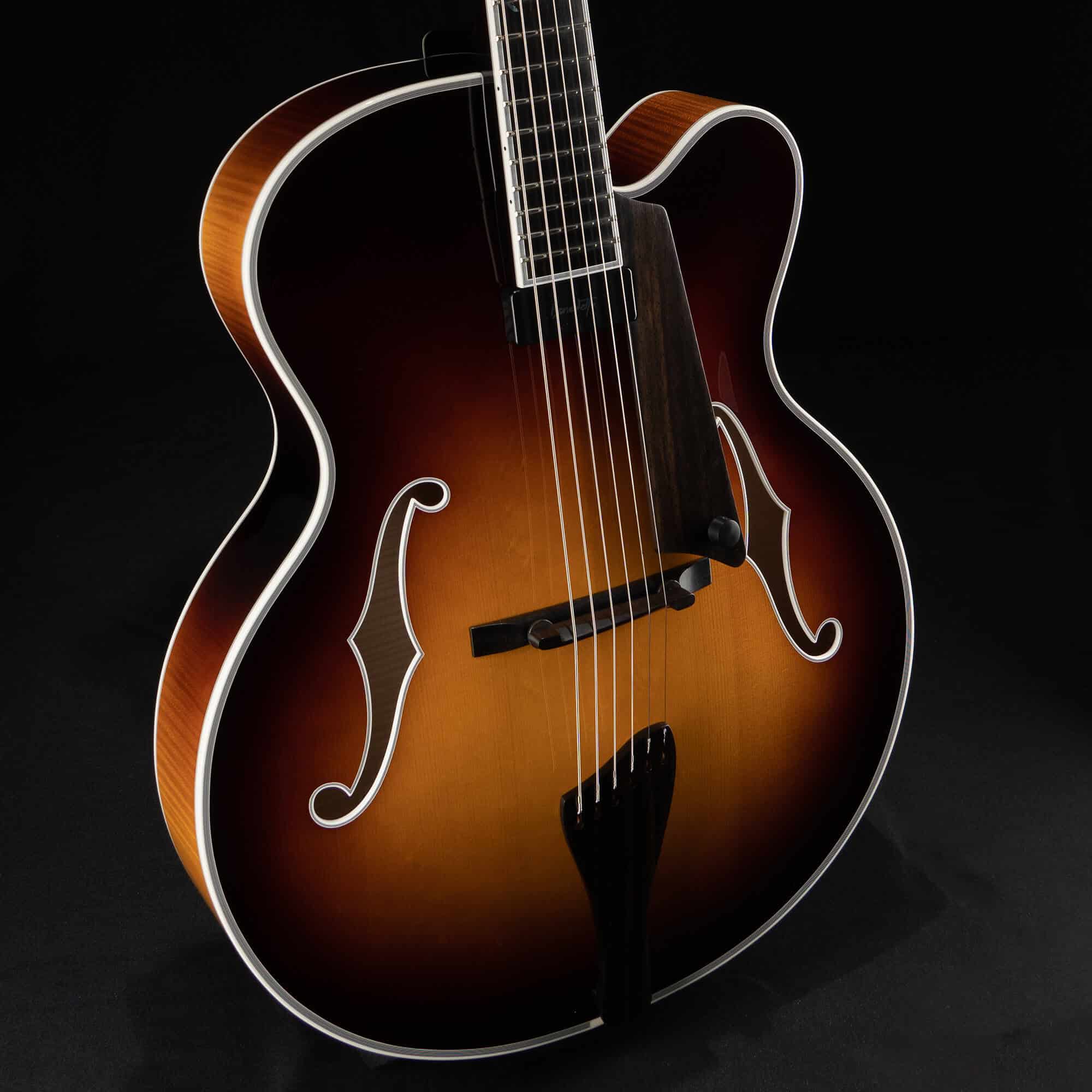
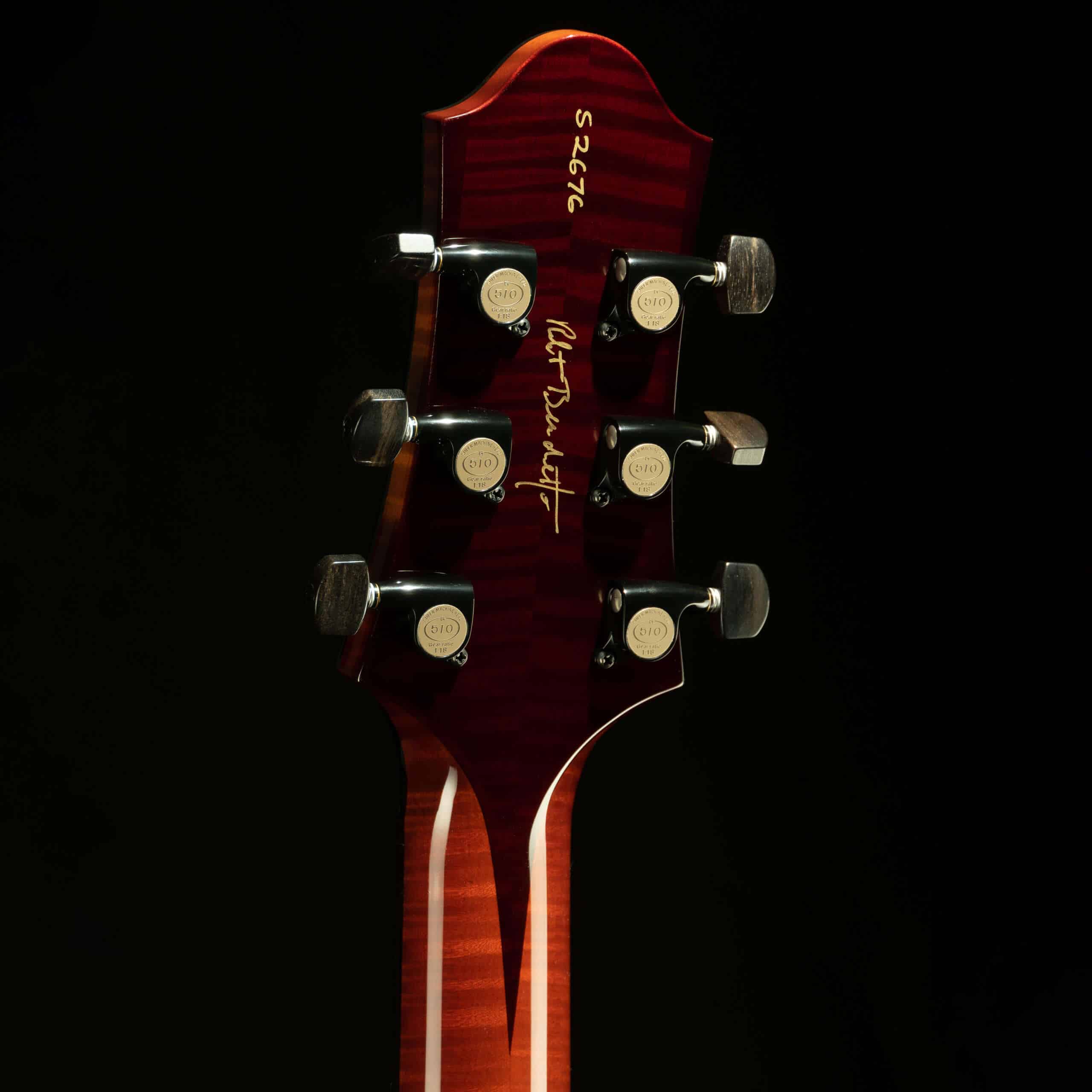
When viewing the guitar under a direct light source, a masterfully applied finish will be completely level and transparent, especially around difficult, tight spots like the neck joint, the inside curls of the f-holes, and the edges of the cutaway.
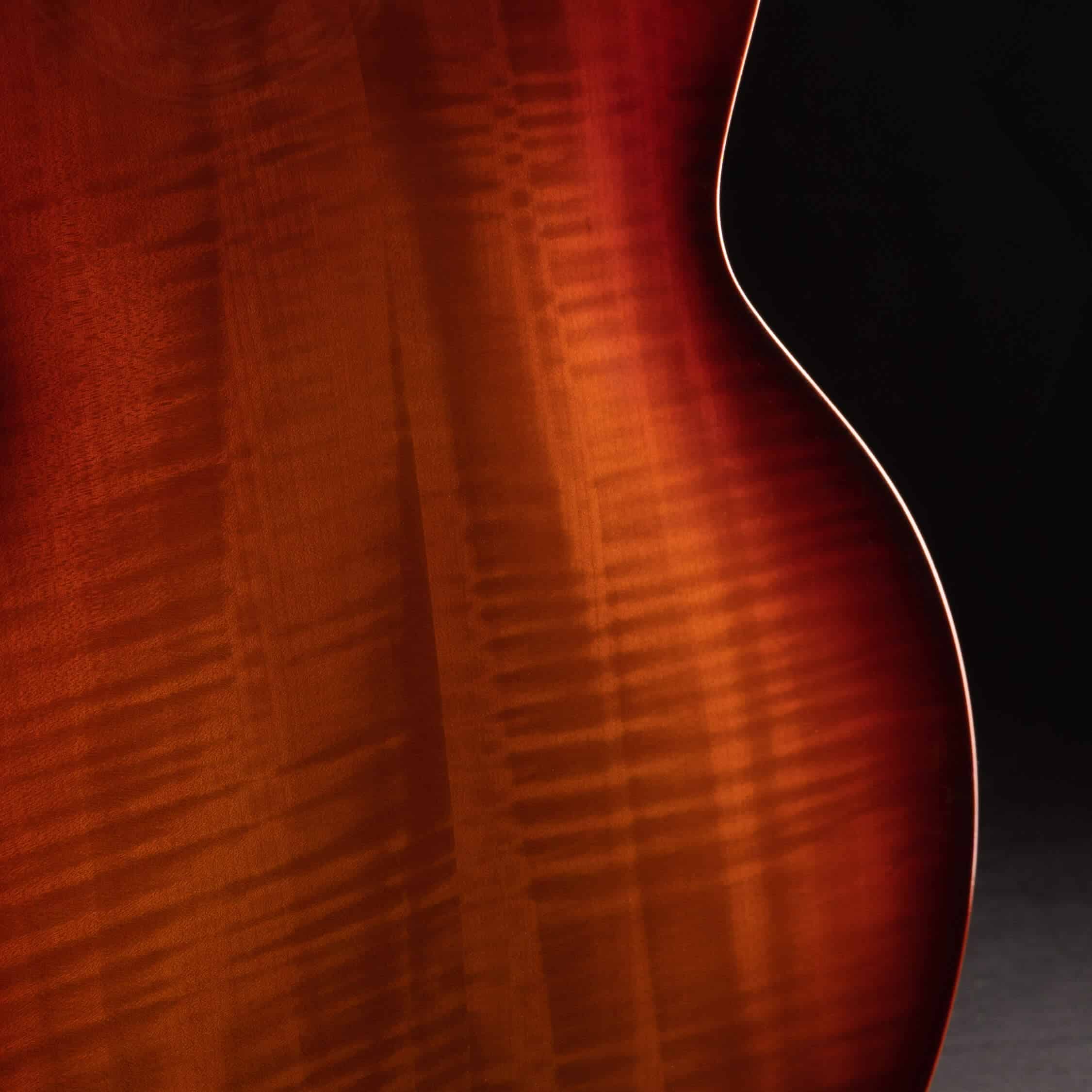
Unlike the thick, plastic-like jackets common on standard guitars, an artisan finish is incredibly thin and glass-like, revealing the deep, three-dimensional character of the underlying wood grain while preserving the guitar’s acoustic headroom.
The Master Craftsmanship Checklist
Use this baseline of standards to understand what sets a world-class, handcrafted archtop apart:
- Tonal Balance: Complex chords maintain clean note separation and balanced volume across all registers.
- Plate Carving: The recurve is fluid and smooth, carved away by hand to maximize acoustic response.
- Fret Finish: Fret ends are perfectly crowned, polished, and flush with the fingerboard binding.
- Joint Seamlessness: Bindings, purfling, and neck joints are completely flush and clean without visible gaps.
- Finish Thinness: The lacquer is applied in micro-thin layers, allowing the wood to breathe and project.
- Hardware Function: Tuners, tailpieces, pot controls, and switches operate smoothly and silently.
Choosing Your Instrument
Understanding your specific staging and musical needs helps you target the correct class of instrument. The legacy of modern archtop design is defined by an unwavering dedication to detail, tone, and long-term value—a standard proudly carried on by the generation of players featured on The Benedetto Players roster. By recognizing these core principles of master craftsmanship, you can confidently invest in an instrument that honors tradition and supports your musical voice for generations.

Frequently Asked Questions
What are the main quality indicators of a custom-built jazz archtop guitar?
The primary indicators of high quality are consistent tone across all registers, clear note separation when playing complex jazz chords, and a highly responsive, micro-thin finish that lets the timber resonate. Visually, a master-built archtop features a fluid recurve carve near the rims, seamless wood-to-wood joint seams, and internal tone bars that are meticulously sanded and free of messy glue squeeze-out.
Why do premium archtops use an ebony bridge and tailpiece instead of metal?
Premium archtops use low-mass timber components like ebony to minimize surface weight on the delicate, hand-carved soundboard. Heavy metal tailpieces and bridge assemblies act like a mechanical mute, dampening the natural acoustic vibrations of the spruce top. Hand-scraped ebony anchors transfer string energy directly into the top plate without introducing harsh or metallic overtones.
How does grain line consistency impact an archtop soundboard?
An elite archtop soundboard relies on straight, parallel winter growth lines running uniformly from the center seam out to the rims. If the grain spacing changes erratically, the wood will flex inconsistently under the heavy structural tension of the strings. Uniform grain across the entire width of the top ensures predictable acoustic resonance, balanced projection, and stable dynamic range.
What is the advantage of a thin nitrocellulose finish over standard polyester finishes?
Traditional nitrocellulose lacquer is applied in micro-thin layers that bond gracefully with the wood pores, protecting the instrument while allowing it to breathe, expand, and age over generations. In contrast, heavy modern polyester or polyurethane finishes act like an encasing plastic jacket, stifling the top plate’s flexibility and severely deadening its acoustic properties.
Related Content

Understanding Tonewoods: How Wood Choices Shape Jazz Guitar Tone
How Tonewoods Shape the Sound of a Jazz Guitar Every jazz guitarist knows the importance of tone, but few elements influence that sound as much as the wood beneath your hands. From warmth and resonance to clarity and projection, tonewoods …
Read More >
How to Choose the Right Jazz Guitar for Your Playing Style
The guitar you choose defines how you sound and feel as a player. In jazz, tone and touch matter more than volume or flash. A well-chosen guitar responds to your phrasing, supports your rhythm, and inspires new ideas. Choosing the …
Read More >
Your Next Guitar?
This new Bravo is up in Bob’s Boutique and ready to go! Click on over to buy online, or contact us with any questions: info@benedettoguitars.com
Read More >