

From Billets to Soundboards: High-Quality Materials for Custom Jazz Guitars
Every note a jazz guitarist plays starts in the wood. Because spruce, maple, and ebony each shape resonance, attack, and sustain differently, material choice matters just as much as body shape, whether the guitar is a fully hand-carved archtop or built on a laminated body for the road. This guide breaks down how those choices, across both constructions, define an instrument’s voice from the soundboard to the tailpiece.
Archtop Tonewood: Soundboards, Backs, and Acoustic Diaphragms
In our Savannah, GA workshop, selecting a tonewood billet is a careful exercise in acoustic evaluation. The top of an archtop acts as a spring-loaded diaphragm, and when a player plucks a heavy-gauge flatwound string, the bridge sends that vibrational energy directly into it. That top has to be rigid enough to withstand over 75 pounds of downward string pressure while staying pliable enough to vibrate freely across complex chord voicings, which is exactly why tonewood selection is one of the first decisions in any custom order.
Solid Carved vs. Laminated Construction
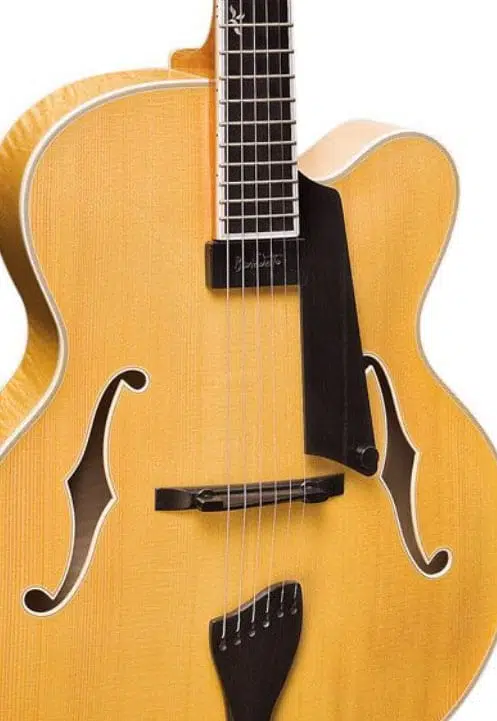
Every Benedetto starts with one of two construction methods, and it’s typically the first fork in the road for a custom build. Our Flagship Series is entirely hand-carved from solid, aged tonewoods; the top, back, and sides begin as thick blanks and are carved down by hand until each panel reaches its ideal thickness and tap-tone. Our laminated models use layered tonewood plies for the top, back, and sides, built over the same parallel-braced spruce internal structure and finished with the same ebony fingerboard, bridge, and tailpiece as our carved guitars.
Fine-Grained Spruce Tops: Sitka vs. European Master-Grade
On our fully carved Flagship archtops, the choice of top wood always comes down to two dominant spruce species:
Quarter-Sawn Sitka Spruce (Picea sitchensis): Renowned for its exceptional strength-to-weight ratio and dynamic headroom. Sitka yields a fundamental tone with crisp note separation, making it ideal for players who use a firm plectrum attack and demand zero acoustic distortion on loud stages.
European / Alpine Spruce (Picea abies): Softer than Sitka with lower density, European spruce delivers a complex overtone series, immediate light-touch response, and a rich, bell-like acoustic bloom. It is the gold standard for fingerstyle jazz purists and intimate solo chord-melody performance.
When evaluating a raw spruce billet, we inspect the grain density. Close, straight grain (15 to 25 rings per inch) ensures uniform longitudinal stiffness. During the hand-carving phase, our luthiers execute tap tuning: flexing the carved soundboard, listening to its fundamental pitch decay, and carving away minute fractions of wood until the top rings with clarity before it ever touches a rim assembly. This is the same evaluation process every custom top goes through before it’s approved for a build.
Flamed Maple: Dynamic Projection and Rim Rigidity
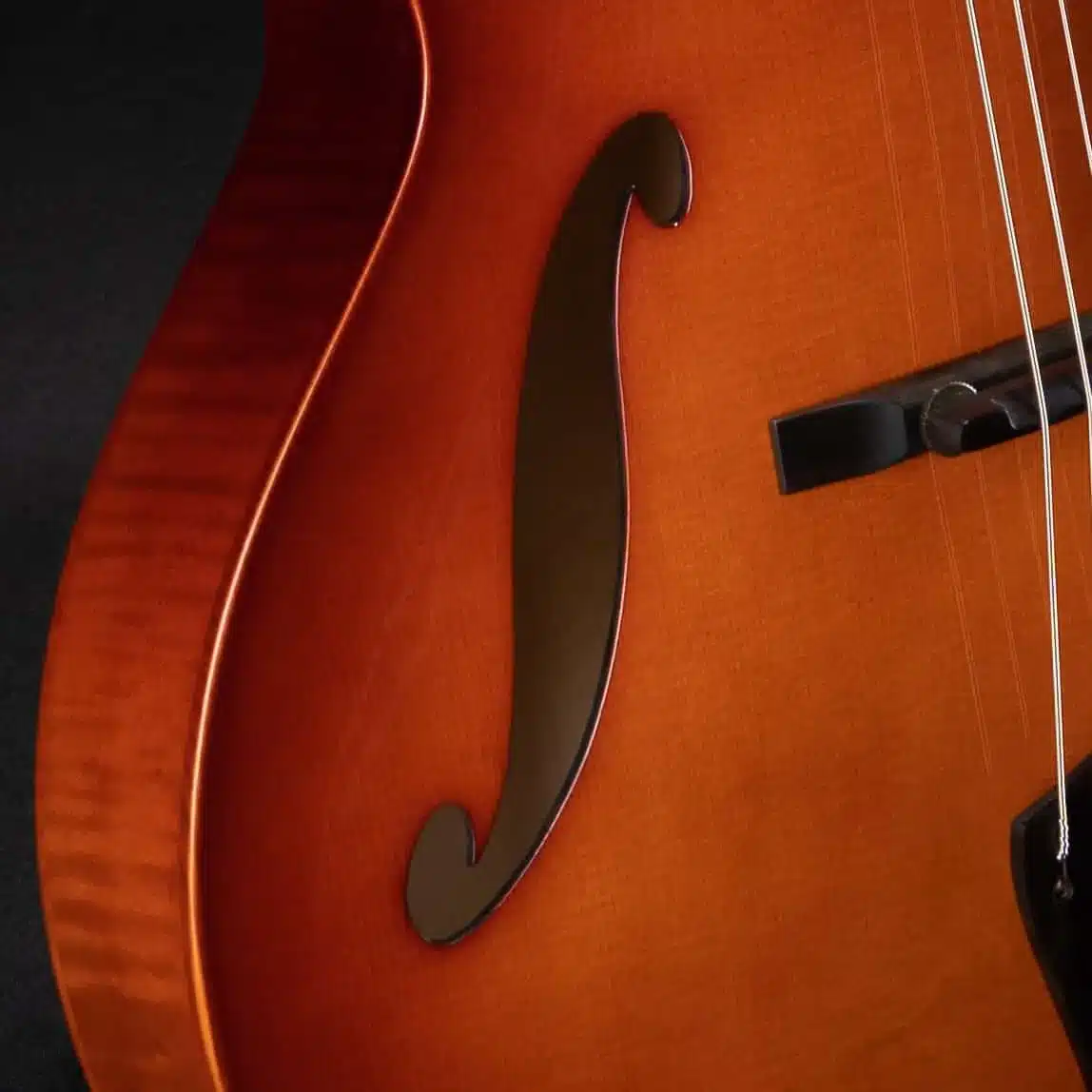
Across both carved and laminated models, quarter-sawn flamed or quilted maple (Acer saccharum) provides the structural frame and acoustic reflector for the back and sides. The back and sides of an archtop do not drive the sound; rather, they reflect internal air pressure waves back up through the f-holes.
Highly figured maple is structurally dense. On carved backs, precise graduating contours (thinner near the recurve, thicker near the centerline) let a solid maple back act as a mirror that focuses lower-mid frequencies into clear, projecting notes that cut through a big band horn section. Figured grades also vary widely in appearance, which is part of why maple selection is often a visual as well as acoustic decision for custom clients.
Archtop Geometry and Scale Mechanics
A custom guitar’s tone is inextricably linked to its physical scale geometry. There is a common misconception in modded instrument circles that changing scale lengths mid-build is a harmless cosmetic tweak. In truth, altered scale geometry changes string tension vectors across the bridge, completely altering top loading and internal bracing deflection.
Scale and Body Size
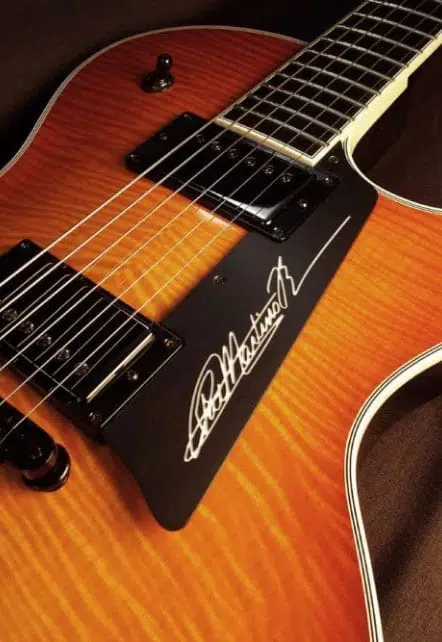
We build almost exclusively to a 25-inch scale, with two named exceptions: the Pat Martino Signature Model™ (24-5/8″) and our compact Andy™ line (23″). Custom carved builds can also be ordered at 25-1/2″ or 24-3/4″, though we strongly recommend staying at 25″. See the full range of options when designing a custom Benedetto archtop.
Body size follows a similar logic: 17-inch lower bouts deliver maximum unamplified volume and bass, 16-inch balances punch with playability, and 14-1/2-inch bodies favor portability and feedback resistance on stage. All three are available as a starting point for a custom order.
Archtop Fingerboards and Ebony Fittings: The Touch Mechanics
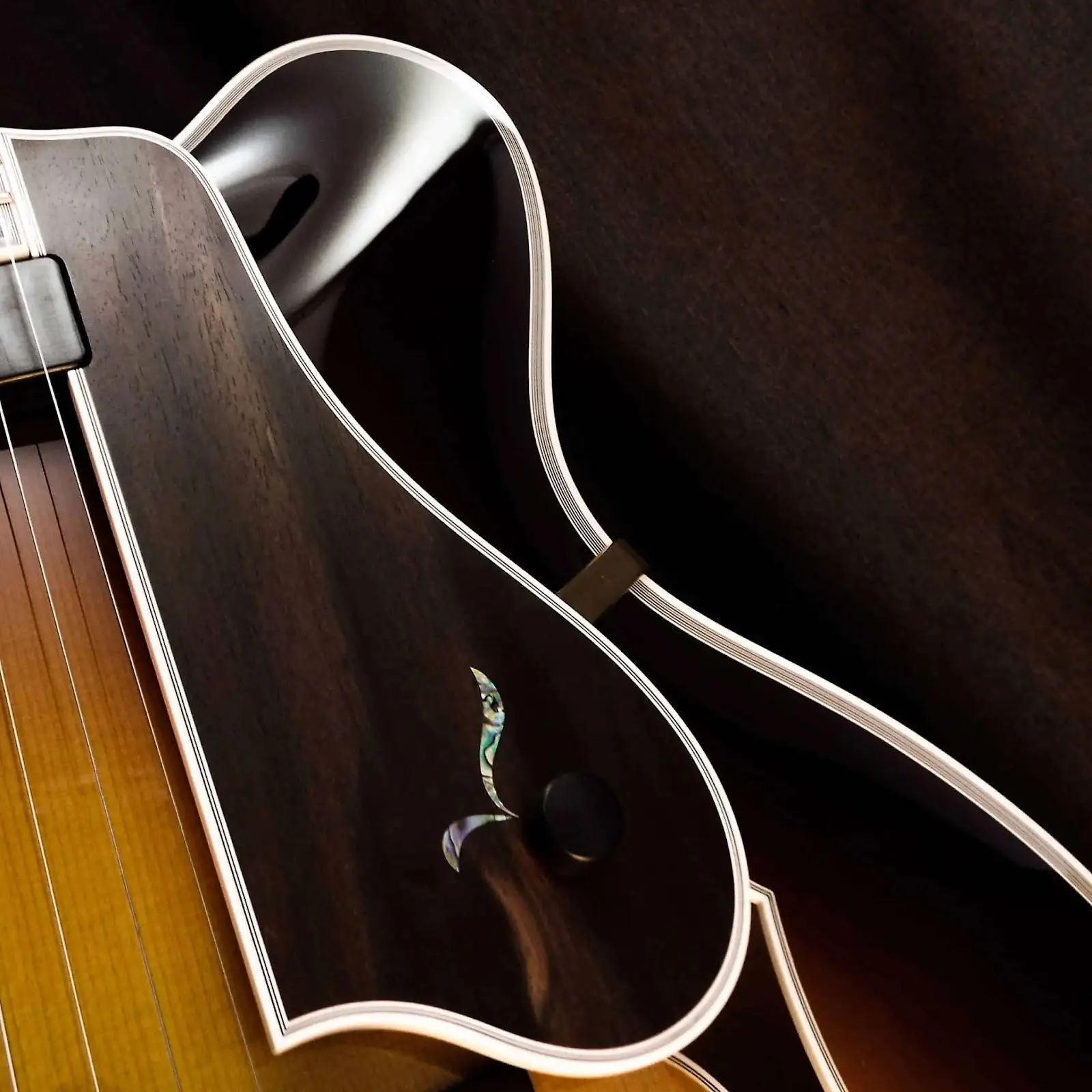
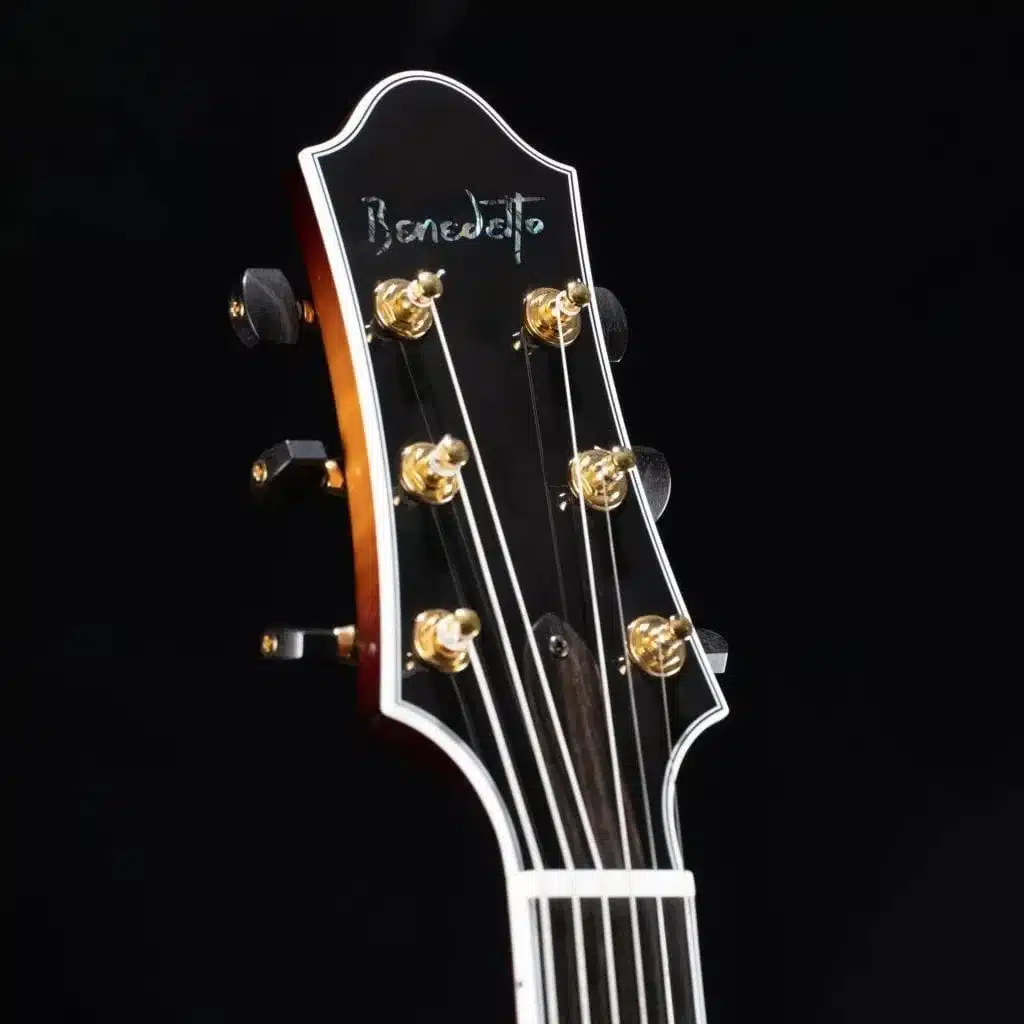
The point of contact between musician and instrument is where subtle material differences become immediately apparent. While rosewood offers a softer feel, dense African Gaboon Ebony (Diospyros ebenum) remains the undisputed material choice for fingerboards, floating tailpieces, and height-adjustable bridges across our entire line, carved or laminated, and it’s rarely a component custom clients ask us to swap out.
Why Ebony Matters for Acoustic Attack
Ebony is incredibly dense and non-porous. When a string is fretted against an ebony fingerboard, virtually zero vibrational energy is absorbed by the wood underneath. The string’s energy stays in the string, yielding an immediate, percussive attack decay that allows fast-moving bebop lines to articulate clearly without getting muddy.
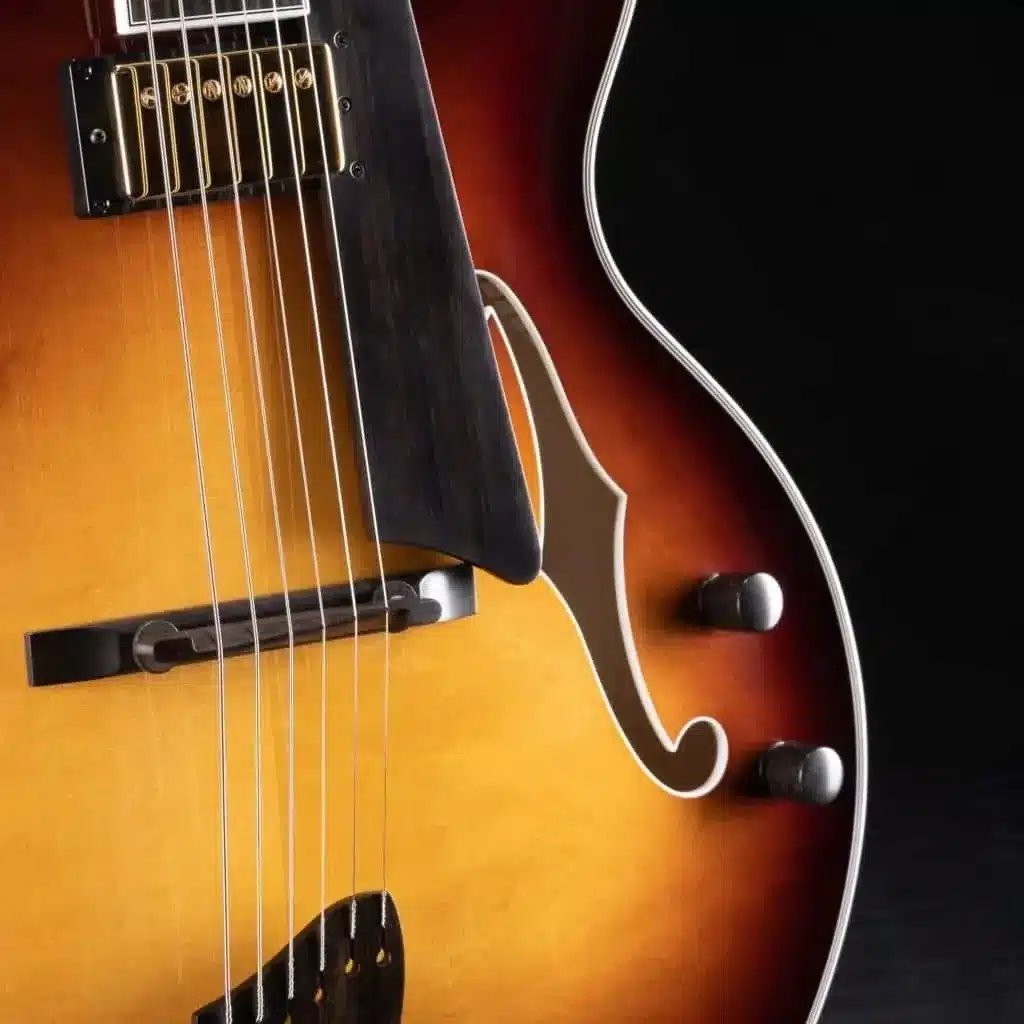
Furthermore, hand-carved ebony tailpieces anchored via a nylon-sheathed steel cable fastener serve a crucial acoustic role: they add minimal mass to the top soundboard, allowing the top to vibrate without the dampening effect of heavy brass or nickel hardware.
How Archtop Material Choices Come Together in the Shop
When our founder, Robert Benedetto, established his archtop building methods over fifty years ago, he proved that high-quality materials are only as good as the luthier’s hands guiding the chisel. You can take the most expensive piece of master-grade Alpine spruce, but if you carve it to uniform factory thickness without listening to its internal grain structure, the instrument will sound flat and choked.
In our Savannah, GA workshop, our team of expert luthiers approaches every build as a unique structural challenge, whether it’s a fully hand-carved instrument or a laminated model built for the road. Our craftspeople evaluate the exact weight, density, and flexibility of each wood blank, hand-carve internal parallel or X-braces on our solid-top guitars, and apply the same thin, breathable nitrocellulose lacquer finish across the entire line, protecting the wood without locking down its natural acoustic movement.
Backed by 50 years of master luthiery, it’s the same standard we hold all guitars to today.
Start Designing Your Custom Archtop
The journey toward a custom archtop begins by identifying the exact acoustic voice, neck profile, and stage response your playing demands, whether that leads you to a fully hand-carved instrument or a laminated model built for the road. Explore our Savannah workshop to discover how our master luthiers translate fine tonewoods into lifetime musical companions.
FAQs: Archtop Guitar Materials
How much does tonewood choice actually affect an archtop’s sound?
Tonewood choice affects nearly every dimension of an archtop’s voice; headroom, overtone complexity, attack, and sustain all trace back to which species is used and how it’s carved or laminated. It’s one of the few decisions in guitar building where the material itself, not just the craftsmanship applied to it, sets a hard ceiling on what the instrument can do.
Why do luthiers choose Sitka spruce over European spruce, or vice versa?
Sitka spruce’s higher strength-to-weight ratio gives it more dynamic headroom and a crisp, punchy fundamental, which suits players with a firm attack or those performing at real volume. European spruce is lighter and less dense, producing a more complex overtone series and an immediate response favored by fingerstyle and chord-melody players. The right choice comes down to touch and repertoire, not one species being categorically better than the other.
Why is ebony used for fingerboards, bridges, and tailpieces instead of a softer wood like rosewood?
Ebony’s density and closed grain absorb almost none of a string’s vibrational energy, which keeps that energy in the string and produces the crisp, percussive attack fast bebop lines need to stay distinct. Rosewood feels softer under the fingers, but that softness comes at the cost of some of that immediacy, along with more wear over decades of heavy playing.
Related Content

Understanding Tonewoods: How Wood Choices Shape Jazz Guitar Tone
How Tonewoods Shape the Sound of a Jazz Guitar Every jazz guitarist knows the importance of tone, but few elements influence that sound as much as the wood beneath your hands. From warmth and resonance to clarity and projection, tonewoods …
Read More >
How to Choose the Right Jazz Guitar for Your Playing Style
The guitar you choose defines how you sound and feel as a player. In jazz, tone and touch matter more than volume or flash. A well-chosen guitar responds to your phrasing, supports your rhythm, and inspires new ideas. Choosing the …
Read More >
Your Next Guitar?
This new Bravo is up in Bob’s Boutique and ready to go! Click on over to buy online, or contact us with any questions: info@benedettoguitars.com
Read More >