

Famous Jazz Guitarists Who Trust Benedetto Guitars: Exploring Handcrafted Archtop Excellence
Benedetto Guitars holds a near-mythic reputation in the jazz world, celebrated for its immaculate precision engineering, structural integrity, and perfectly balanced acoustic tone. For decades, the world’s most discerning virtuosos have trusted these instruments to bring complex musical visions to life.
By looking closely at the renowned jazz artists who play Benedetto, you can see how deeply this brand is woven into the history of modern music. Below, we explore the precise craftsmanship behind these handcrafted archtop jazz guitars, the history supporting this iconic American lineage, and the specific reasons why premier musicians make a Benedetto their definitive voice on stage and in the studio.
The Living Instrument: Why Virtuosos Trust the Benedetto Build
At the highest levels of jazz performance, an instrument cannot merely be a beautiful piece of furniture; it must behave as an intuitive extension of the musician’s hands. While mass-produced guitars frequently hit their peak performance the day they leave an assembly line, a handcrafted Benedetto is uniquely engineered to evolve alongside the artist who plays it.
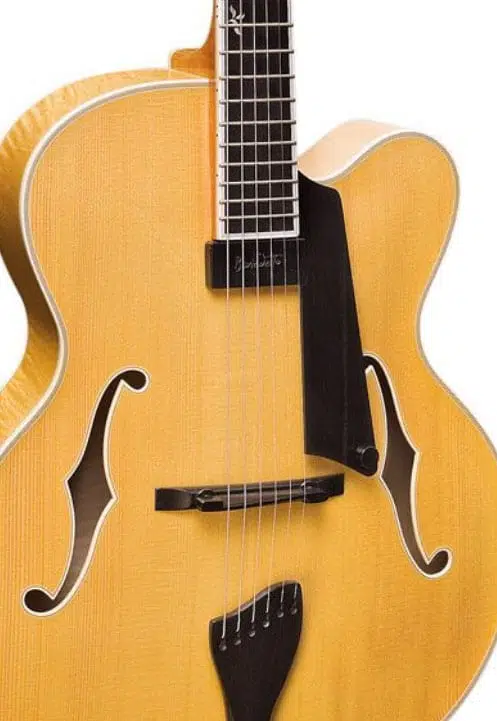
The deep trust premier jazz musicians place in these instruments comes down to how a master luthier listens to and shapes raw wood. Rather than using automated factory presses to force tonewoods into a standardized mold, a process that crushes organic fibers and stifles long-term resonance, Benedetto soundboards are sculpted by hand, following the natural, unbroken grain lines of premium spruce and maple.
By meticulously graduating the thickness of the top, keeping it structurally robust under the bridge to handle heavy string tension while carving it down to a flexible perimeter near the rims, the luthier creates an exceptionally responsive acoustic pump. When a touring professional performs night after night, the continuous vibrational energy physically breaks in the hand-sculpted top, allowing the wood to mature and “learn” the player’s specific dynamic habits, pick attack, and chord voicings. This organic elasticity creates an unmatched level of reliability on stage, ensuring a perfectly even frequency response, transparent note separation, and a rich, woody voice that only grows deeper and more expressive over a lifetime of performances.
Tailored for the Stage: Comparing the Core Series
A Benedetto is engineered to withstand the rigorous daily demands of professional touring. Every design choice, from proprietary bracing to custom electronics, supports an effortless partnership between the player and the fretboard. To see how these engineering philosophies translate across the instrument lineup, consider the distinction between our two primary product tiers:
The Roster: Famous Jazz Guitarists and Their Benedetto Lineup
The relationship between a jazz musician and their archtop is deeply personal. Players choose Benedetto because the instrument allows their individual touch, phrasing, and identity to come through cleanly without sonic compromise.
The Vanguard & Masters
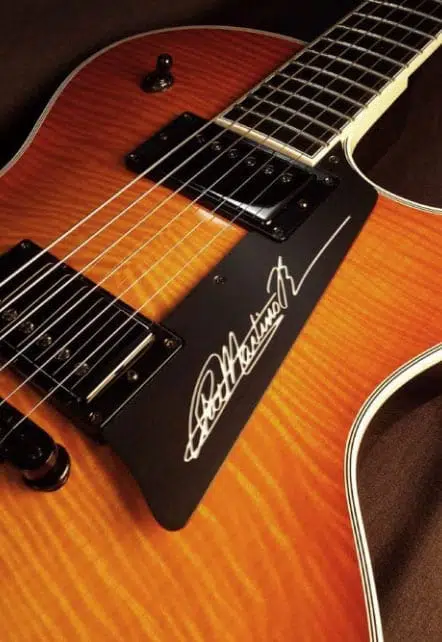
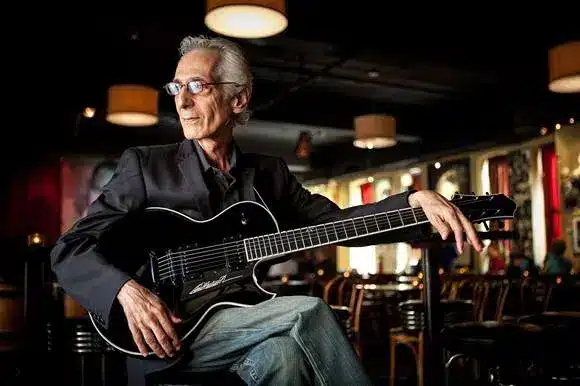
- Pat Martino: As a titan of hard-bop innovation, Martino required an instrument capable of handling his legendary, high-velocity linear attacks and heavy string gauges. His long-standing collaboration with Robert Benedetto yielded an iconic signature model that balanced dark, punchy warmth with unparalleled structural stability.
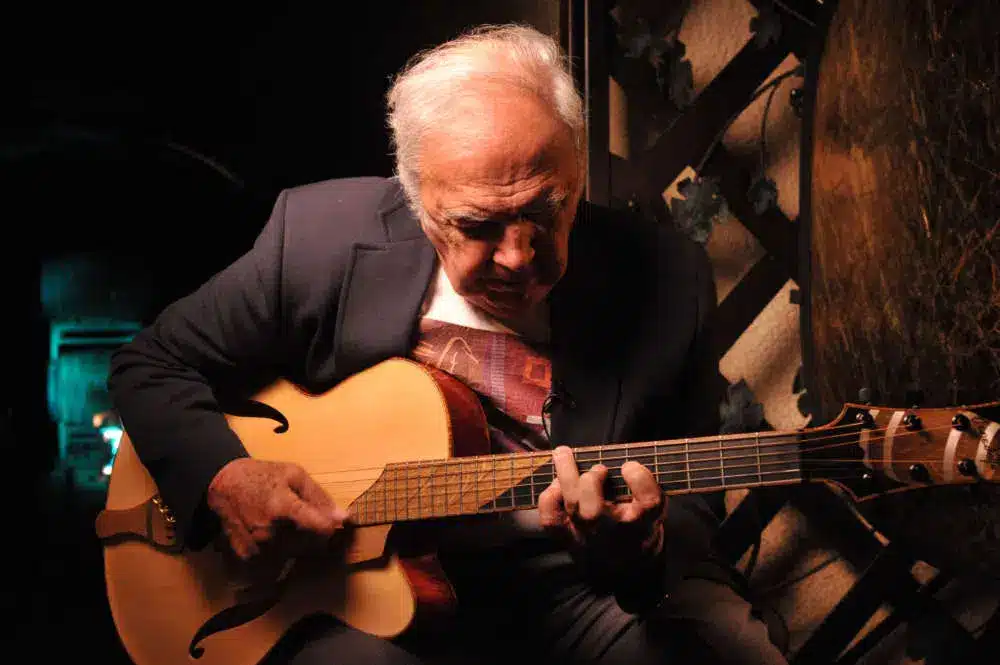
- Bucky Pizzarelli: Spanning a career over seven decades, Pizzarelli was the quintessential master of seven-string rhythm and solo guitar for icons like Benny Goodman and Stephane Grappelli. As Benedetto’s very first official artist champion in 1978, his historic 37-year partnership cemented the 7-String Benedetto as the gold standard for acoustic jazz accompaniment.
- Chuck Wayne: A vital architect of the 1940s 52nd Street scene, Wayne brought a lyrical, fiercely swinging bebop vocabulary to bands led by Woody Herman, Dizzy Gillespie, and George Shearing. Transitioning from swing to bop, his sophisticated concepts were perfectly supported by his custom Benedetto, engineered for high-velocity linear clarity.
- Howard Alden: A globally recognized seven-string virtuoso with an encyclopedic command of the jazz songbook, Alden famously shaped the soundtrack of Woody Allen’s Sweet and Lowdown, while teaching actor Sean Penn to play. To navigate his complex, contrapuntal chord melodies with absolute clarity, he relies on custom Benedetto 16-B models.
The Organ-Trio, Blues & Hard-Bop Masters
- Dan Wilson: Blending a gospel upbringing with a deep devotion to Wes Montgomery’s lineage, Wilson’s explosive technique earned him years of global touring with organ legend Joey DeFrancesco and bassist Christian McBride. To cut through dense organ trios with focused muscle, he relies on the feedback-resistant Pat Martino Signature Model.
- Paul Bollenback: A versatile New York area artist and educator, Bollenback is celebrated for his influential, two-decade partnership with Joey DeFrancesco and session work with Stanley Turrentine. He leverages his inventive chord voicings and soaring linear lines on stage and at The New School using a reliable Benedetto Bambino.
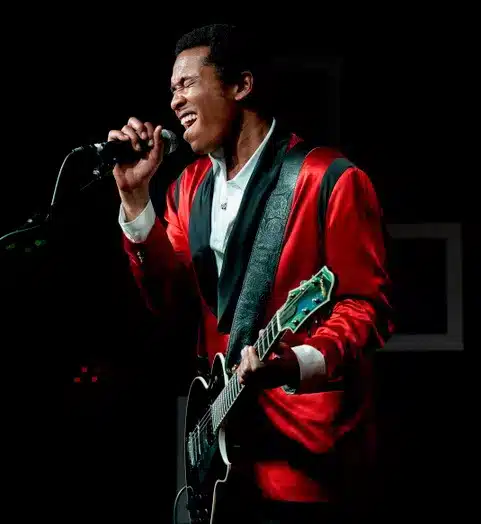
- Solomon Hicks: A cross-genre phenom who began fronting a 13-piece band at the Cotton Club at just 13 years old, Hicks effortlessly traverses jazz, blues, R&B, and funk. He has shared stages with Tony Bennett, Russell Malone, and the B.B. King Blues Band, channeling his eclectic, soulful phrasing and deep blues heritage through a versatile Pat Martino Signature Model.
Global Voices & Contemporary Stylists
- Romero Lubambo: Arriving in New York in 1985, Lubambo rapidly established himself as the premier, first-call guitarist for an authentic Brazilian sound fused with absolute fluency in American jazz. A brilliant solo improviser and co-founder of Trio Da Paz, his touch-sensitive dynamics have supported legends like Dianne Reeves, Yo-Yo Ma, and Diana Krall on a custom Benedetto 16-B.
- Leandro Pellegrino: An internationally acclaimed Brazilian virtuoso, Pellegrino was the first South American to win first prize at the prestigious Montreux Jazz Guitar Competition. Celebrated for his work on Dianne Reeves’ Grammy-winning album Beautiful Life and collaborations with John Patitucci, his impeccably articulate lines find their voice via The Bravo and custom The Benny models.
- Chris Standring: A contemporary jazz pioneer based in Southern California, Standring is widely celebrated for a chart-topping, flawless technique that masterfully bridges old-school soul-jazz with ultra-modern electronic textures. Bringing a fresh, groove-centric approach to electronic dance music, drum and bass, and progressive chill, Standring crafts his infectious melodies using a custom Benedetto Bambino.
The New Guard: Torchbearers & Educators
- Davy Mooney: A New Orleans-born Sunnyside Records artist, UNT Assistant Professor, and finalist in the 2005 Thelonious Monk International Guitar Competition, Mooney has recorded seven albums as leader and toured globally. To cleanly execute his intricate harmonic concepts and advanced chord melodies, he relies on the extended range, absolute clarity, and flawless fretboard ergonomics of his 7-string Bravo Deluxe model.
- Jocelyn Gould: As a JUNO Award winner and former Head of the Guitar Department at Toronto’s Humber College, Gould represents the vibrant future of mainstream jazz guitar storytelling. Her melodic, swinging style relies on the rich, natural acoustic resonance of a traditional Benedetto 16-B to captivate audiences worldwide.

Why Famous Jazz Players Prefer the Benedetto Voice
When interviewing professional jazz guitarists, three consistent design truths explain why they choose a Benedetto over mass-produced alternatives:
- Acoustic Balance Across All Registers: Traditional archtops often suffer from unpredictably booming notes or thin, dead zones past the 12th fret. Every Benedetto is engineered for a completely flat frequency response, ensuring uniform volume, sustain, and clarity across the entire fingerboard.
- Ergonomics and Reduced Fatigue: Touring virtuosos perform long sets night after night. Benedetto’s fast-grained necks, custom nut widths, and careful weight distribution ensure the guitar seamlessly supports the player’s natural technique.
- Road-Tested Reliability: By combining proven luthier traditions with stable, professional-grade bracing and hardware, these instruments deliver consistent performance in every environment, from outdoor summer stages to dry recording studios.
The Benedetto Legacy and History
The history of Benedetto Guitars began in 1968 when Robert Benedetto built his first archtop guitar in New Jersey. His goal was straightforward yet revolutionary: to refine the traditional archtop design, focusing strictly on acoustic balance, clear projection, and structural consistency.
Over the last half-century, these design philosophies have fundamentally altered how modern archtops are crafted worldwide. The brand’s commitment to sharing these methods openly, most notably through Robert Benedetto’s landmark book and blueprint publications, has educated generations of modern luthiers and helped preserve the heritage of American jazz guitar making. Today, you can dive deeper into this journey by reading about the history of Benedetto Guitars and the master luthiers carrying the craft forward.
Selecting Your Instrument
Serious musicians invest in a Benedetto because it serves as an uncompromising, lifetime tool for their craft. Depending on your performance environment and aesthetic preferences, you can explore the durable gigging instruments of the Benedetto Professional Series collection or the heirloom-quality acoustic masterworks in the Benedetto Flagship Series collection.
If you require a specialized neck profile, distinct boutique tonewood combinations, or unique aesthetic appointments, you can design your dream archtop from scratch using the online Benedetto custom guitar builder portal.
Discover Your Definitive Voice
If you are ready to find an instrument that completely aligns with your musical identity, feel free to browse our current inventory or contact the Benedetto workshop directly to discuss your next instrument with a master luthier.
Frequently Asked Questions
What makes a handcrafted archtop superior for jazz music?
A hand-carved soundboard responds instantly to the subtle velocity of a player’s touch. The natural acoustic resonance provides a warm, round bass register and clear treble definition, ensuring complex jazz chords do not sound muddy or compressed.
How do Benedetto guitars handle stage feedback?
Models like The Benny feature chambered solid bodies designed to eliminate feedback entirely, while laminate-top models like The Bravo are explicitly engineered to dampen the specific frequencies that trigger feedback in high-volume settings, making them highly reliable on loud stages.
Are Benedetto guitars suitable for musical styles outside of jazz?
Absolutely. While the brand’s identity is deeply rooted in the history of jazz, the inherent tonal balance, note separation, and dynamic range of a Benedetto make it highly effective for blues, fingerstyle acoustic arrangements, neo-soul, and classical crossovers.
Related Content

Understanding Tonewoods: How Wood Choices Shape Jazz Guitar Tone
How Tonewoods Shape the Sound of a Jazz Guitar Every jazz guitarist knows the importance of tone, but few elements influence that sound as much as the wood beneath your hands. From warmth and resonance to clarity and projection, tonewoods …
Read More >
How to Choose the Right Jazz Guitar for Your Playing Style
The guitar you choose defines how you sound and feel as a player. In jazz, tone and touch matter more than volume or flash. A well-chosen guitar responds to your phrasing, supports your rhythm, and inspires new ideas. Choosing the …
Read More >
Your Next Guitar?
This new Bravo is up in Bob’s Boutique and ready to go! Click on over to buy online, or contact us with any questions: info@benedettoguitars.com
Read More >