

The Anatomy of Tone: How Archtop Guitar Materials Affect Sound and Projection

Great archtop design exists at the exact intersection of art and engineering. While the striking contours of a Benedetto catch the eye, it is the deliberate pairing of raw materials beneath the finish that defines the instrument’s soul. From the lightning-fast response of a spruce soundboard to the feedback-rejecting stiffness of a premium laminate, every material choice carries immense acoustic weight. Whether you are playing an acoustic venue or a loud, amplified stage, here is how the anatomy of our tonewoods, bracing, and component architecture shapes the legendary Benedetto voice.
The Core Tonewoods: The Physics of Spruce and Maple
The classic acoustic profile of a carved archtop relies on a time-tested pairing: Spruce and Maple. Rather than acting independently, these two woods work as a team to balance projection with structural integrity.
1. Spruce Soundboards and Clear Projection
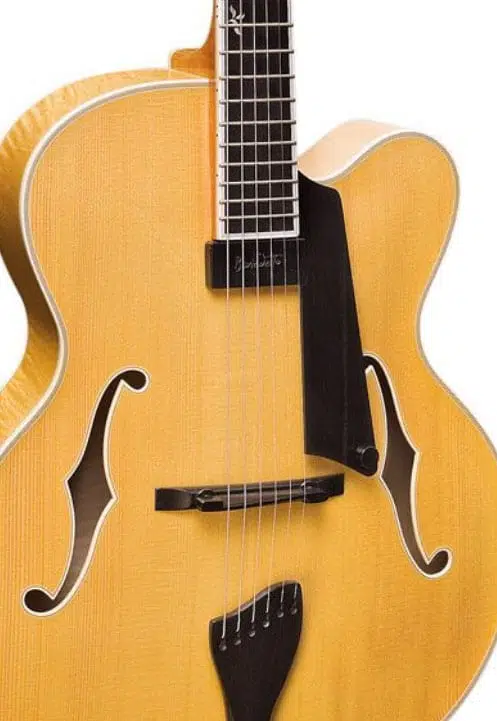
Spruce is the gold standard for archtop soundboards, and for good reason. It boasts an incredibly high strength-to-weight ratio and a high “velocity of sound,” meaning vibrational waves travel through it at lightning speed. Because it’s so lightweight, the top can vibrate freely in response to your strings, giving you clear projection and instant note articulation.
The tight grain structure of select spruce provides the directional stiffness needed to handle heavy string tension while staying sensitive to the lightest touch, and because spruce has very low internal damping, it doesn’t soak up or muffle energy; it rings out immediately. This gives the guitar its forward, articulate voice, ensuring your complex melodies stay crystal clear, even in a dense ensemble setting.

2. Maple Back and Sides for Structural Tone
Where spruce provides the sensitivity and speed, maple delivers the rock-solid foundation. Used for the back, sides, and neck, maple is a dense hardwood that provides vital structural stability. In a carved instrument, the maple back essentially acts as an acoustic mirror, focusing the energy generated by the spruce top and throwing it forward.
Unlike spruce, maple has a higher degree of internal damping, acting as a natural acoustic limiter. It keeps the back of the guitar from vibrating completely out of control, which is exactly what prevents muddy, runaway low-frequency feedback when you’re plugged in on stage.
Debunking the Myth: Contrary to the old assumption that maple makes a guitar sound overly bright, a properly carved maple back actually helps articulate complex jazz chords. It provides clean separation between notes, emphasizing the fundamental pitch rather than a chaotic wash of overtones.
Material Architecture: Carved vs. Laminated Physics
How our master luthiers integrate these materials depends entirely on the musical demands of the player’s environment.
Flagship Series: Solid Hand-Carved Construction
In our Flagship Series guitars (such as the Cremona, La Venezia, or Sinfonietta), the tops, backs, and sides are entirely hand-carved from solid, aged tonewoods. Carving a solid block of spruce leaves the wood fibers running continuously from edge to edge. This structural continuity allows low-frequency acoustic waves to bloom naturally, maximizing the natural acoustic resonance, harmonic complexity, and dynamic sensitivity of the instrument. It is the ultimate acoustic experience.
Professional Series: Premium Laminated Construction
For instruments like the Bravo and Bambino in our Professional Series, we utilize premium laminated construction. The soundboards consist of thin layers of wood pressed together with alternating grain directions and targeted adhesives, forming a cross-grain matrix that creates omnidirectional stiffness. Because a laminated top doesn’t flex or vibrate wildly in response to sound waves coming from a loud stage amp, it inherently suppresses feedback while maintaining that clear, punchy, professional jazz tone touring musicians rely on.
The Role of Ebony in Playability and Note Definition
While the body woods dictate the main acoustic profile, the fingerboard, bridge, and tailpiece serve as the critical contact points for your strings.
For these peripheral components, Ebony is our absolute go-to because of its immense density and silky-smooth texture. As a playing surface, ebony gives you a wear-resistant fingerboard that supports fast, precise technique. Sonically, its hardness contributes to a crisp, immediate note attack, perfectly balancing the natural acoustic warmth of the carved body.
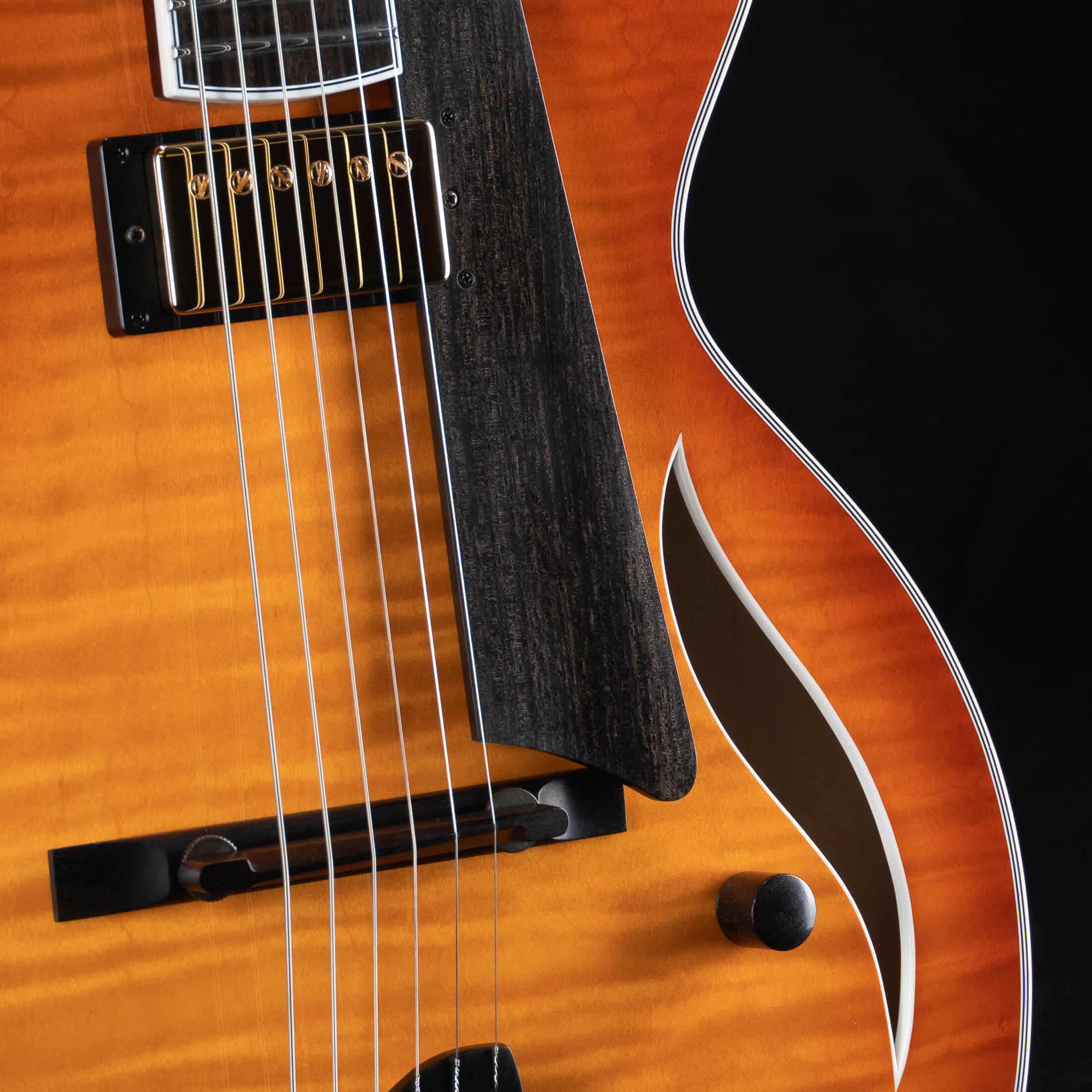
Down on the body, the ebony bridge and tailpiece act as direct conductors of string vibration. Because ebony is so dense, it transfers energy into the soundboard efficiently without eating up your high frequencies, supporting sustain and overall tonal consistency across all six strings.
Craftsmanship Techniques: Graduation and Bracing
Even the finest raw materials can’t achieve their full potential without precise graduation. Wood density and grain patterns vary from tree to tree, meaning a master luthier has to adapt their approach to every single piece of wood that enters the shop.
Hand-Carving and Tap Tuning
In our workshop, our luthiers evaluate each wood set by hand. Rather than carving to rigid, uniform measurements, the graduation of a soundboard is guided entirely by tap tuning.
An archtop soundboard is never uniform in thickness. It’s carved thickest right under the bridge to support the massive downward pressure of the strings, and tapers dramatically thinner toward the “recurve” near the rims, allowing the top to flex like the surround of a speaker cone. By flexing the wood and listening to its resonant response during the carving process, the luthier meticulously adjusts the contours. They aren’t just tuning the wood to a specific musical note; they are listening to the decay of the tap and checking the flexibility of the plate to perfectly balance stiffness against weight.
Bracing Architecture: Parallel vs. X-Bracing
The internal bracing pattern further refines how the top moves. The choice of bracing changes the fundamental character of the instrument:
- Parallel Bracing features two parallel braces running along the longitudinal grain, mimicking the architecture of a violin. This restricts the top’s cross-grain flexibility, resulting in a punchy, mid-range forward, and compressed acoustic projection that easily cuts through a big band.
- X-Bracing links the top plates diagonally, lowering the overall stiffness of the top. This allows the soundboard to breathe more freely, yielding a warmer, more spread-out low-end bass response and longer sustain.
This precise marriage of wood and technique is exactly why the world’s premier jazz players trust our tonal profile.

Material and Component Architecture
Every component swap or aesthetic choice carries physical and acoustic weight. Here is how standard material choices compare to alternative design paths across our instruments.
Exotic Woods and Sonic Appropriateness
We maintain a highly curated, small inventory of exceptional exotic woods suitable for tops, backs, sides, binding, and veneers. However, material choice must always prioritize performance over purely visual appeal. Certain exotic materials are so dense they can stiffen or deaden the traditional acoustic voice of an archtop. If a wood set isn’t sonically right for the structural design of a model, the workshop selects a more appropriate alternative to protect the integrity of the instrument’s performance.
Translucent Finishes and Wood Grading
Aesthetics and wood selection are deeply intertwined. Highly translucent finishes, such as a classic Blonde finish, leave the natural grain completely visible. Because there is no pigment to mask visual imperfections, these instruments require wood sets with flawless visual grading. For example, applying a translucent finish to a standard model requires upgrading the build to premium materials typically reserved for ultra-premium tiers, which increases the baseline cost.
Pickups and Bracing Constraints
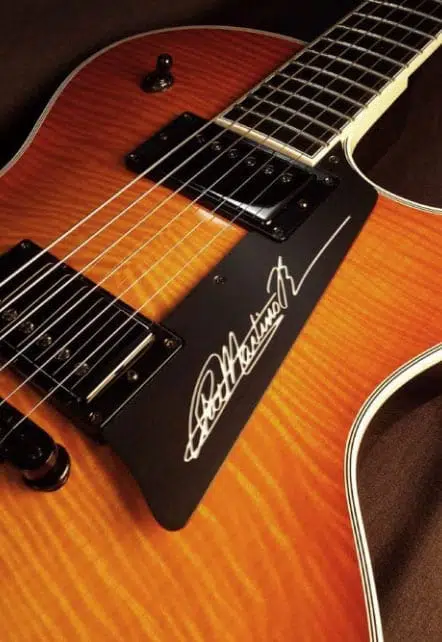
Our proprietary Benedetto pickups, designed by Bob and built exclusively for us by Seymour Duncan, are engineered to capture the natural acoustic voice of our instruments. They are specifically voiced to compensate for the acoustic properties of spruce and maple, smoothing out harsh upper-mids while preserving the complex frequencies moving through the top plate.
Because an archtop’s top is under immense string tension, the placement and size of a pickup route are critical. If you want us to install another company’s pickup, we are happy to accommodate you, as long as it shares the same dimensional footprint. However, unique placements or non-standard dimensions are restricted; cutting through traditional parallel or X-bracing patterns compromises structural integrity and requires significant custom tooling changes.
Designing an Instrument for Your Voice
Achieving your specific tonal preferences requires balancing construction style, wood choices, and hardware setups. Whether your priority is feedback resistance for a heavy touring schedule or the complex acoustic resonance of a hand-carved soundboard, selecting materials with intent ensures a reliable, professional instrument that performs consistently for a lifetime.
If you are ready to design an instrument tailored to your technical and musical needs, you can map out your custom specifications directly through the Build Your Own Benedetto platform.
Frequently Asked Questions
What are the best tonewoods for an archtop jazz guitar?
The industry standard for a premium archtop guitar body is a solid spruce soundboard paired with maple back and sides. Spruce provides the high strength-to-weight ratio and low internal damping required for clear projection, articulation, and responsiveness. Maple supplies structural stability and an acoustic reflection platform that controls overtones and maintains note definition across complex chord structures.
How does wood selection affect jazz guitar feedback on stage?
Solid, hand-carved wood soundboards flex freely, making them highly resonant but prone to feedback at high stage volumes. For performing environments requiring amplification, premium laminated tonewood construction offers superior feedback rejection. Laminated tops use alternating wood grain matrices that reduce unwanted microphonic top movement, ensuring reliable acoustic performance in amplified settings.
Why do custom archtop finishes like Blonde cost more?
Translucent or Blonde finishes do not contain opaque pigments, leaving the natural grain patterns of the spruce and maple fully visible. This requires builders to upgrade to wood sets that feature flawless aesthetic grading, free from mineral streaks or visual asymmetries. This strictly visual upgrade requires scarcer premium raw materials, which increases the overall build cost.
Can changing an archtop pickup affect its acoustic structure?
Yes. Archtop soundboards are graduated under high tension and reinforced with precise internal parallel or X-bracing patterns. While standard dimensional pickup swaps are simple to accommodate, non-standard pickup placements or enlarged cutouts can require cutting through these critical load-bearing braces. Altering braces compromises both the structural safety and the natural acoustic projection of the guitar top.
Related Content

Understanding Tonewoods: How Wood Choices Shape Jazz Guitar Tone
How Tonewoods Shape the Sound of a Jazz Guitar Every jazz guitarist knows the importance of tone, but few elements influence that sound as much as the wood beneath your hands. From warmth and resonance to clarity and projection, tonewoods …
Read More >
How to Choose the Right Jazz Guitar for Your Playing Style
The guitar you choose defines how you sound and feel as a player. In jazz, tone and touch matter more than volume or flash. A well-chosen guitar responds to your phrasing, supports your rhythm, and inspires new ideas. Choosing the …
Read More >
Your Next Guitar?
This new Bravo is up in Bob’s Boutique and ready to go! Click on over to buy online, or contact us with any questions: info@benedettoguitars.com
Read More >