

5 Essential Ways to Evaluate Archtop Jazz Guitars

For more than half a century, the jazz archtop guitar has stood as the absolute pinnacle of the luthier’s art—a marriage of acoustic science and sculpted form that transforms raw tonewood into a singular, breathing voice. Unlike flat-top or solid-body designs, a great archtop relies on a meticulously balanced, carved soundboard capable of projecting an expansive acoustic voice while sustaining immense string tension. When executed by a master craftsman, this complex architecture yields an instrument with an innate warmth, instantaneous transient response, and a rich harmonic palette unique to the world of jazz.
Because these elite traits are rooted deeply in structural physics, knowing how to accurately evaluate an archtop is paramount. Whether you are an affluent enthusiast investing in a piece of functional history or a touring virtuoso demanding uncompromised performance, understanding these benchmarks ensures you can identify an instrument that will truly step out of the way, granting your musical expression complete, uninhibited freedom.
To help you navigate this rarefied landscape, we have compiled five essential, technically rigorous benchmarks for evaluating an authentic, high-caliber archtop guitar. Want to see these exacting standards realized in an instrument built for absolute studio, stage, and classroom dependability? Explore our Professional Series to see how these benchmarks serve as our everyday baseline.
1. The Acoustic Response: Note Separation & Upper-Partial Integrity
A common misconception is that an archtop’s unplugged performance is secondary to its amplified signal. In truth, the acoustic response is the very soul of the instrument; a premier archtop must deliver a rich, complex tonal palette before it ever meets a pickup.
When testing an instrument, begin completely unplugged. Strum open chords and let complex, voice-led jazz passages ring out in a quiet room, listening closely for two main attributes:
- Note Separation and Intermodulation: Even within a dense, altered jazz chord (such as a minor 7♭5 or a 13♭9), every note must remain distinct. Lower intervals shouldn’t descend into a muddy wash, and upper extensions should bloom without harsh intermodulation or phase cancellations.
- Acoustic-to-Amplified Translation: A magnificent archtop exhibits a seamless correlation between its unplugged warmth and amplified tone. The pickup should act as a transparent window, elevating the guitar’s natural acoustic voice rather than masking it with a generic, overly compressed magnetic signal.

2. The Mechanics of Hand-Carving: Recurve and Graduation
Mass-produced instruments rely on steam-pressing or automated CNC machines to mimic the shape of an archtop, but wood is a living, variable medium. The structural and sonic heart of a world-class instrument relies entirely on a meticulously hand-carved top and back.
A master luthier practices the exacting art of “tap tuning”—gradually carving spruce or maple plates by hand, continually tapping the wood to listen to its shifting resonant frequencies and flexibility. Because no two pieces of wood are genetically identical, a rigid machine cannot account for organic variations in density and grain pattern.
When evaluating an instrument’s build, examine the transitions of the recurve—the dipped channel carved just inside the perimeter of the top that acts as a flexible acoustic hinge for the soundboard. Look also at the graduation of the arch from its peak thickness near the bridge down to the rims. Smooth, deliberate carving allows the top plate to vibrate freely under string tension, unlocking a profound dynamic range and complex upper-partial harmonics that laminated alternatives cannot match.
3. Ergonomics and Action: The Compound Radius and Neck Geometry
An instrument should never feel like an obstacle to your creativity; it should feel like an elegant physical extension of your hands. Perfect playability is shaped by the symbiotic relationship between neck profile, action height, and body geometry.
During an extended evaluation, pay close attention to how the instrument settles against your body. For a professional spending hours a day with an instrument in hand, ergonomic comfort is a strict mechanical necessity to avoid hand fatigue and repetitive strain.
Look for a neck carve that offers a fluid, natural grip. High-caliber instruments often feature a compound radius on the fingerboard, transitioning from a rounded profile near the nut (for comfortable chording) to a flatter profile across the upper register. This geometry allows for ultra-low, buzz-free action during fluid solo lines. Finally, the finish along the back of the neck should feel silky and fast under the thumb—never sticky, heavy, or over-applied.

4. Absolute Consistency: Eliminating Destructive Phase Cancellation
A fundamental indicator of premium lutherie is a completely uniform response up and down the neck. Inferior construction, structural imbalance, or poorly stabilized tonewoods often manifest as “dead spots”—particular frets where notes choke out, lose sustain prematurely, or sound perceptibly thinner than neighboring pitches. This thinness is frequently caused by destructive phase cancellation, occurring when a note’s frequency matches an uncontrolled, sympathetic resonant frequency in the guitar body.
To perform a thorough consistency test, follow this simple, systematic approach:
5. Electronics Integration: Floating vs. Built-In Systems
The manner in which an archtop is amplified dictates both its acoustic behavior and its resistance to live performance challenges like microphonic feedback. High-end jazz guitars generally utilize one of two electronic configurations:
Floating Pickups
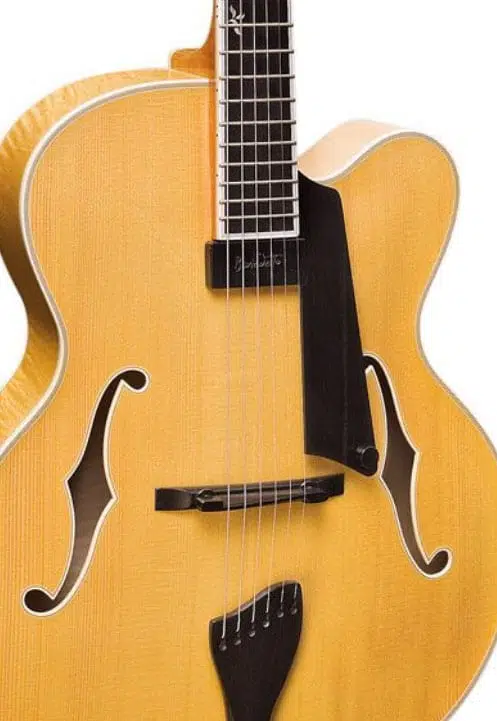
A floating pickup is mounted directly to the pickguard or the end of the neck extension, never touching the carved spruce top. This preserves the pure, uninhibited acoustic resonance of the soundboard and remains the definitive choice for purists who prioritize acoustic fidelity and archival, orchestral tone.
Built-In Pickups
Built-in (or inset) pickups require cutting directly into the carved top. While this naturally dampens a portion of the top plate’s pure acoustic resonance, it introduces a beautiful, fat electric warmth and provides excellent feedback rejection at higher stage volumes. For example, the Bravo Elite and 16-B models offer the precise, reliable feedback control required by touring professionals playing diverse, acoustically challenging venues, while maintaining the complex responsiveness of a hand-carved model.

The Anatomy of Elite Materials: Beyond the Wood Species
The finest handcrafted archtop guitars rely on a timeless pairing of premium tonewoods: a carved top of select Spruce for its brilliant elasticity, lightning-fast responsiveness, and clear projection, paired with a back and sides of figured Maple to provide structural clarity, visual majesty, and fundamental warmth.
However, relying solely on wood species as a metric for acoustic quality is inadequate, given the immense variability in resonant properties within identical tree types. The geographic provenance, the natural air-drying and seasoning protocols over decades, and the internal bracing design (such as traditional parallel bracing or responsive X-bracing) all govern the instrument’s structural integrity and ultimate acoustic palette. For those seeking an instrument carved from the absolute rarest selections of these historic timbers, our meticulously appointed Flagship Series showcases the zenith of material luxury and acoustic property optimization.
Further evaluation should look closely at the hardware and structural execution:
- The Binding: The multi-ply binding around the body, F-holes, and headstock must be flawlessly uniform and tightly fitted, serving as both visual art and armor against humidity fluctuations.
- The Finish: Traditional nitrocellulose lacquer is applied in micro-thin layers. Unlike thick, encasing modern polyester finishes, nitrocellulose protects the wood while allowing it to breathe, age gracefully, and mature tonally over generations.
- The Hardware: Solid ebony tailpieces, bridges, and ultra-precise tuners ensure that string vibration transfers perfectly to the body while maintaining absolute tuning stability.
The Legacy of the Benchmark
The history of archtop guitars is a journey of continuous refinement, evolving from early acoustic orchestral string instruments into the definitive voice of modern jazz. For over five decades, this evolution has been guided by the pioneering techniques of our founder, Robert “Bob” Benedetto. His standards remain the benchmark by which the global lutherie community evaluates a handcrafted instrument. Today, every guitar created in our boutique workshop is built by master luthiers trained directly under Bob’s philosophy, preserving that singular acoustic heritage.
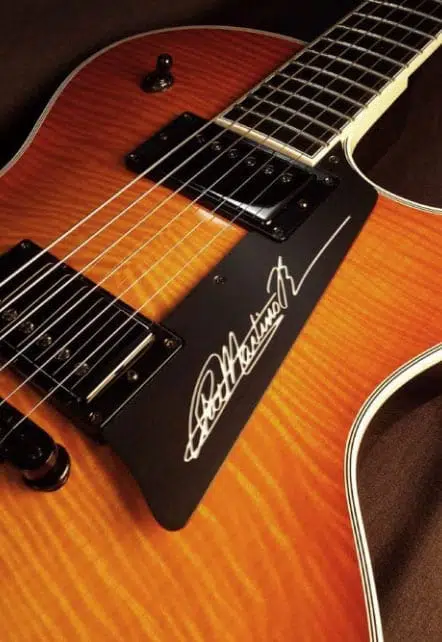
We treat our legendary roster of artists not as mere clients, but as members of an extended family. From the historic masterclasses of the late Pat Martino to the modern stages and recordings of masters like Howard Alden, Paul Bollenback, and Royce Campbell, our instruments are continuously road-tested and proven by the true giants of jazz. To explore the full lineage of musicians who entrust their creative voices to our craft, we invite you to view The Benedetto Players roster.

Commission Your Voice
As another option to explore, we offer the opportunity to collaborate directly with our workshop to tailor an instrument to your precise physical and musical needs. From sourcing exotic master-grade tonewoods to customizing neck profiles and responsive internal bracing, our master craftsmen bring your vision to life with unparalleled technical artistry.
Ready to invest in a masterpiece of functional art that will define your musical legacy? Begin designing your heirloom today and Build Your Own Benedetto.
Frequently Asked Questions (FAQ)
Why is hand-carving preferred over steam-pressing in an archtop guitar soundboard?
Steam-pressing forces a uniform sheet of wood into a shape, destroying its internal grain structure and elasticity. Hand-carving and tap tuning allow a luthier to thin the plates meticulously in response to the specific structural density and natural resonant properties of that exact piece of timber, maximizing the soundboard’s acoustic vibrancy and dynamic headroom.
How does a compound radius fingerboard benefit jazz guitarists?
A compound radius fingerboard transitions from a more rounded profile near the nut to a flatter plane across the upper registers. This specialized neck geometry facilitates comfortable, fatigue-free barre-chording near the headstock while simultaneously allowing for ultra-low, buzz-free string action past the twelfth fret during high-speed improvisational solo lines.
What is the tonal difference between parallel bracing and X-bracing?
Traditional parallel bracing runs alongside the grain lines under the bridge area, prioritizing projection, mid-range punch, and acoustic volume suited for orchestral swing patterns. X-bracing joins the brace strips crosswise beneath the soundboard plate, promoting balanced sustain, broader frequency dispersion, and richer harmonic complexity for solo performance environments.
Related Content

Understanding Tonewoods: How Wood Choices Shape Jazz Guitar Tone
How Tonewoods Shape the Sound of a Jazz Guitar Every jazz guitarist knows the importance of tone, but few elements influence that sound as much as the wood beneath your hands. From warmth and resonance to clarity and projection, tonewoods …
Read More >
How to Choose the Right Jazz Guitar for Your Playing Style
The guitar you choose defines how you sound and feel as a player. In jazz, tone and touch matter more than volume or flash. A well-chosen guitar responds to your phrasing, supports your rhythm, and inspires new ideas. Choosing the …
Read More >
Your Next Guitar?
This new Bravo is up in Bob’s Boutique and ready to go! Click on over to buy online, or contact us with any questions: info@benedettoguitars.com
Read More >