

How Can You Ensure the Guitar You Choose Meets Your Playing Style Needs?
A Luthier’s Guide to Custom Jazz Guitar Selection
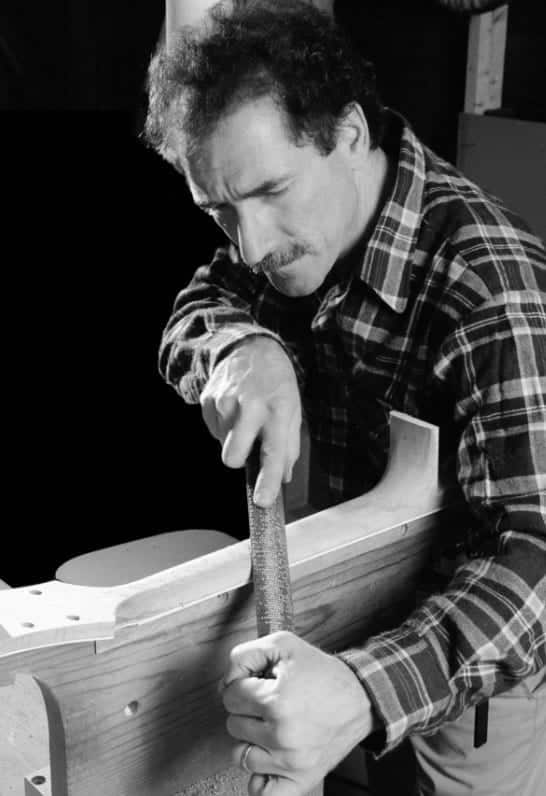
Many players choose an archtop by eye and then spend years adapting their technique to it. With over five decades at the bench building for legendary jazz artists, we have come to believe the relationship should run the other way.
To make sure a custom guitar meets your playing style needs, match four core variables to the build: your gigging volume, your touch weight, your preference for acoustic or amplified tone, and your body-size ergonomics. Quiet, acoustic chord-melody work favors a hand-carved solid spruce top with a floating pickup. Loud stages favor laminate tops with built-in humbuckers.
That framework is the starting point. What follows is the detail that turns it into an instrument you will still reach for decades from now.
Begin With the Room, Then the Guitar
A guitarist comping behind a sixteen-piece big band works in an entirely different acoustic environment from one recording solo chord-melody arrangements in a quiet studio. The first needs an instrument that remains composed when the amplifier is pushed and the brass section is at full strength. The second needs a top that responds to the lightest touch of the thumb with bloom and sustain.
In practice, the distinction looks like this:
High-Volume Ensemble Work: A 16″ laminate-top archtop with a built-in humbucker resists feedback, projects evenly through an amplifier, and withstands the demands of touring. Our gig-ready Professional Series was conceived specifically for this environment.
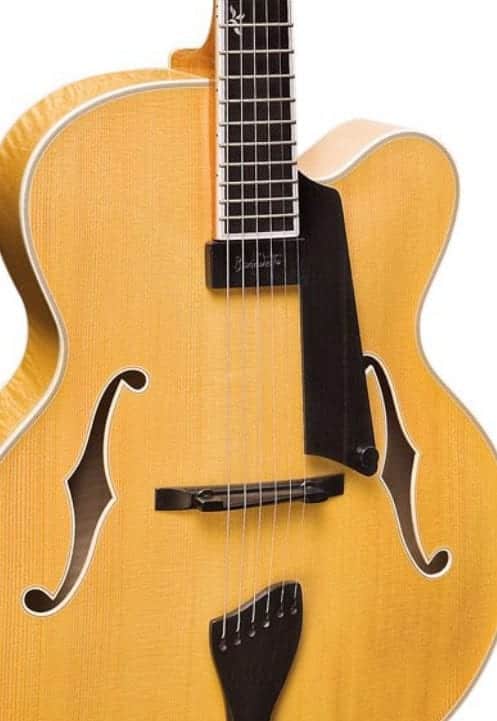
Solo, Duo, and Studio Acoustic Work: A 17″ hand-carved spruce top with a floating mini-humbucker allows the soundboard to move freely, so the listener hears the instrument itself rather than the pickup alone. Our Flagship Series hand-carved archtops speak most fluently to this space.
Mixed-Use Performance: A hand-carved top in a somewhat smaller body often offers the best of both worlds, retaining genuine acoustic character while maintaining composure on an amplified bandstand.

Body Size and Jazz Archtop Ergonomics
Lower bout width (14-1/2″, 16″, or 17″) directly dictates right-arm posture during long sets, making physical comfort just as important as acoustic output.
A 17″ body provides unmatched acoustic depth and maximum acoustic volume. However, over long sets, its width holds the picking arm higher and further from your torso. For many players, that added reach introduces shoulder tension that restricts picking dynamics. A 16″ body generally offers the ideal sweet spot, delivering full acoustic character while keeping the arm in a relaxed, natural posture. For travel or tight stage setups, a 14-1/2″ lower bout offers authentic archtop tone in a compact profile.
Hand-Carved Archtop Specs: How the Top Behaves
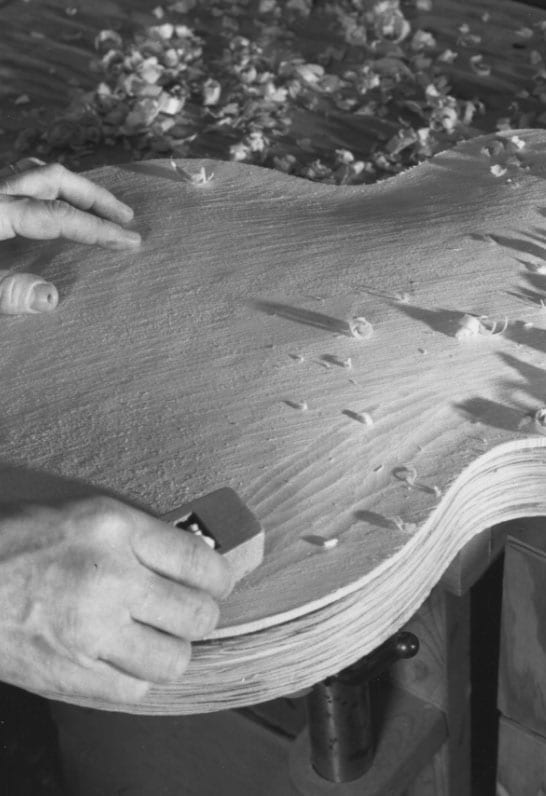
A hand-carved spruce soundboard functions as a living diaphragm. We carve it, flex it, and tap-tune it, listening to how its resonance changes as the graduations are refined, until the plate responds as that particular piece of wood is inclined to respond. No two tops are identical, and that is by design.
Bracing is where your pick attack dynamics directly enter the architectural conversation:
Parallel Bracing: Reinforces the top along its length. It favors a focused fundamental note with snappy projection and handles volume gracefully, which suits players with a firm attack or those who perform at higher amplification.
X-Bracing: Allows the top to vibrate in more complex patterns, rewarding a lighter touch with a broader, more open voice and longer sustain. A player with a heavy pick and a strong wrist may find an X-braced top difficult to control, whereas a player with a delicate fingerstyle touch may find parallel bracing somewhat reserved.
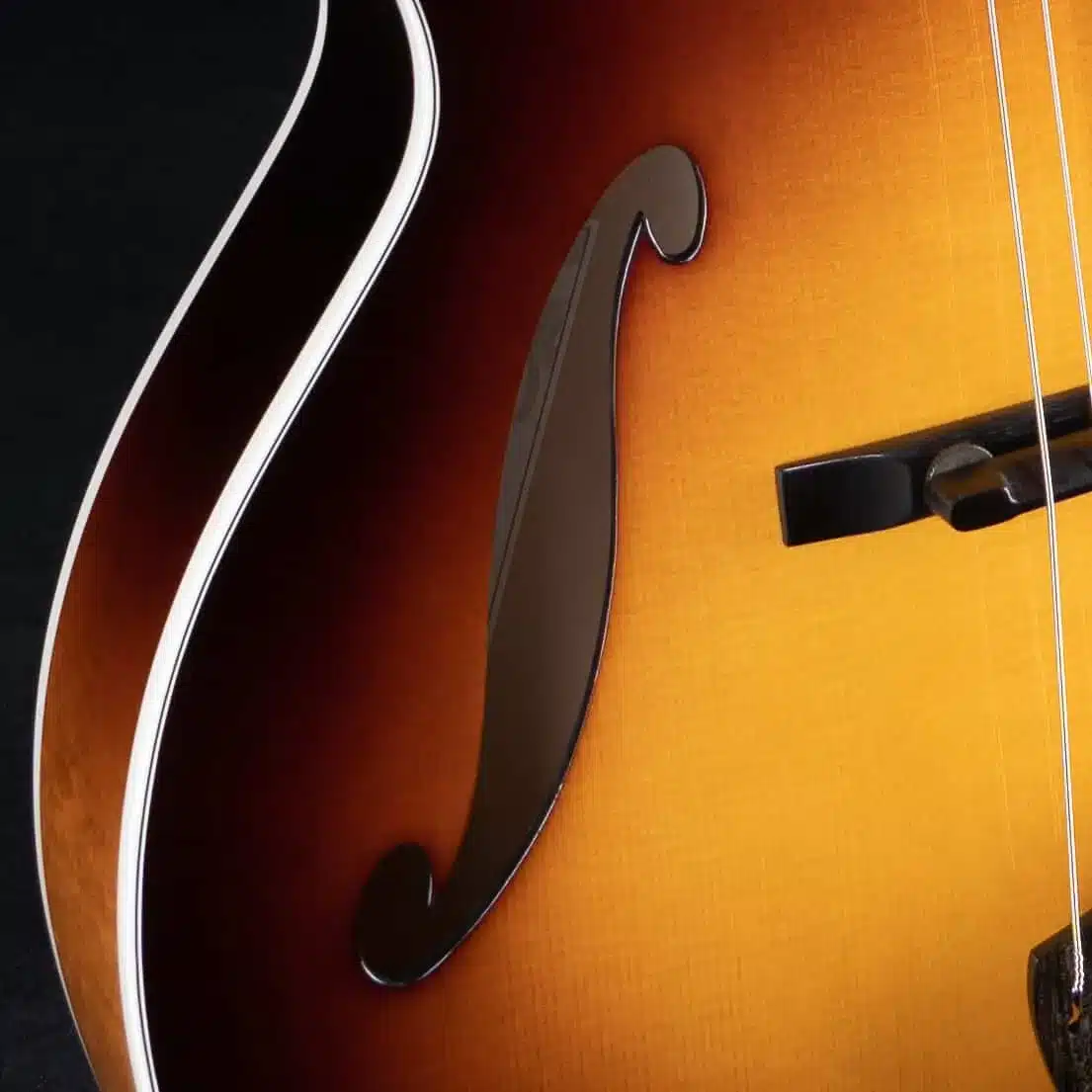
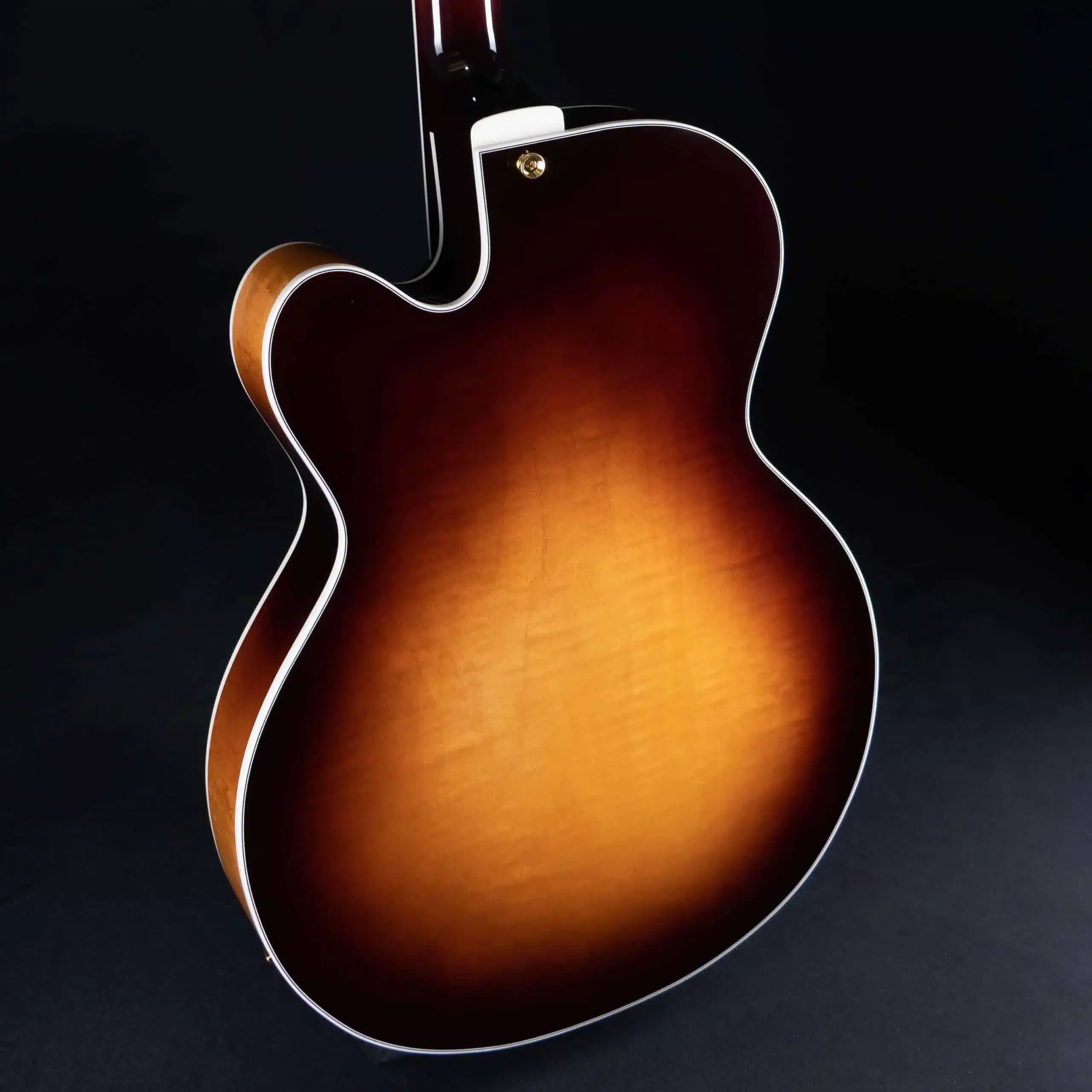
Combine these choices with figured maple back and sides, an ebony tailpiece, and a thin nitrocellulose finish that allows the wood to continue resonating, and the result is what many regard as the gold standard of jazz archtops. We do not use synthetic composite tops, and we never will.
Floating Pickup vs. Built-In Humbucker
Of all the technical choices involved, custom jazz guitar selection often hinges on how the signal is captured:
A floating pickup captures the acoustic voice of a carved top without inhibiting it. A built-in humbucker exchanges a measure of acoustic response for absolute stage reliability at volume. Neither design is superior in absolute terms; each is superior for a specific player’s environment.
Scale Length, Top Loading, and the Benedetto Standard
Almost every guitar built in our workshop features a 25″ scale length for a crucial reason: scale length determines string tension, which directly dictates how the soundboard is loaded and driven. Altering it alters top deflection and internal bracing behavior, changing the essential Benedetto voice.
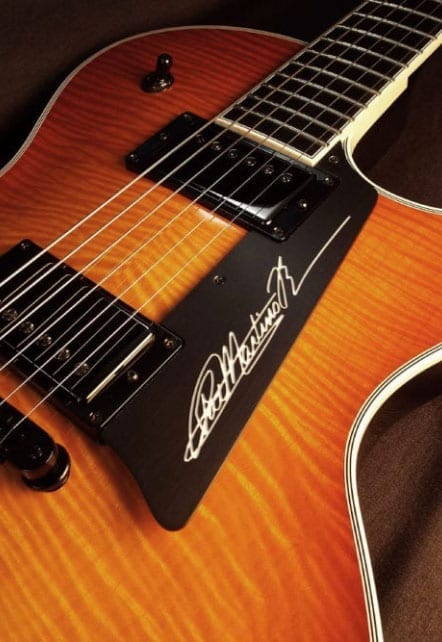
While we can accommodate a 24-3/4″ or 25-1/2″ scale length upon request, we encourage discussing why 25″ sits in the sweet spot before making a change. Apart from our Pat Martino Signature model (24-5/8″) and the compact Andy Model (23″), we do not build extra-short, extra-long, or fan-fret scales; they require redesigning the body geometry entirely, at which point it wouldn’t be a Benedetto anymore.
Neck profile remains entirely custom. When designing a custom Benedetto archtop, we recommend sharing the thickness (1st and 12th frets), nut width, and shoulder shape of your favorite instrument so we can match your fretting hand’s muscle memory.
Considerations Before Commissioning Your Archtop
To map out your ideal instrument specifications, evaluate these six parameters:
Performance Volume: In which settings do you play most often, and at what decibel level?
Touch Weight: Is your approach light fingerstyle, a medium flatpick, or a firm right-hand attack?
Signal Path: Do you perform primarily acoustically, primarily amplified, or evenly split?
Body Fit: How long are your sets, and how does a larger lower bout feel over their duration?
Neck Feel: Which profile, nut width, and shoulder shape does your fretting hand already trust?
Repertoire: Is your focus chord-melody, rhythm comping, fast bebop lines, or a mix of all three?
Learning From Benedetto Player Profiles
Few resources are as instructive as the example of working musicians. We encourage you to begin by exploring our roster of Benedetto guitarists, which spans bebop soloists, chord-melody specialists, studio players, and touring artists. If a particular player’s sound resembles the one you’re pursuing, mention it when you speak with our luthiers.
Each of those instruments was built in the same Savannah workshop. You can explore the history of Benedetto Guitars, a legacy extending more than half a century to Bob’s very first archtop, or meet our team of luthiers who carve and voice every instrument by hand. As Bob has long maintained, the guitar must serve the player.
Your Next Step
Take the instrument you play most often, measure its neck profile, note its body size, and consider candidly where it falls short of your performance needs. Those observations form the foundation of a meaningful conversation with our luthiers, and the beginning of a guitar built to carry your musical legacy.

Frequently Asked Questions
What size archtop body is best for jazz guitar playing?
It depends on your physical frame and performance setting. A 17″ lower bout offers maximum acoustic presence for studio and solo work, a 16″ body provides the sweet spot between shoulder comfort and acoustic projection, and a 14-1/2″ body excels for travel and tight bandstands.
Is a hand-carved solid spruce top worth it over a laminate top?
For acoustic purity, solo chord-melody, and low-volume studio work, a hand-carved spruce top is unmatched in dynamic range and touch sensitivity. On louder stages with loud drummers or horn sections, a laminate maple top is often superior because it controls cabinet resonance and resists feedback.
Does a floating pickup affect the acoustic tone of an archtop?
Only minimally. Because a floating pickup attaches to the neck extension or pickguard without routing into or contacting the soundboard, the solid spruce top remains completely unhindered to vibrate as an acoustic diaphragm.
Why are almost all Benedetto guitars built with a 25″ scale length?
The 25″ scale length provides the exact string tension required to load our hand-carved spruce tops properly, achieving optimal acoustic resonance, note separation, and projection without altering body architecture.
Can I customize the neck profile on a custom Benedetto archtop?
Yes. Every custom build allows you to specify nut width, neck thickness at the 1st and 12th frets, fret wire size, and shoulder contour to match the exact dimensions of your favorite instrument.
Related Content

Understanding Tonewoods: How Wood Choices Shape Jazz Guitar Tone
How Tonewoods Shape the Sound of a Jazz Guitar Every jazz guitarist knows the importance of tone, but few elements influence that sound as much as the wood beneath your hands. From warmth and resonance to clarity and projection, tonewoods …
Read More >
How to Choose the Right Jazz Guitar for Your Playing Style
The guitar you choose defines how you sound and feel as a player. In jazz, tone and touch matter more than volume or flash. A well-chosen guitar responds to your phrasing, supports your rhythm, and inspires new ideas. Choosing the …
Read More >
Your Next Guitar?
This new Bravo is up in Bob’s Boutique and ready to go! Click on over to buy online, or contact us with any questions: info@benedettoguitars.com
Read More >