

Elevate Your Jazz Guitar Skills Today: A Guide to Archtop Playing
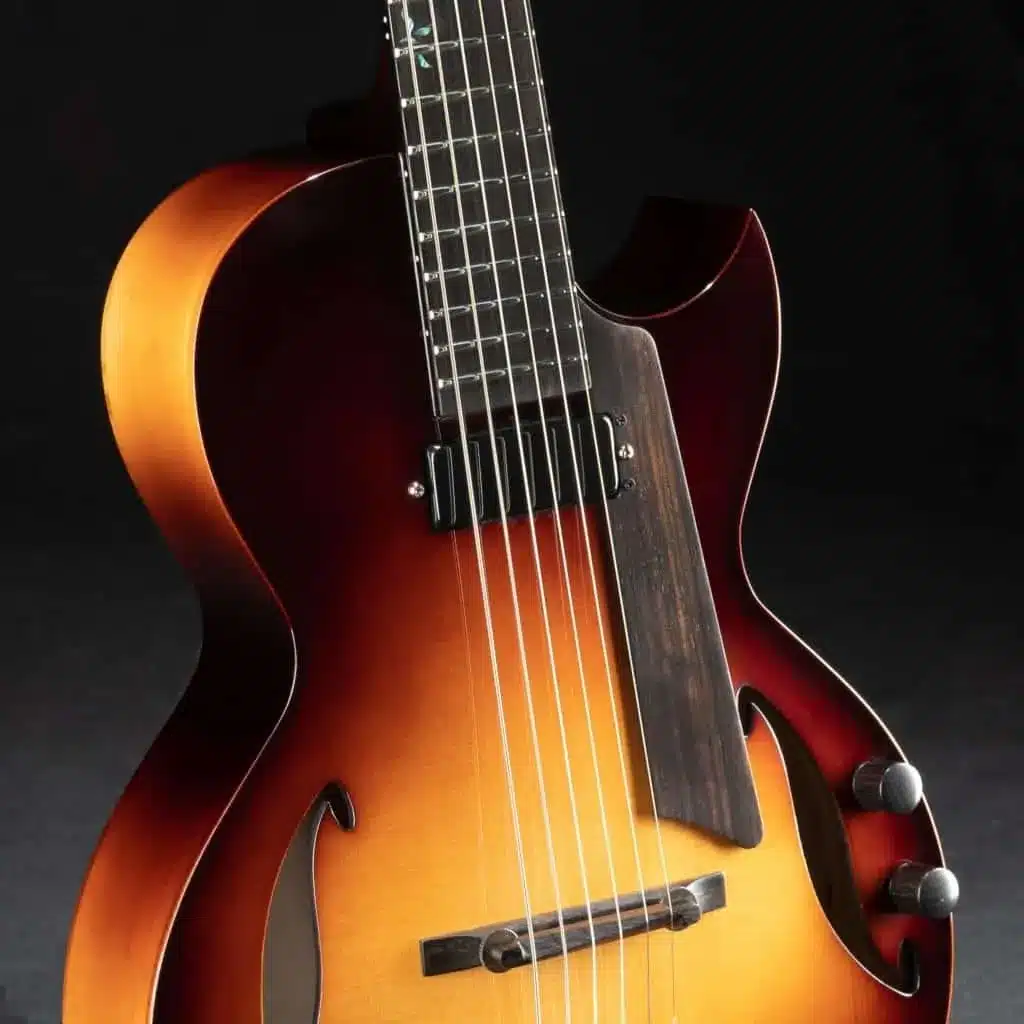
When Howard Paul, CEO here and a longtime fixture of Savannah Jazz, took the helm alongside Bob Benedetto in 2006, the priority was clear: keep building flagship acoustic masterpieces while expanding professional tools for gigging musicians. Every instrument leaving our Savannah bench is carved to function as an acoustic engine, reacting dynamically to every nuance of your attack.
To unlock that potential in your own jazz guitar playing, your focus must shift beyond raw speed. Elevating your guitar skills requires grounding your lines in guide-tone voice-leading, controlling your right-hand dynamics, internalizing time-feel, and letting the archtop’s soundboard breathe.
Right-Hand Touch: Driving the Acoustic Archtop Soundboard
Most players treat the instrument as a passive generator of pitch. You press a string against a nickel-silver fret, strike it with a piece of celluloid, and expect a note. But when you step into the world of traditional archtops, that static mental model breaks down entirely.
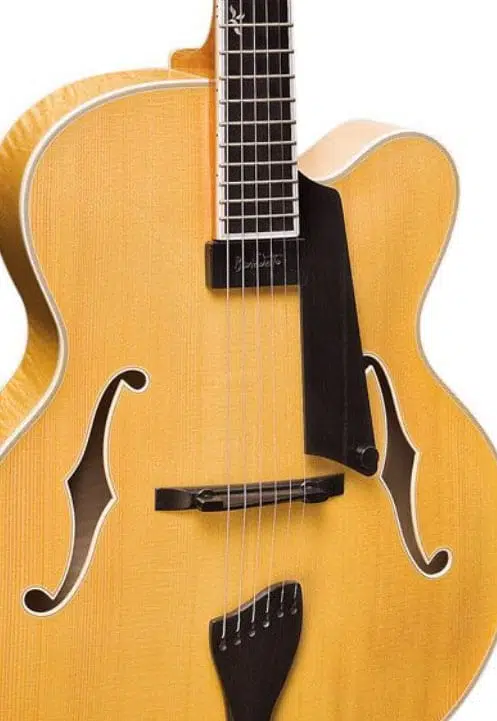
A hand-carved archtop works less like a slab of mahogany with pickups bolted on and more like an acoustic engine. The solid spruce top acts as a spring-loaded diaphragm, so when you pluck a string, its energy travels through the ebony bridge and sets the whole top in motion. If your attack is stiff or heavy-handed, you choke that motion before it can develop. High-level jazz guitar technique means learning to draw tone out of the instrument rather than slamming energy into it.
Rest-stroke articulation: Follow through so the pick comes to rest on the next string. That drives the string down toward the top instead of sideways across it, and a carved top responds far more to that vertical motion.
Variable pick angle: A slight angle on the plectrum softens the high-end click of the attack and brings the fundamental forward, which is where an archtop’s warmth lives.
Dynamic headroom: Keep some reserve in your right-hand motion so you can accent inner chord voices without overdriving the top or inviting feedback.
In our Savannah workshop, every top is voiced by hand to respond to the lightest touch. When you adjust your attack to match the resonance of the soundboard, your tone immediately gains depth, warmth, and acoustic carrying power.
Guide-Tone Continuity: Moving Beyond Static Scales
Endless scale runs up and down the neck rarely sound like jazz, because swing lives in the movement of chord tones, specifically the 3rds and 7ths that define each harmonic shift. Rather than treating the fretboard as a collection of disconnected boxes, let those guide tones anchor your lines and lead you from one chord to the next.
Notice that one voice steps down a half step while the other holds, and on the next chord the roles swap. When you build your jazz guitar practice routines around that kind of motion, your lines gain direction on their own, and you stop leaping blindly across the neck in favor of small, logical finger shifts through major and minor ii–V–I progressions.
Building Guide-Tone Continuity in 3 Steps
Isolate the 3rds and 7ths: Play through a 32-bar standard using only the 3rd and 7th of each chord on the G and D strings.
Connect with smooth voice-leading: Move to the nearest guide tone in the next chord, keeping motion to a step or half step wherever you can.
Add scalar fills: Work in short scale fragments or chromatic approach notes between guide tones, treating the guide tones as resting points.
Jazz Guitar Chord Melody: Harmonizing Without Crowding the Tone
Good chord-melody playing balances melodic clarity against harmonic support. The most common pitfall is harmonizing every single note, which clutters the arrangement and muddies the instrument’s natural voice. You don’t need six-string block chords on every beat to imply rich harmony, so harmonize selectively.
Prioritize shell voicings: Root–3rd–7th structures give you the full harmonic picture with only three notes, which keeps the texture open.
Use drop-2 voicings for the melody: Play them on the top four strings with the melody as the top voice, so every melody note carries its own harmony. Save drop-3 voicings for moments when you want a bass note underneath.
Keep the voices independent: Let a melody note sustain over moving inner voices to create counterpoint without extra physical effort.
Benedetto’s Flagship Series hand-carved archtops are built on the traditional techniques Bob Benedetto established, voiced to let inner harmonic movements speak without crowding the melody.

Jazz Archtop Phrasing: How to Improvise with Acoustic Authority
To improvise jazz guitar with confidence, your phrasing has to reflect how your instrument actually behaves. Solidbody electrics offer longer, flatter sustain that suits long linear passages, while an archtop’s note has a quick acoustic attack followed by a natural, woody decay. Working with that decay is the heart of good archtop jazz guitar phrasing.
Leave space: On an archtop, the decay is part of the note, and crowding it with the next line throws away half the sound.
Shade your dynamics: Accent beats two and four lightly. That’s where swing lives, and a carved top rewards small accent differences that a solidbody would flatten out.
Land on resonant tones: End phrases on long chord tones and let their overtones bloom in the body.
Whether you’re playing a gig-ready Professional Series laminate archtop on a loud stage or a fully carved acoustic instrument in an intimate venue, matching your phrasing to the instrument’s physical response yields cleaner, more authoritative solos.
Live Stagecraft: Taming Feedback and Optimizing Projection
Taking an archtop onto a modern stage brings its own challenges, above all low-end feedback, since a vibrating spruce top will happily pick up sound from your amplifier and start a feedback loop. Body size plays a part here as well: a 17″ lower bout moves more air, and pushes more low end back into the room, than a 16″ or 14-1/2″ body.
Stage placement: Keep your amp out of line with the lower bout. Setting it to your side at an angle reduces the sound hitting the top directly.
Targeted EQ: A low-cut alone rarely solves archtop feedback, because the howl usually sits a bit higher, in the low-mids. At gig volume, sweep a narrow EQ cut slowly until the ringing drops out, then leave it there.
Right-hand muting: Rest the edge of your palm lightly on unplayed low strings during loud solos to stop sympathetic vibration.
By applying these practical adjustments, you preserve your Benedetto’s warmth and depth while maintaining total control over your signal, even at higher performance volumes.

Take the Next Step in Your Jazz Journey
True musicianship develops through physical awareness and a genuine dialogue with your instrument. As you tune your touch to the natural resonance of the soundboard and let guide tones steer your lines, technical effort gives way to effortless expression. The archtop ceases to be just a tool; it becomes a direct extension of your musical voice.
When you are ready to find an instrument that matches your artistic growth, explore options for designing a custom Benedetto archtop. You can also connect directly with our workshop’s craftsman team to discover how a hand-carved instrument can help carry your musical legacy forward.
FAQs: Jazz Guitar Skills
How can I improve my jazz guitar skills faster?
Focus on deliberate, structured practice rather than endless scale repetition. Divide your time between refining right-hand touch for better tone production, practicing guide-tone voice-leading through ii-V-I progressions, and building chord-melody arrangements over standard tunes. Consistency in these foundational areas yields much faster progress than sporadic marathon sessions.
How do I stop my jazz solos from sounding like scales?
Connect your lines using guide tones, specifically the 3rds and 7ths of each chord, rather than running static scale patterns up and down the neck. Targeting these core harmonic notes creates smooth, logical voice-leading through chord changes, giving your improvisations a vocal, melodic quality.
What makes a jazz archtop guitar sound different from a solidbody?
Hand-carved archtops feature acoustic spruce soundboards that vibrate dynamically in response to string energy, producing a fast attack, rich midrange overtones, and a warm acoustic decay. Solidbody guitars rely almost entirely on magnetic pickup induction, resulting in linear sustain without the acoustic depth and dynamic touch-sensitivity of a carved soundboard.
Related Content

Understanding Tonewoods: How Wood Choices Shape Jazz Guitar Tone
How Tonewoods Shape the Sound of a Jazz Guitar Every jazz guitarist knows the importance of tone, but few elements influence that sound as much as the wood beneath your hands. From warmth and resonance to clarity and projection, tonewoods …
Read More >
How to Choose the Right Jazz Guitar for Your Playing Style
The guitar you choose defines how you sound and feel as a player. In jazz, tone and touch matter more than volume or flash. A well-chosen guitar responds to your phrasing, supports your rhythm, and inspires new ideas. Choosing the …
Read More >
Your Next Guitar?
This new Bravo is up in Bob’s Boutique and ready to go! Click on over to buy online, or contact us with any questions: info@benedettoguitars.com
Read More >